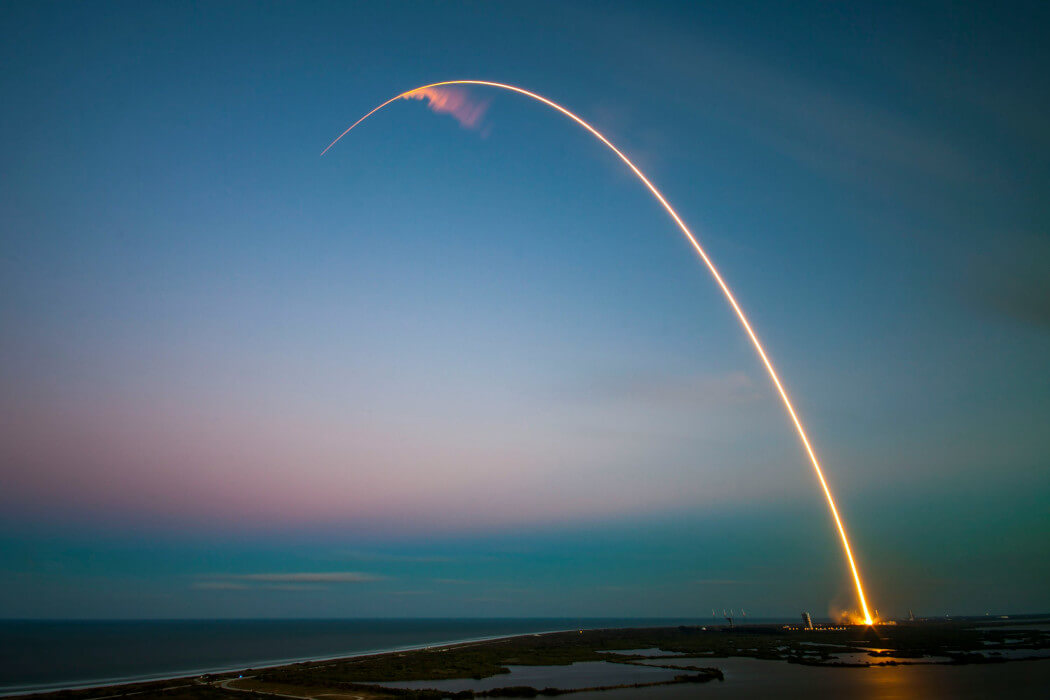
SpaceX is pulling back from the small-satellite rideshare market, and Canada's launch startups see an opening.
Reuters first reported that SpaceX is increasingly reserving room on its rockets for its own Starlink satellites rather than third-party payloads. Bloomberg then reported the company has started turning away customers seeking Falcon 9 rideshare slots past 2028. SpaceX, newly public after the largest IPO on record, holds most of the commercial market for small-satellite launches. BetaKit has reached out to SpaceX for comment.
Canada has a small, federally funded launch industry that is still years from its first orbital mission. The country is the only G7 member without independent launch capacity. A nearly $225-million federal pledge announced in March, most of it directed at Maritime Launch Services' Nova Scotia spaceport, is meant to close that gap.
Startups race to fill the launch gap
"For us, this is fantastic," said Hugh Kolias, CEO of Canada Rocket Company, a Toronto startup developing a medium-lift vehicle. "The industry hasn't been investing in medium-lift, because everyone thought SpaceX had it solved."
Kolias said the prospect of a less dominant SpaceX led Canada Rocket Company to enlarge its planned vehicle. The company's first launch is still about eight years away.
Rahul Goel, CEO of Markham, Ont.-based NordSpace, said the Falcon 9 scaleback left him feeling "vindicated." NordSpace builds light-lift rockets and its own satellites, a structure Goel said mirrors SpaceX's model of launching its own constellation. "By the time our launch vehicle comes online, we want to have enough internal demand for satellite launches that we're not reliant on any third parties, and we can achieve low internal cost the way SpaceX does for Starlink," Goel said. He said NordSpace, like several Canadian peers, still holds Falcon 9 slots in the near term.
Jesse Mikelberg, director of business, technology, and strategy at Reaction Dynamics in Longueuil, Que., said capacity tightening will reinforce that "demand for launch continues to outpace supply, dramatically."
Wyvern hedges, Telesat holds its Falcon 9 bookings
Wyvern CEO Chris Robson said the squeeze exposes what he called a "critical dependency" on a single U.S. provider. He said SpaceX's Transporter program handled 57 percent of Western small-satellite launch demand between 2019 and 2023, excluding Starlink and OneWeb. Prices rose over the same period, he said.
Wyvern has flown on Falcon 9 before. Robson said it now builds its satellites to fit light and medium-lift vehicles, the category of rockets NordSpace and Reaction Dynamics are developing.
The federal government this week awarded Telesat a $2.3-billion contract to extend Arctic military communications, with Brampton, Ont.-based MDA Space supplying the satellites. The deal adds 69 satellites to Telesat's Lightspeed network, all of them launching on Falcon 9.
A Telesat spokesperson said every satellite in the agreement will fly on already-secured Falcon 9 rockets. One rocket is "subject to the completion of a launch services agreement," the spokesperson said. All launches are expected before Telesat Lightspeed global service starts, on track for Q1 2028.