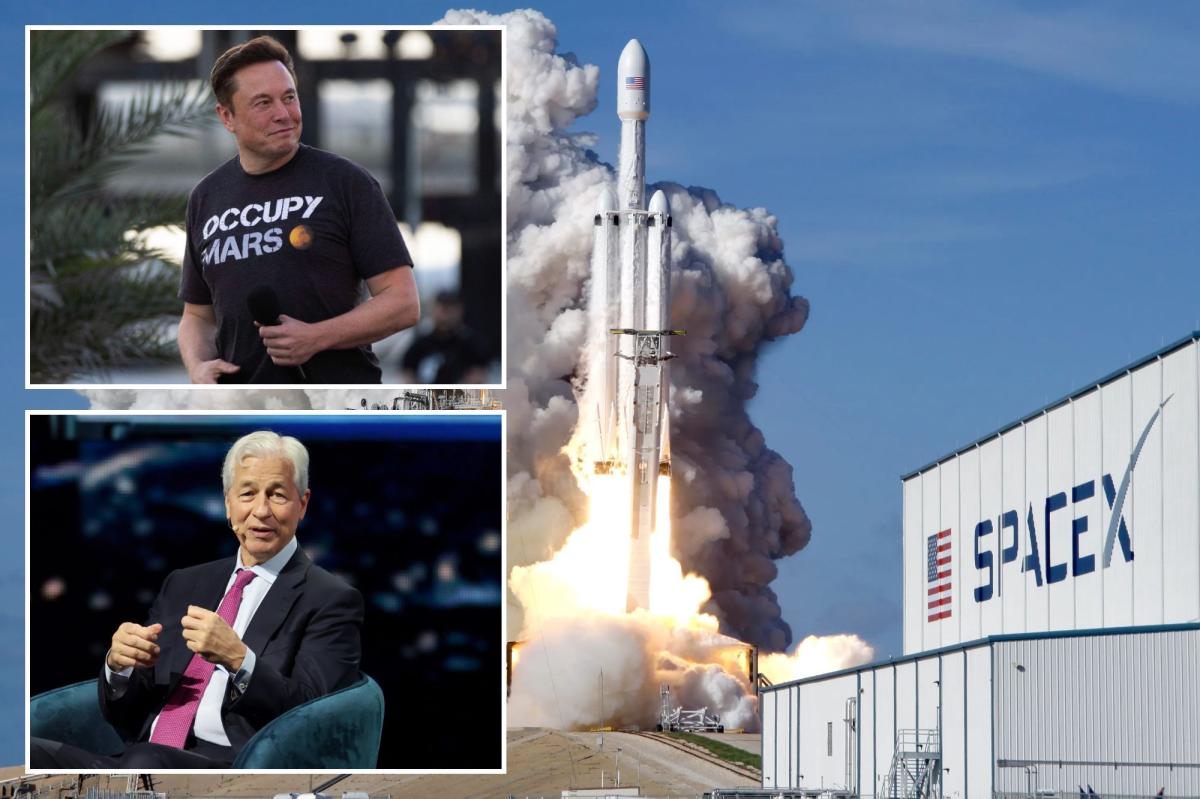
Elon Musk joined JPMorgan CEO Jamie Dimon at the bank’s Manhattan headquarters Thursday to kick off SpaceX’s investor road show. The event targeted wealthy retail investors ahead of what the company hopes will be a historic IPO – a $1.5 trillion valuation on the Nasdaq under the ticker SPCX. The offering of about 556 million shares at $135 per share closes on June 11, with trading starting the next day.
The road show painted a vision of AI data centers in orbit and vacations on the moon. The S-1 filing that SpaceX submitted to the SEC in May tells a more grounded financial story. The company generated $18.6 billion in revenue in 2025, up 33% from the prior year. It posted a net loss of $4.3 billion for the three months ended March 31. Capital expenditures consumed $20.7 billion last year, split between launch and satellite operations ($8 billion) and the AI business ($12.7 billion).
The revenue growth rate is real. The cash burn at this scale means the $135 per share price values a company whose quarterly loss alone runs nearly a quarter of its annual revenue. The gap between Musk’s vision and the S-1’s numbers is the central risk for anyone considering a position at the IPO.
Revenue Growth vs. Cash Burn
SpaceX’s top-line growth is impressive. The capex line shows where the money goes. The $12.7 billion spent on AI infrastructure last year represents 68% of total revenue. Combined with $8 billion in launch and satellite capex, the company invested more than it earned – a pattern that requires either relentless revenue acceleration or external financing to sustain.
The AI data centers in space are the most capital-intensive piece. Musk acknowledged the scale during the road show, calling it a “massive capital endeavor.” The S-1 filing frames these as the primary means to expand AI computing without the constraints of terrestrial power plants. That thesis depends on customer demand being ready before the cash runs out.
| Metric | Value |
|---|
| 2025 Revenue | $18.6 billion |
| Q1 2026 Net Loss | $4.3 billion |
| 2025 Capex – Launch & Satellite | $8.0 billion |
| 2025 Capex – AI | $12.7 billion |
| Implied Valuation at IPO | $1.5 trillion |
The table shows the arithmetic. Annualizing the quarterly loss gives roughly $17 billion, close to the full-year revenue. The $12.7 billion in AI capex is largely upfront spending with a payoff that remains unproven.
The AI Data Center Bet – Scale and Risk
SpaceX’s space-based data centers are not a hypothetical concept. The company is spending $12.7 billion a year to build them, positioning the business against terrestrial AI infrastructure dominated by Amazon, Microsoft, and Google. The advantage – avoiding ground-based power limits – is real. Execution risk is extreme. No commercial space data center has operated at hyperscale. The timeline from testing to revenue is uncertain, and regulatory hurdles for orbital compute nodes are undefined.
Underwriter Exposure and Execution Risk
Goldman Sachs and Morgan Stanley lead a syndicate of 23 banks underwriting the deal. If the stock trades poorly after the June 12 debut, the underwriters face reputational and financial exposure. Retail investors buying through brokers should note that the banks’ own risk models may be pricing in volatility less visible in the road show presentation. Goldman Sachs holds an Alpha Score of 69/100, labeled Moderate, on AlphaScala's stock page. Morgan Stanley scores 65/100, also Moderate, via its /stocks/ms page. Neither score suggests the banks are betting on easy success – the moderate label reflects the inherent uncertainty in this size of deal.
The Timeline and the Test
The offering closes on June 11, and trading opens the next day, June 12. That timeline leaves a narrow window for prospective buyers to digest the S-1 and decide whether the valuation matches the numbers.
What the Road Show Revealed About Investor Sentiment
Thursday’s audience of wealthy retail investors appeared enthusiastic. “It was an epic event,” Sidd Pagidipati, founder and chairman of Ayon Capital, told Bloomberg. “This company I think will be the biggest, largest, most iconic company in human civilization.”
Barron’s noted that Musk was “light on details,” focusing on big-picture predictions rather than the financial mechanics that the S-1 requires. The gap between anecdotal excitement and the fundamental data is the classic setup for an IPO that pops on the first day then drifts toward fundamental fair value.
What Would Confirm the Investment Thesis
- Sustained revenue growth above the 33% clip, driven by Starlink subscriber uptake and AI service contracts.
- Narrowing quarterly losses as capex begins to generate operational cash.
- Traction for space AI data centers – a named customer, a pilot project, or a government contract.
What Would Weaken the Thesis
- Further capex escalation without matching revenue acceleration.
- Regulatory delays on in-orbit computing or spectrum allocation for Starlink.
- Founder distraction from Musk’s other ventures, particularly if capital is diverted away from SpaceX’s core execution.
The Key Decision for Prospective Investors
Practical rule: A company burning $4.3 billion per quarter at a $1.5 trillion valuation implies extreme future growth expectations. Any sign of deceleration in Starlink or AI revenue will punish the stock quickly.
No sell-side analyst has yet published a valuation target for SpaceX, because the company is not yet public. The S-1 is the only source of audited financials. Investors must weigh the $1.5 trillion implied market capitalization against a business that has never reported a profitable quarter.
The June 11 IPO and June 12 first trade are only the opening chapters. The real story will be written in the following quarters – when the cash burn either shrinks, or it drives the stock back toward the risk of loss. For now, the road show created the narrative, the S-1 provided the math. The two are still misaligned.
This article is for informational purposes only and does not constitute investment advice. Data sourced from SpaceX’s S-1 filing, Bloomberg, Barron’s, and Business Insider. See full stock market analysis at AlphaScala.