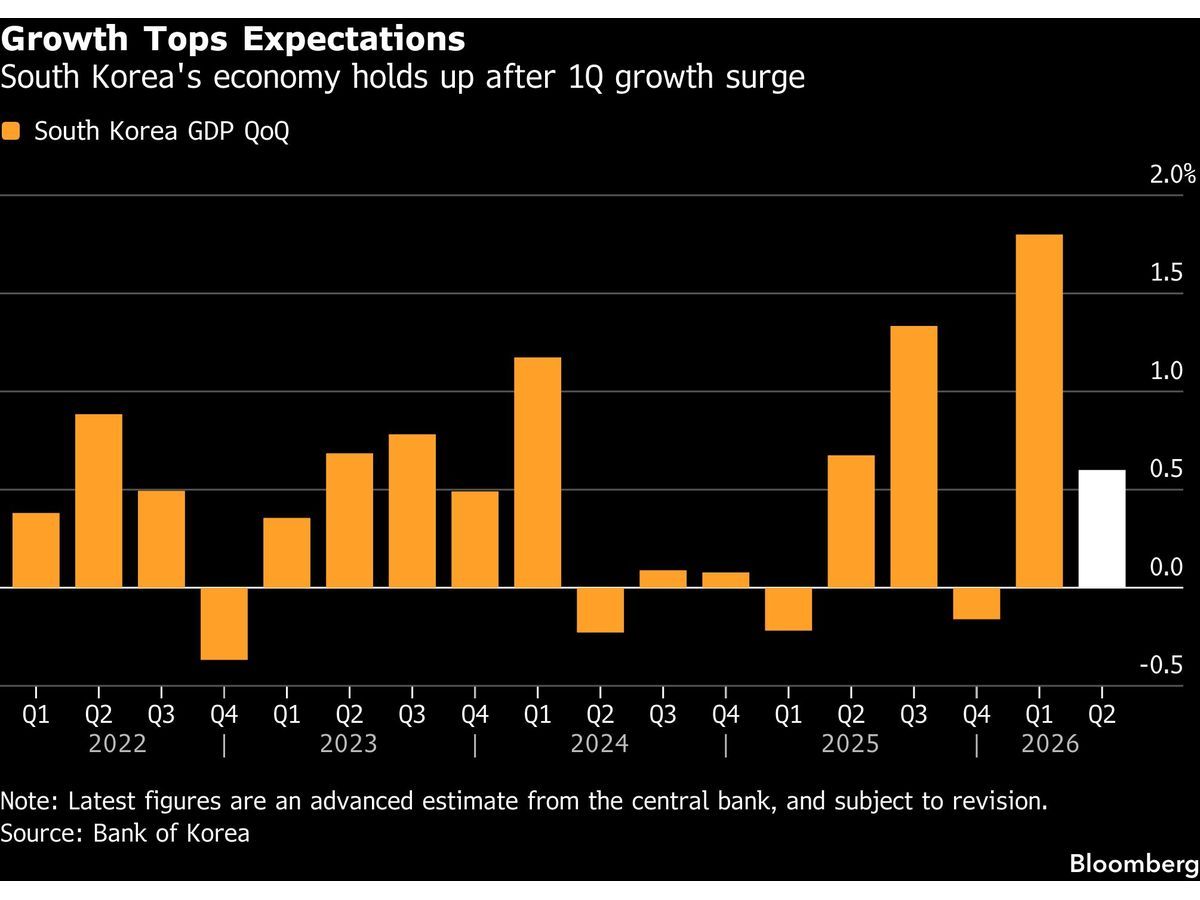
South Korea's economy grew faster than expected in the second quarter, powered by an AI-driven chip boom that gives the central bank room to keep raising interest rates.
Gross domestic product expanded 0.6% in the three months through June from the previous quarter, the Bank of Korea said Thursday. That beat the 0.4% median estimate in a Bloomberg survey. The first quarter saw a 1.8% jump, the fastest since late 2021.
Thursday's reading was a step down from the strong first quarter. It extends a string of stronger-than-expected data. The government and the International Monetary Fund have upgraded South Korea's growth outlook this year. The central bank plans to raise its own forecast next month.
The figures support the case for another rate increase after the BOK hiked last week for the first time since 2023. A survey of economists shows they expect another move by October, with a minority predicting it could come at the Aug. 27 board meeting.
After the July 16 hike, Governor Shin Hyun Song said policymakers would keep a hawkish bias. Inflation remains above target, economic growth is strengthening and financial stability risks are building, he said. The BOK said it would "substantially" raise its growth forecast when it meets next month.
Economists had predicted a slower pace in the second quarter versus the start of the year. The war in Iran, which broke out in late February, rippled through the economy. South Korea is one of the world's most energy import-dependent economies, leaving it exposed to higher oil prices. That negative impact offset some of the gains from the semiconductor boom, the BOK said.
Chipmakers struggled to expand production fast enough to meet surging AI-related demand, limiting output growth despite strong orders. The broader growth story remained intact.
During the second quarter, exports rose 1.4%, driven by stronger semiconductor shipments. Imports rose 0.8% on gains in motor vehicles, machinery and equipment, the BOK said.
Chip shipments surged about 163% in the first half from a year earlier, already above the record annual level reached in all of 2025, according to the trade ministry. Computer exports jumped 262%.
Authorities have argued that AI-driven chip demand is spilling over into the broader economy through stronger corporate profits, investment, wages and tax revenue, cushioning the impact of external pressures.
That also supported household spending. Private consumption rose 0.4% from the previous three months after a 0.6% increase in the prior quarter. Government spending climbed 2.2%. Facilities investment edged up 0.2% after jumping 6.6% in the previous quarter. Construction investment slipped 0.2% following a 1.4% gain.
Recent data have reinforced signs of economic resilience. Exports are buoyed by strong semiconductor shipments. The year-to-date current-account surplus already exceeds last year's annual record. The strength of the recovery is also feeding price pressures. Inflation accelerated in June to the fastest pace since late 2023.
The BOK will update its growth forecast at the Aug. 27 board meeting. Governor Shin has signaled the next move is likely up.