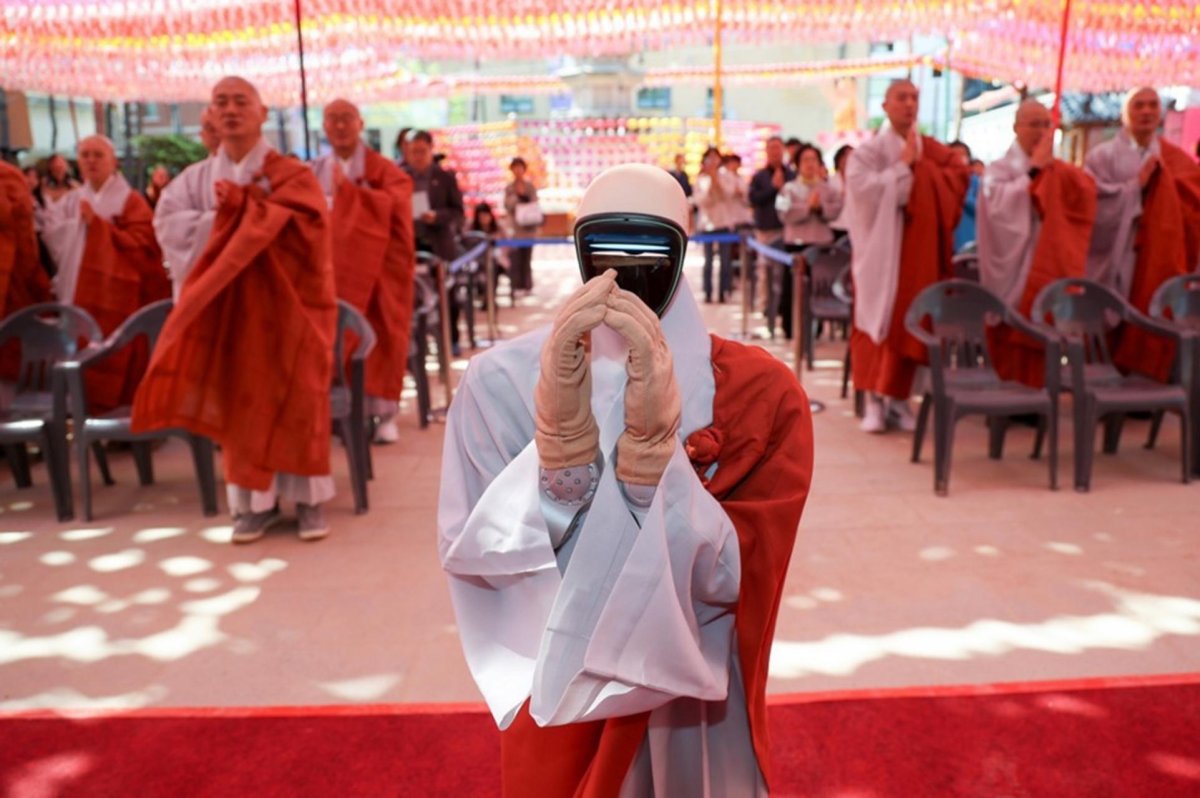
The ordination of a humanoid robot named Gabi at Seoul’s Jogye Temple on May 6 marks a symbolic convergence between traditional monastic practice and the rapid advancement of South Korea’s robotics sector. While the ceremony focused on the coexistence of tradition and future technology, the underlying industrial narrative points toward a maturing domestic ecosystem for physical AI. For investors, the event serves as a public-facing milestone for a manufacturing base that is increasingly pivoting from industrial automation toward autonomous, human-centric robotics.
The Shift Toward Physical AI Integration
The Jogye Order’s decision to adapt the five Buddhist precepts for a robot—specifically mandates regarding energy conservation, non-deceptive action, and respect for other hardware—mirrors the real-world operational constraints currently facing developers of mobile robotics. The ceremony highlighted the technical capabilities of Gabi, a humanoid standing 4 feet 3 inches tall, which demonstrated basic mobility and verbal interaction. This is not merely a cultural curiosity; it represents the maturation of the hardware platforms being developed by South Korean defense and technology firms to compete in the global physical AI market.
South Korea’s manufacturing base is uniquely positioned to leverage its existing strength in semiconductor production and precision engineering to fuel a competitive advantage in physical AI. The collaboration between firms like Hyundai and Kia on the MobED platform ecosystem suggests that the industry is moving beyond single-purpose industrial arms toward modular, multi-terrain mobile platforms. By integrating these systems into public spaces, these companies are testing the social and technical limits of human-robot interaction in real-time environments.
Sector Read-Through and Industrial Scaling
The read-through for the broader robotics sector is clear: the focus is shifting from factory-floor efficiency to social and service-oriented deployment. The participation of additional robot companions named Seokja, Mohoe, and Nisa in the upcoming May 16 Lotus Lantern Parade indicates that these platforms are being readied for fleet-level operations. This transition requires a shift in software architecture, moving from rigid, programmed paths to the adaptive, sensor-fused navigation necessary for navigating crowded urban spaces.
Investors tracking this sector should look past the novelty of the ceremony and focus on the underlying hardware-software integration. The ability of a robot to navigate a pagoda or participate in a parade requires sophisticated spatial awareness and power management, both of which are critical bottlenecks for commercial viability. The specific instruction for Gabi to avoid overcharging highlights the ongoing challenge of energy density and battery management in humanoid platforms, a critical factor for firms like ARM that provide the underlying compute architecture for these power-sensitive systems.
Valuation and Execution Risks
The primary risk for the South Korean robotics play is the gap between prototype capability and scalable, profitable deployment. While the MobED alliance and similar initiatives demonstrate strong R&D pipelines, the path to monetization remains tied to the successful integration of these robots into existing labor-intensive sectors. As these companies move toward 2026, the focus will likely shift from hardware demonstrations to the software-as-a-service models that will define the long-term profitability of physical AI.
Market participants should monitor the transition of these platforms from controlled, ceremonial environments to high-traffic commercial applications. The success of these initiatives will depend on the ability of firms to maintain low latency in decision-making while managing the power constraints noted by the Jogye Order. For those interested in the broader stock market analysis of this transition, the key metric will be the reduction in unit costs for the sensors and actuators that allow these robots to interact safely with human environments. The current momentum suggests that South Korea is moving toward a standardized, platform-based approach that could eventually mirror the hardware-software synergy seen in global leaders like NVIDIA.