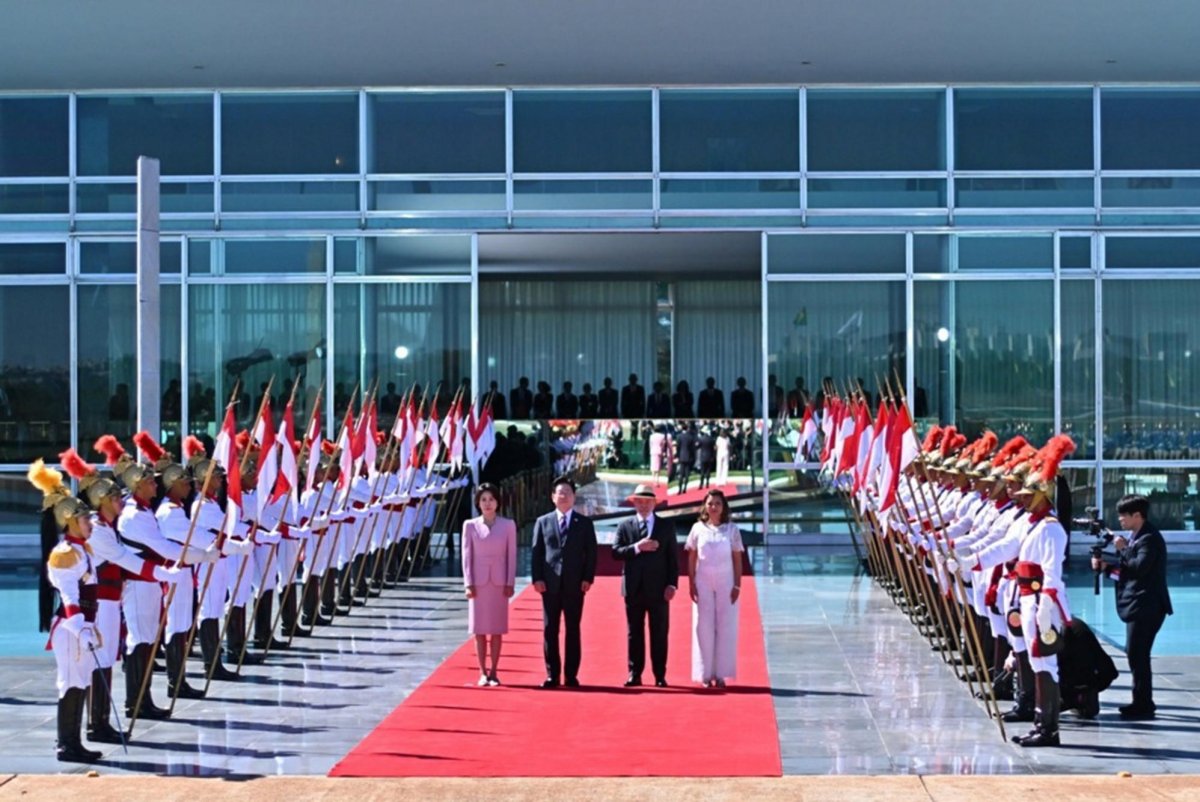
South Korea and Brazil agreed to set up a working group to restart stalled trade negotiations between Seoul and the Mercosur bloc, following a summit between the two presidents.
President Lee Jae Myung and President Luiz Inácio Lula da Silva reached the deal Monday at the Alvorada Palace in Brasília, where Lee was making a state visit. The two sides aim to announce the resumption of talks at the Mercosur summit in December, according to South Korean presidential spokeswoman Kang Yu-jung.
Negotiations between South Korea and Mercosur – the South American trade bloc whose founding members are Brazil, Argentina, Paraguay and Uruguay – began in 2018 but were suspended after the seventh round in 2021. Differences over agricultural market access, sanitary inspections and other sensitive trade issues stalled progress.
Kim Yong-beom, South Korea's presidential chief of staff for policy, and Brazilian Vice President Geraldo Alckmin will lead a bilateral working group. The group will examine trade opportunities and sensitive sectors and try to resolve obstacles before formal negotiations restart, the two leaders said.
"In an era of increasing uncertainty in the global trade environment, we deeply agreed that a trade agreement between South Korea and Mercosur is an important task that can no longer be delayed," Lee said during a joint news conference.
Lula said the working group would identify and coordinate sensitive issues to remove barriers to restarting the negotiations.
Mercosur has a combined population of about 300 million and gross domestic product of roughly $2.9 trillion, according to figures cited by the South Korean presidential office.
A trade agreement could reduce tariffs on major South Korean exports including automobiles, machinery, steel and electronics. Lower tariffs could improve the price competitiveness of South Korean companies in Brazil and other South American markets as Seoul seeks to diversify trade relationships amid growing global protectionism.
The agreement could also expand cooperation on critical minerals, energy, infrastructure and advanced manufacturing.
South Korean companies could face stronger competition from Mercosur producers in the domestic agricultural market. Brazil, Argentina, Paraguay and Uruguay are major exporters of beef, chicken, corn and soybeans. South Korean farmers and livestock producers have expressed concern that lower tariffs could lead to increased imports of less expensive agricultural products.
The scope and pace of agricultural market opening are expected to become central issues in future negotiations. South Korea plans to send an inspection team to Brazil next year to examine slaughterhouses and assess sanitary and quarantine conditions in preparation for possible market-opening measures.
Lee attended a state luncheon, a cultural performance and a reception after the summit before traveling to São Paulo.