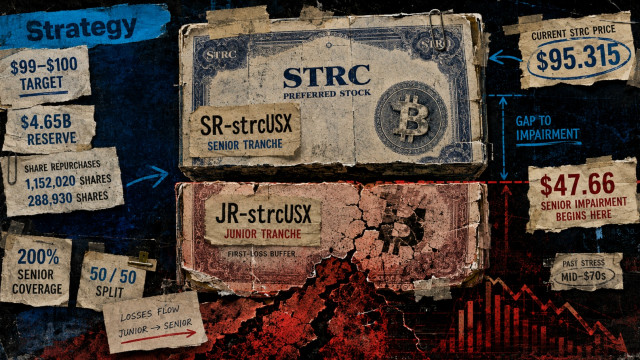
Solstice has launched a tranched product built on Strategy's Bitcoin-linked STRC preferred stock, with the senior piece shielded from losses until the security trades below $47.66. STRC changes hands near $95.315, about half of today's market price and roughly 52% below the $100 par value.
David Plisek, Solstice's COO, describes $47.66 as a modeled senior-impairment threshold under the protocol's current coverage structure and assumptions. Both can be revised, he said.
Strategy has spent the past six weeks actively managing STRC's price. On June 29 the company announced a Digital Credit Capital Framework that pairs a dollar reserve policy with a revised dividend structure. The framework also authorized repurchases, with the explicit goal of keeping STRC trading between $99 and $100.
Between July 20 and July 26, Strategy repurchased 288,930 STRC shares for about $25 million, an average price near $86.52. In early August the company sold $108.6 million worth of Bitcoin (BTC) and used the proceeds to buy back 1,152,020 STRC shares. A $4.65 billion dollar-denominated reserve was reported as of Aug. 9.
Solstice built its risk model on that defense policy, and its documentation lists any move away from the framework among the named risks.
The exposure splits into two tokens, SR-strcUSX and JR-strcUSX. A $100 combined exposure means $50 in each, and that 50/50 split produces the 200% senior coverage ratio.
Junior absorbs realized losses first, in exchange for a yield target well above the senior side's roughly 7% APY. STRC's stated 12% annual dividend implies close to a 12.59% Bitcoin-fueled yield on the current price, before Solstice's tranching and fees split that spread between the two sides. The gap is the price of the downside protection. In exchange for sitting last in line for losses, the senior token collects a narrower slice of STRC's yield.
Plisek frames the tranching as a way to deliver a NAV-based return on STRC without exposure to the security's price swings. It's a claim on the preferred stock's performance, not share ownership.
A price decline becomes a realized loss only when redemptions force the structure to sell the underlying position. Senior holders heading for the exit during a drop trigger junior losses. Solstice built in a restricted mode that halts junior redemptions and new senior minting once STRC trades below the threshold, stopping the coverage ratio from deteriorating further. A deeper decline shifts the protocol into a liquidation phase, during which Solstice works to sell STRC collateral before the senior tranche incurs any loss.
Plisek said market makers have agreed to buy STRC outside normal Nasdaq trading hours, narrowing the gap between a DeFi product that trades continuously and an underlying security that doesn't. He also said the protocol's products operate independently. STRC entering liquidation would not affect Solstice's other products, USX or eUSX, because each runs its own risk controls.
The tranche structure reorders who absorbs STRC's risk, and the risk itself stays fully intact. Strategy has said STRC dividends require board approval each period, and the preferred securities carry no collateral claim on the company's Bitcoin holdings. They carry only a preferred claim on whatever assets remain.
Solstice modeled the structure against STRC's earlier slide into the mid-$70s, before the product existed, so the exercise is a reconstruction rather than a live record. STRC bottomed near $73.62 in that stretch, about 35% above the current threshold. Senior stayed unimpaired in the model regardless of what junior holders did, and junior's outcome hinged on senior behavior. Plisek said junior would have stayed unimpaired too, had seniors held their positions through the drawdown.
The bull case has Strategy's buybacks and reserve pulling STRC back to the $99 to $100 target. When the discount narrows, junior's mark-to-market risk shrinks and senior takes on the profile of a bond rather than a leveraged bet. The bear case puts STRC back in the mid-$70s, with the market questioning whether a Bitcoin treasury company can sustain preferred-stock price defense indefinitely. Senior stays modeled as unimpaired under either scenario, and most of the variance lands on junior. Plisek's model makes behavior the deciding factor rather than price. Solstice's retrospective model put junior's worst case at a roughly 50% drawdown if every senior holder had redeemed at once.