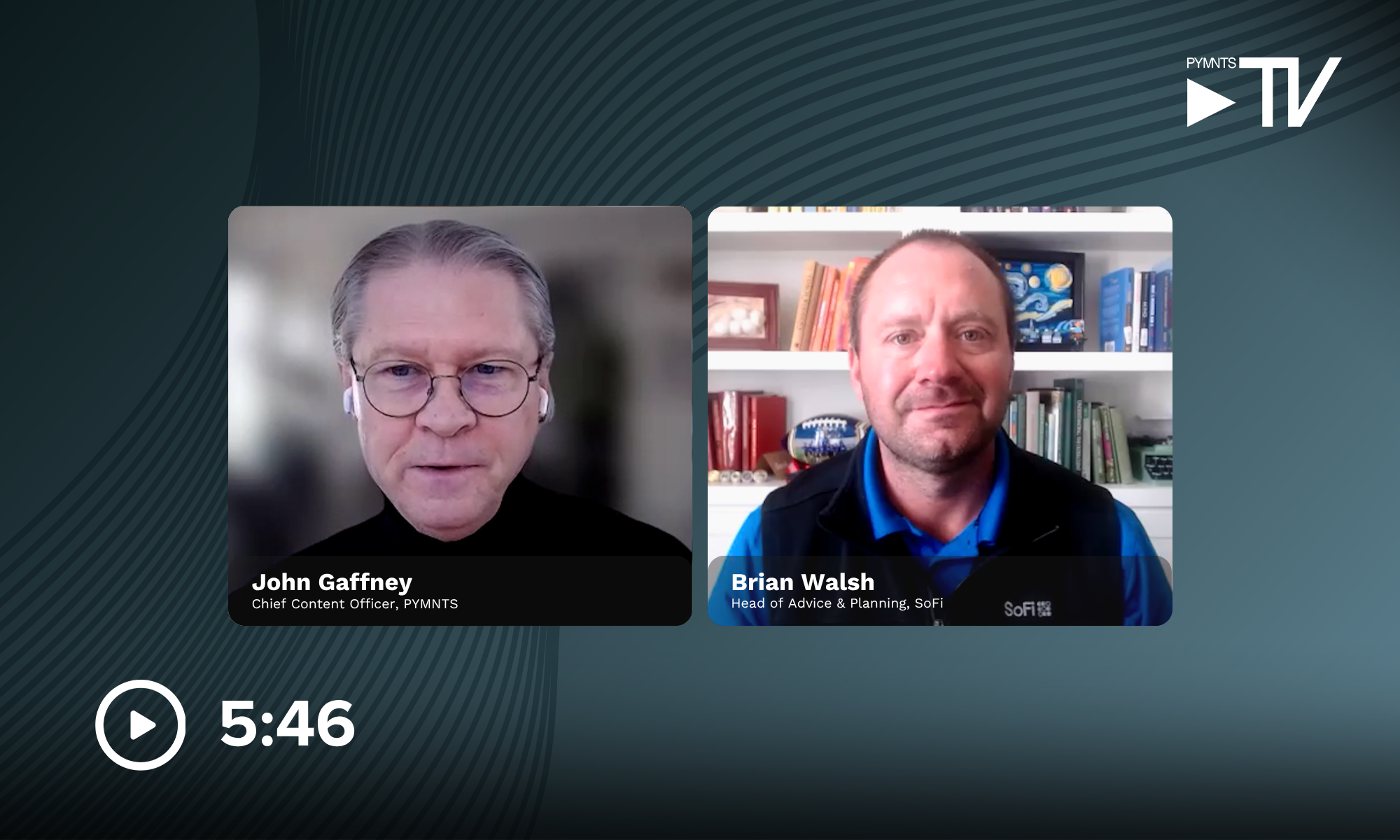
SoFi's AI Coach sees strong engagement: 50% of interactions involve investing. Context, memory, and visual aids drive behavior change, Walsh said. The human-in-the-loop structure helps scale advice safely.
SoFi’s AI-powered Coach platform is drawing heavy engagement, with roughly half of customer interactions focused on investing, Brian Walsh, the company’s head of Advice and Planning, told PYMNTS. That figure reflects the core financial challenge most users face: how to spend less than they earn and put the difference to work.
Walsh said the Coach combines conversational guidance with account-level data, visual explanations and persistent memory. The system is designed to mimic an ongoing advisory relationship, not just answer one-off questions. “People want to interact and receive guidance in different ways,” he said. “Sometimes it’s going to be a convenient chat-based experience. Sometimes it’s going to be a little bit more complicated, more high-touch with humans.”
Context, Walsh said, is the difference between helpful advice and harmful recommendations. A suggestion to invest excess cash may be appropriate for a user with a fully funded emergency reserve and no costly debt. The same suggestion could hurt someone facing a near-term expense or carrying a high-interest credit card balance. “It’s one thing to say, ‘Hey, you have a bunch of extra cash in this account. This cash should be invested, or it should be used to pay down debt,’” Walsh said. “But if you don’t have any context in how it fits into their overall picture, that could be correct, it could be incorrect.”
Consumers often hold accounts across five, 10 or even 15 institutions, making it difficult to see their actual financial position. The Coach brings that information together, reducing the organizational work that often prevents people from acting. Memory adds another layer. When the system retains details about family circumstances, long-term priorities or previous conversations, users do not have to repeatedly reconstruct their financial lives.
Visual explanations can prompt behavior change where text falls short, Walsh said. A written statement that 30% of discretionary spending goes toward one category may have little impact. A pie chart showing that category towering over every other expense can create a different response. “There are a lot of financial concepts that are much easier to express visually than they are in writing,” he said. “It opens up this whole new dynamic of how do we communicate these topics in as simple and understandable manner as possible.”
The expansion of AI guidance raises a question: Where should automation stop? Coach was built using principles, communication methods and boundaries drawn from eight years and tens of thousands of conversations conducted by human financial planners, Walsh said. Rule sets are designed to identify when an interaction moves beyond the intended scope and should be escalated. “There are going to be clear rule sets that are built in,” he said. “This is going to expand beyond the scope of the advice or the guidance that we want to provide. Now let’s escalate this to a human interaction.”
That human-in-the-loop structure may be essential to scaling AI in regulated financial environments. It allows software to handle education, organization and routine guidance while preserving a pathway for complexity, judgment and regulated advice. The result could be a two-sided productivity gain. AI tools can serve consumers who might otherwise receive no guidance, while human planners can use the information gathered through digital interactions to serve more people efficiently. Walsh described the dynamic as a “snowball effect” where expertise reaches more people and the human side becomes more efficient.
For SoFi, the Coach is more than a feature. Deeper engagement through the platform could reduce churn and increase lifetime value, especially as the company competes with other fintechs and traditional banks for users. SoFi’s advantage lies in its integrated suite of banking, lending and investing products, which gives the AI a fuller picture of a user’s finances than a standalone robo-adviser might have. The escalation framework also addresses the liability question that hangs over automated financial advice, a topic explored in AI Rogue Agents: Who Bears Liability for Breaches.
Walsh said the ultimate measure of progress is whether technology can make informed, contextual and actionable guidance available to people who have historically been left outside the financial advice system. SoFi’s Coach is one attempt at that. Half the interactions already focus on investing, the hardest financial behavior to change.
Drafted by a large language model from the source reporting linked above, then screened by automated publishing checks. It is not read by a journalist before publication. Some articles cite our Alpha Score. Verify prices and figures against the original source. Educational coverage, not personalized advice.