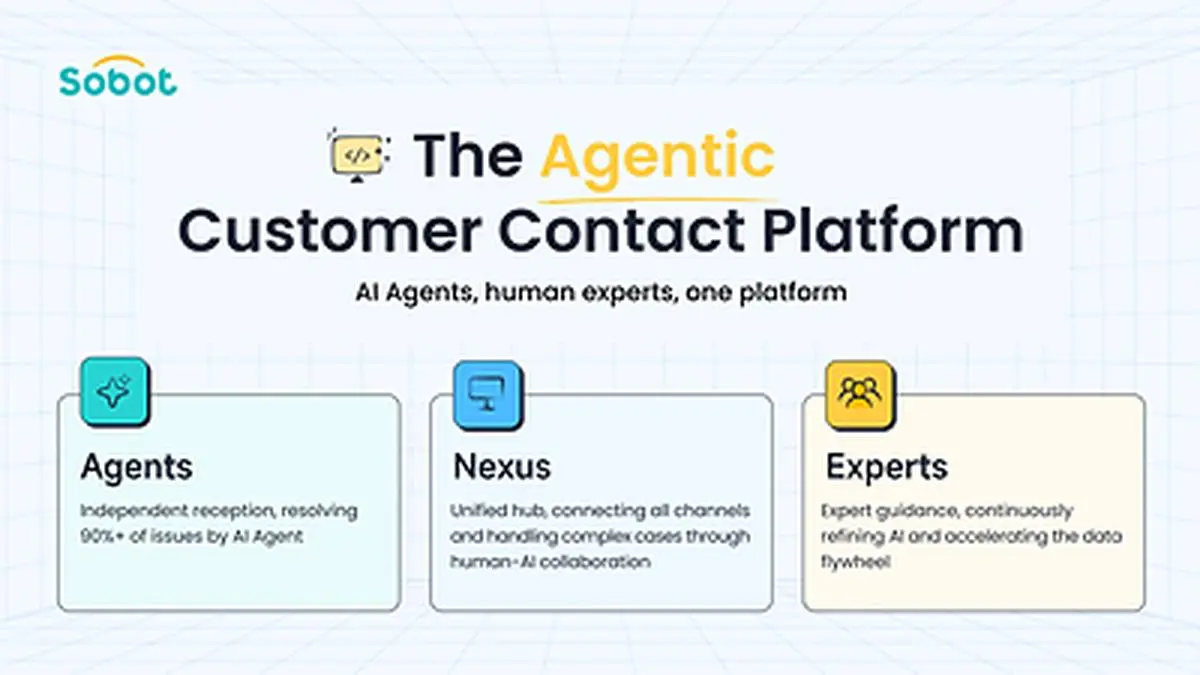
Sobot, the agentic customer contact platform, upgraded its AI agents this week. The change is not just a smarter model. It is a shift in how the agents think and act, moving from a fixed workflow-trigger pattern to a continuous reasoning loop the company calls ReAct.
Previously, Sobot agents followed a workflow built in advance. When a customer's intent was recognized, the agent stuck to that path. It could not adapt when a situation fell outside the predefined steps, and nothing fed back into its decision-making until the process ended.
The upgraded agents work differently. They run on a loop of reasoning, acting, and observing. For a return request, the agent works out what information it still needs, checks what the customer has already shared, and asks for the rest. Workflows still suit scenarios that need a fixed process, Yi Xu, Sobot's CEO, said. ReAct is simply a more adaptive option. RAG keeps every answer grounded in the right knowledge, and ReAct turns that understanding into a finished task.
The foundation is a unified resource layer of knowledge, skills, tools, MCPs, memory, and variables. These are centrally managed and shared across every agent rather than configured separately. A skill built to handle one type of request only needs to be created once. Any agent can call on it automatically when it recognizes a matching scenario.
Building an agent used to mean specialist-level setup: bot styles, prompts, knowledge bases, each on its own page. In the updated Sobot Agents Studio, businesses describe what they want to build in a conversation. The Studio pulls up the right settings on its own. Knowledge, skills, and tools all come together in one place.
The upgrade also introduces "Ask AI for Data." Instead of reading a dashboard with preset templates, managers can ask a question in natural language and get a direct answer with trend interpretation, anomaly flags, and next steps.
Sobot agents handle customer interactions independently, but they do not run in isolation. The company's Nexus infrastructure connects every channel – website chat, voice, email, WhatsApp, Facebook Messenger, Instagram – into a single platform. When a request needs a human, it transfers with the full conversation history. An AI Copilot works alongside the human agent throughout.
Sobot Experts stay involved after deployment. AI Strategists design implementation plans. Deployment Specialists configure and launch agents. AI Trainers refine models using real conversation data. Operation Analysts monitor performance and flag where to adjust next.
"We're moving AI in customer contact from a supporting role to a leading one," Xu said. "The question is no longer how well AI can assist a human agent, but how much AI can resolve on its own."