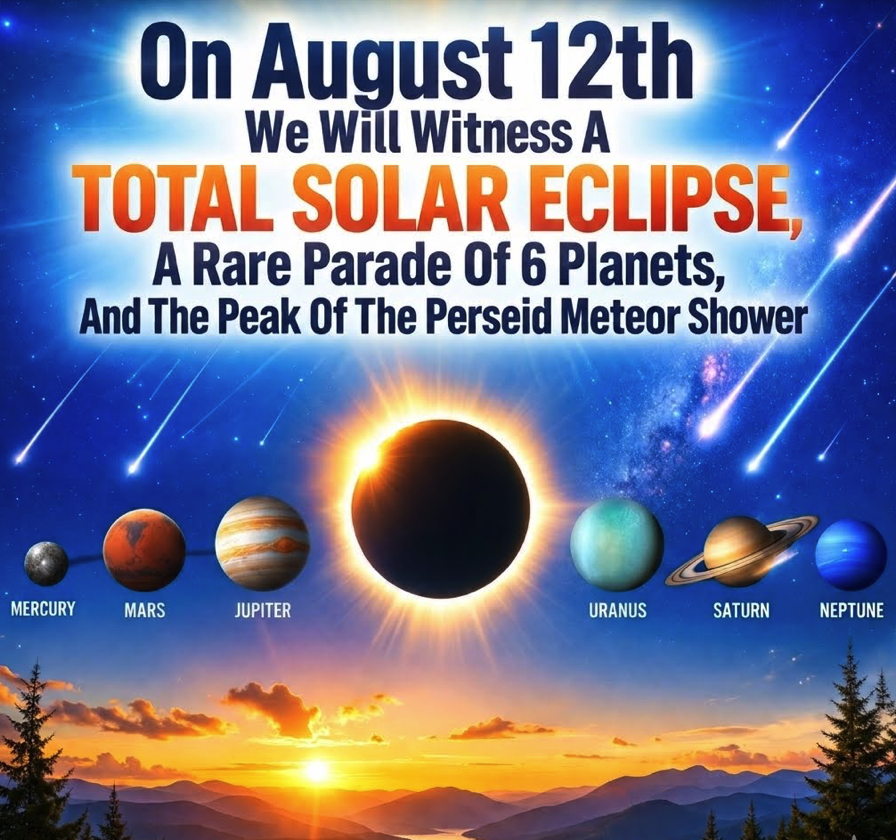
On August 12, three major celestial events will converge on a single day. A parade of six planets – Mercury, Mars, Jupiter, Uranus, Saturn, and Neptune – will line up across the morning sky before sunrise. Mars and Saturn will be visible to the naked eye. Mercury will sit low near the horizon. Jupiter will be even lower. Uranus and Neptune will require binoculars or a telescope. Venus will not appear.
Later that day, a total solar eclipse will sweep across Greenland, Iceland, northern Russia, the Atlantic Ocean, Spain, and a small corner of Portugal. For mainland Europe, this will be the first total solar eclipse since 1999. Spain last saw one in 1905. Much of the Northern Hemisphere will see a partial eclipse, including parts of the northern U.S. from Alaska to North Carolina, most of Canada, much of Europe, and northwestern Africa. In some areas along the western edge of the path, the Sun will set while still partially eclipsed, creating a sunset eclipse.
The moon will be barely a day past its closest approach to Earth, so its disk will be large enough to cover the Sun completely. The path of totality starts in far northern Siberia, runs south through the Arctic and the North Atlantic, crosses western Iceland including Reykjavík, and reaches northern Spain.
After sunset, the Perseid meteor shower will peak on the night of August 12 into August 13. The Perseids run from July 17 to August 24. Earth will pass through the densest part of the debris stream left by comet 109P/Swift-Tuttle. That comet's nucleus is about 16 miles (26 kilometers) across, roughly twice the width of the asteroid linked to the dinosaurs' extinction.
Wildfire smoke could obscure views in parts of North America. More than 900 wildfires are burning in Canada, and smoke has reached as far south as Florida. In the western U.S., the total acreage burned in Oregon, Washington, and southern British Columbia may soon surpass one million.