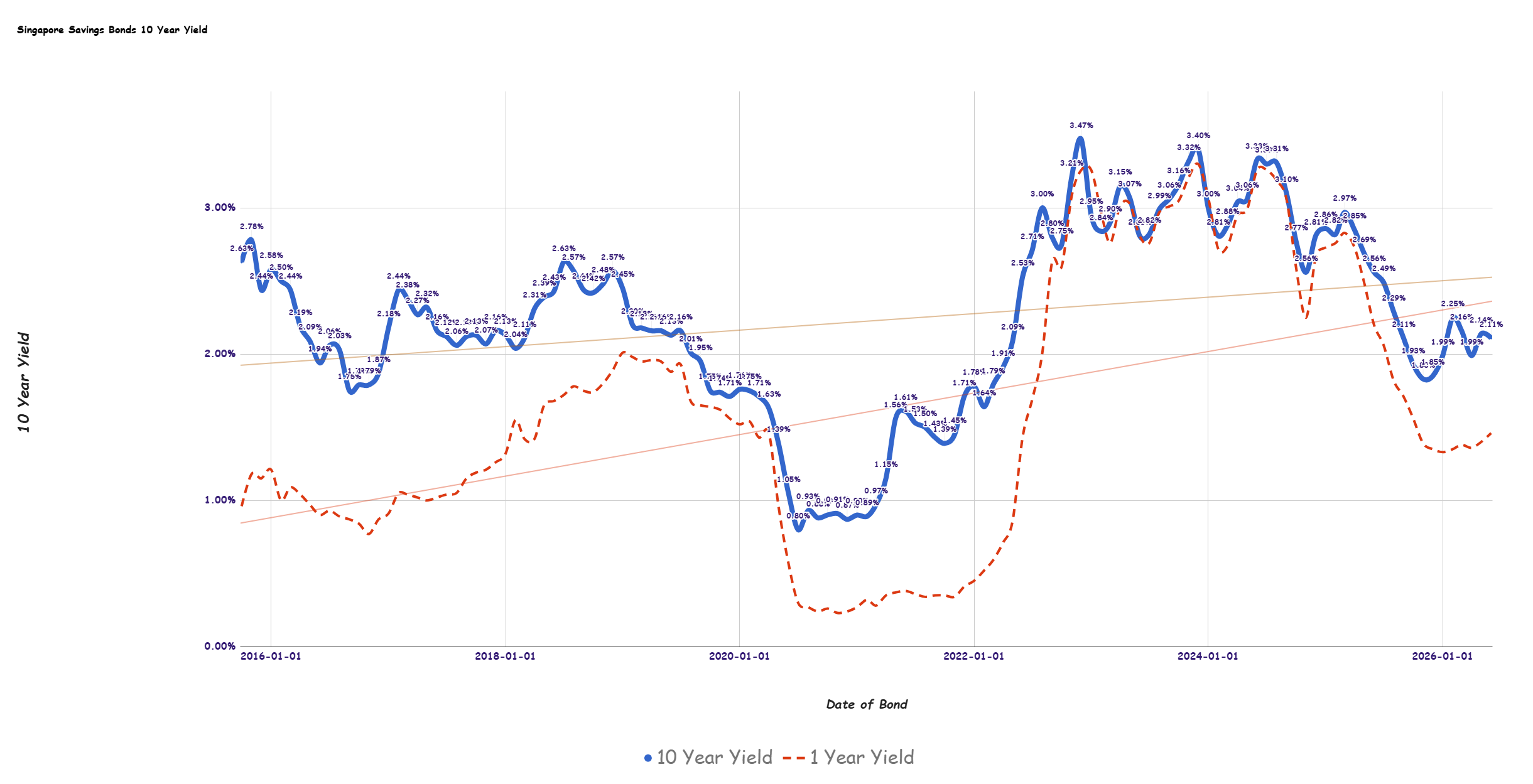
The June 2026 Singapore Savings Bonds (SBJUN26 GX26060N) offer a 10-year yield of 2.11%. Investors should monitor allotment risks as demand impacts allocation.
Alpha Score of 57 reflects moderate overall profile with moderate momentum, moderate value, moderate quality, moderate sentiment.
The June 2026 Singapore Savings Bonds (SSB), identified by ticker SBJUN26 GX26060N, offer a 10-year average annual yield of 2.11%. This issuance continues a period of relative stability in long-term rates for the instrument, though the underlying yield curve structure is shifting. Investors looking at shorter time horizons will note that the one-year yield for this tranche sits at 1.46%, a marginal increase from the 1.40% seen in the previous month's issue. While the 10-year headline rate remains the primary focus for long-term savers, the slight uptick in the one-year yield suggests a potential flattening of the curve compared to prior months.
The Singapore Savings Bonds operate on a step-up interest structure, where the yield increases the longer the bond is held. The 2.11% figure represents the average annual return if the bond is held for the full 10-year duration. Investors should distinguish between this average and the actual cash flow received in the early years. Because the interest is paid semi-annually, the effective yield for an investor who chooses to redeem after only one year is significantly lower than the 10-year average. This mechanism is designed to incentivize long-term capital preservation rather than short-term liquidity, though the bonds remain redeemable on a monthly basis without penalty.
One of the most misunderstood aspects of the SSB program is the allotment process. Unlike a standard market purchase where the price adjusts to clear the market, the SSB interest rate is fixed at the start of the subscription period. If total demand from applicants exceeds the issuance amount, the Monetary Authority of Singapore (MAS) implements a pro-rata or ceiling-based allocation. This creates a specific execution risk for investors: you may apply for the maximum allowable SG$200,000 but receive only a fraction of that amount. Historical data shows that during periods of high interest rate volatility or attractive relative yields, individual allotments can be slashed significantly, as seen in the August 2022 issue where the maximum allotment per person was capped at $9,000.
For investors requiring higher certainty of allocation, the market for Singapore Government Securities (SGS) Bonds and Treasury Bills (T-Bills) offers a different risk-reward profile. While both the SSB and SGS products are backed by the Singapore government and carry a AAA credit rating, the purchase mechanism differs. SGS Bonds and T-Bills are auctioned, meaning the yield is determined by market demand at the time of the auction. This allows for more predictable allocation sizes, which is critical for investors managing larger portfolios who need to deploy specific amounts of capital. When short-term interest rates are elevated, these instruments often serve as a more efficient liquidity management tool than the SSB, which is better suited for smaller, retail-focused goal-based planning.
Investors should view the SSB not as a high-yield trading vehicle, but as a core component of a defensive allocation. The ability to use Supplementary Retirement Scheme (SRS) funds to purchase these bonds provides a tax-efficient way to lock in government-backed returns. However, the opportunity cost of holding these bonds during periods of rising interest rates is the inability to capture higher yields elsewhere without sacrificing the principal guarantee. For those seeking broader market exposure beyond sovereign debt, understanding the interplay between these risk-free rates and other asset classes is essential. For further context on how broader market conditions affect asset selection, one might review stock market analysis to compare these fixed-income returns against equity risk premiums.
While the SSB provides a stable floor for wealth accumulation, it is not a substitute for active portfolio management. Investors often find that a hybrid approach, utilizing T-Bills for short-term cash management and SSBs for longer-term, lower-volatility requirements, provides the best balance of liquidity and yield. As with any fixed-income instrument, the primary risk to the investor is inflation-adjusted returns. If the cost of living increases at a rate higher than the 2.11% yield, the real value of the capital will erode over the 10-year term. Investors should maintain a disciplined approach to their stock market analysis to ensure that their overall portfolio remains resilient to shifts in the macroeconomic environment. The June 2026 issue remains open for application through UOB, OCBC, and DBS, with the final allotment results determined at the end of the month.
AI-drafted from named sources and checked against AlphaScala publishing rules before release. Direct quotes must match source text, low-information tables are removed, and thinner or higher-risk stories can be held for manual review.