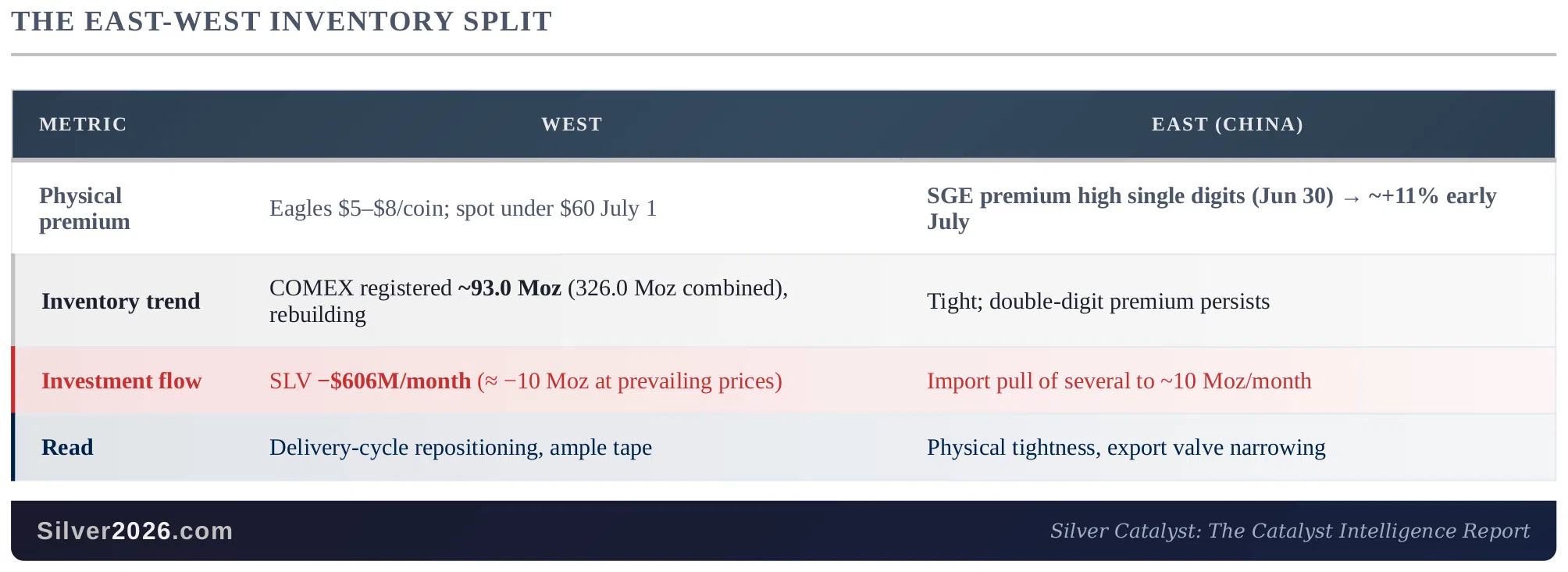
New York's silver vaults are refilling. The metal held in COMEX warehouses and pledged to settle futures contracts – the category exchanges call "registered" – climbed to about 93.0 million ounces on the July 6 report, up from roughly 82 million ounces in mid-June, according to CME data. On its own, a rising deliverable pile looks like loosening.
It is not fresh metal arriving from mines. It is repositioning inside the system ahead of the active July delivery month, with eligible metal being reclassified into registered so it can settle contracts. The pool that Western traders watch is expanding on paper.
The East sees something else. On the Shanghai Gold Exchange, silver traded at a premium of high single digits over the international price at the June 30 benchmark fixes. That gap widened to roughly 11% by early July, per MetalCharts. A double-digit premium is the market's clearest live signal of where physical silver is genuinely tight, even discounted for local taxes, currency, and import costs.
The two pictures are not contradictory. They describe one market with two speeds. Western holders are comfortable letting metal move into deliverable inventory because their own demand is soft. The largest silver exchange-traded fund, SLV, saw net outflows of about $606 million over the past month, roughly 10 million ounces of investment selling at current prices, according to ETF Database. US retail stayed quiet, with 2026 American Silver Eagle premiums down around $5 to $8 a coin.
Chinese buyers, meanwhile, are paying up to secure physical metal. Layer on Beijing's July 1 move to enforce strategic-mineral export controls, under which silver is reportedly licensed per Morgan Lewis, and the direction of travel sharpens: metal is being kept inside China while the West treats it as ample.
The market is in its sixth consecutive annual deficit, a shortfall of 46.3 million ounces per Metals Focus and the Silver Institute. A structural deficit does not require every vault to drain every month. It requires demand to exceed supply over the year. In the meantime, metal sloshes between regions, and a market can look loose in one place while it is tight in another.
None of this is a forecast about where the price goes next. The Western outflows and the soft retail bid are real. Premiums can compress as quickly as they widened. A regional gap can persist longer than anyone expects. The longer-term case for silver rests on a supply-demand balance that has run short for six years, and on the fact that the marginal buyer of physical metal increasingly sits in the East.
A rebuilding vault in New York and an 11% premium in Shanghai are the same story told from two sides. The West is where silver is priced. The East is where the shortage is showing.
CME Group, which operates the COMEX, carries an Alpha Score of 53, reflecting mixed sentiment. The iShares Silver Trust scores 29, indicating weak momentum. For more on the broader commodities analysis, including silver's structural dynamics, see AlphaScala's coverage.