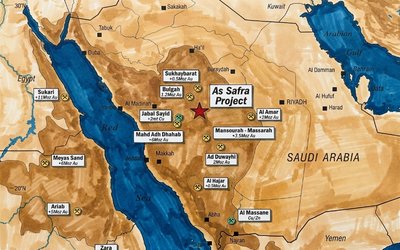
Sierra Nevada Gold (ASX: SNX) has discovered a polymetallic breccia system at the As Safra copper-gold project in Saudi Arabia. Two reverse circulation holes intersected high-grade precious and base metals mineralisation – gold, silver, copper, lead and zinc – beneath shallow cover about 400 metres south of the Central Copper Zone.
The finding confirms that mineralisation at As Safra formed through multiple hydrothermal events, not a single copper-bearing phase. The breccia sits from near surface to roughly 50 metres depth. Its distinct metal association broadens the exploration model and supports the interpretation of a large, long-lived mineral system, CEO Adam Oehlman said.
Best assay from the reverse circulation holes: 11 metres at 1.15 grams per tonne gold, 108.7g/t silver, 0.21% copper, 4.64% zinc and 1.88% lead from 49 metres. The result sits inside a broader interval of 17 metres at 0.81g/t gold, 75.2g/t silver, 0.14% copper, 3.08% zinc and 1.25% lead.
The geometry and true width of the new breccia will be investigated during follow-up drilling under an expanded Phase 2 campaign. That programme comprises more than 25,000 metres of reverse circulation and diamond drilling, Oehlman said.
The campaign aims to expand known mineralised footprints, evaluate extensions along strike and at depth across the broader 5.5 kilometre corridor, and test concealed targets. Results from Phase 1 drilling will be combined with magnetic, gravity and induced polarisation datasets to refine drill targeting.
Oehlman said the discovery represented more than another drill intersection. “It materially advances our understanding of the As Safra mineral system,” he said. “We now have evidence that the system evolved through multiple mineralising stages and was capable of producing copper-gold skarn mineralisation, skarn Au-dominant zones, and precious-metal-rich polymetallic breccias.”
“This level of geological complexity is commonly associated with large mineral districts,” he added. “With only a small proportion of the known mineralised corridor tested, it opens an important new area for follow-up exploration.”
The Alpha Score for SNX sits at 73 out of 100, labelled Moderate, within the Technology sector.