Commodities● Neutral
Shuaa, Key Capital Launch $50M Fund to Unlock MENA Venture Liquidity
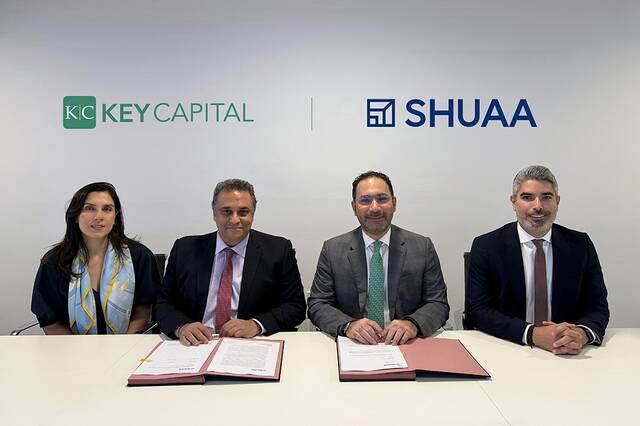
Key Fund I LP has closed two deals and targets a first close soon, aiming to provide exit pathways for early shareholders in a market where VC deployment hit $3.8B in 2025. The fund's deployment pace will test whether a structured secondary market can scale.
Continue with
Shuaa Capital and Key Capital Limited have partnered to launch Key Fund I LP, a $50 million venture capital secondaries fund targeting the Middle East, North Africa, and EMEA. The fund has already closed two transactions. That early execution provides evidence that a structured secondary market can function in a region where annual VC deployment reached $3.80 billion in 2025, according to Magnitt, while exit infrastructure remains thin.
For early shareholders, founders, and employees holding illiquid stakes in high-growth technology companies, the arrival of a disciplined secondary buyer changes the risk calculus. The fund acquires positions through off-cap-table transactions, providing liquidity to existing holders and giving new investors a differentiated entry point into scaled assets. The immediate question is whether this first institutional push can scale fast enough to absorb the pent-up demand for exits.
The $3.8B Venture Market’s Liquidity Mismatch
MENA’s venture capital ecosystem has expanded rapidly. Exit pathways have not kept pace. Annual deployment rose from $1.10 billion in 2020 to $3.80 billion in 2025, according to data platform Magnitt. That growth has created a large pool of capital locked inside private companies, with limited options for early backers to realise returns outside of an IPO or a strategic sale.
From $1.1B to $3.8B: A Market Without Exit Doors
The region’s venture market has historically been dominated by primary rounds. Founders and angel investors who backed companies at seed or Series A stages often had to wait for a full exit event, which could take a decade or more. The absence of a functioning secondary market meant that even successful companies generated paper wealth that was difficult to convert into cash. This illiquidity discount weighed on valuations and made it harder to recycle capital into new startups.
Key Capital estimates the regional secondaries market at over $1 billion and growing. That figure represents the value of existing stakes that could change hands if a structured buyer pool existed. The gap between the $3.80 billion in annual primary deployment and the nascent secondary infrastructure is the opportunity that Key Fund I is designed to address.
Why Secondaries Are the Missing Piece
In mature venture markets, secondaries serve as a pressure-release valve. They allow early employees to monetise equity before an IPO, let funds manage their portfolio construction, and give new investors access to companies that have already de-risked their business models. The global secondaries market hit a record $240 billion in transaction volume in 2025, according to Jefferies, a milestone that reflects how institutional allocators now treat the asset class as a core portfolio tool. The same logic is starting to apply to MENA, where the volume of venture-backed assets has reached a scale that demands a dedicated liquidity layer.
Key Fund I’s Structure and Early Execution
Key Fund I LP is structured as an ADGM Limited Partnership, domiciled in Abu Dhabi Global Market. The fund pursues a disciplined secondaries strategy focused on acquiring positions in high-growth technology companies. The emphasis on off-cap-table transactions means the fund buys existing shares directly from shareholders rather than participating in primary fundraising rounds, which keeps the capital deployment separate from company dilution.
$50M Target and Off-Cap-Table Focus
The $50 million target size is modest relative to the estimated $1 billion regional secondaries opportunity. That sizing suggests the initial raise is designed to prove the model. By concentrating on off-cap-table deals, the fund aims to deliver accelerated distributions compared to traditional primary venture funds. Investors gain exposure to assets that have already demonstrated product-market fit and revenue traction, while sellers receive immediate liquidity.