Stocks● Neutral
Self-Healing AI Agents: How to Build Error Recovery Into Multi-Agent Systems
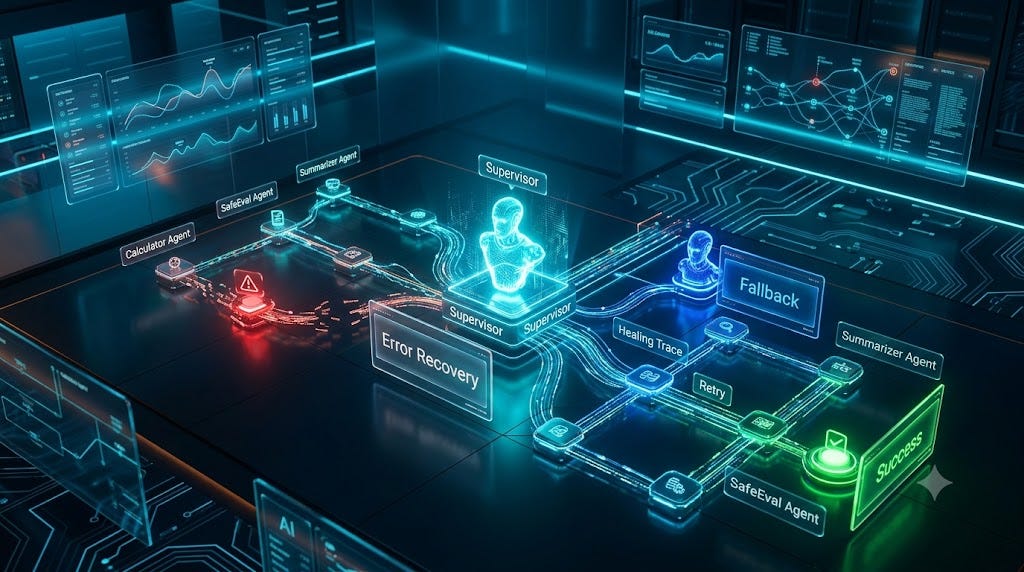
Build a Supervisor-Worker multi-agent system that catches worker failures, routes tasks to a fallback agent with a different strategy, and logs every recovery action. Full tested code on GitHub.
Continue with
Every agentic AI demo looks the same: a clean prompt goes in, a perfect tool call comes out, everybody claps. Then you deploy it, a worker agent hits an edge case it wasn't built for, throws an exception, and your "autonomous" system falls over in front of a customer.
The pattern that separates toy agents from production agents isn't a bigger model or a longer prompt. It's what happens after something fails.
This article walks through SelfHeal, a small but genuinely production-shaped multi-agent system that implements the Supervisor-Worker pattern with automatic error recovery. When a worker agent fails, the Supervisor doesn't crash or return a raw stack trace. It catches the failure, reroutes the task to a fallback agent with a different strategy, and logs exactly how it healed itself.
Every line of code in this article was written and executed in a sandboxed environment. The full, tested code is available on GitHub at Self-Healing-Agent.
How the Supervisor-Worker Pattern Works
The core architecture is straightforward. A Supervisor agent receives a task and assigns it to a primary Worker agent. If the Worker succeeds, the Supervisor returns the result. If the Worker throws an exception, the Supervisor catches it, logs the error, and assigns the same task to a fallback Worker that uses a different approach.
The fallback Worker has a modified system prompt that tells it to avoid the failure mode the primary Worker hit. If the fallback also fails, the Supervisor logs both failures and returns a structured error message. No raw stack trace reaches the caller.
The Code Structure
The system has three components:
-
Worker agents – each has a system prompt and a set of tools. The primary Worker uses a standard approach. The fallback Worker uses a more conservative strategy.
-
Supervisor agent – receives the task, calls the primary Worker, catches exceptions, and routes to the fallback if needed.