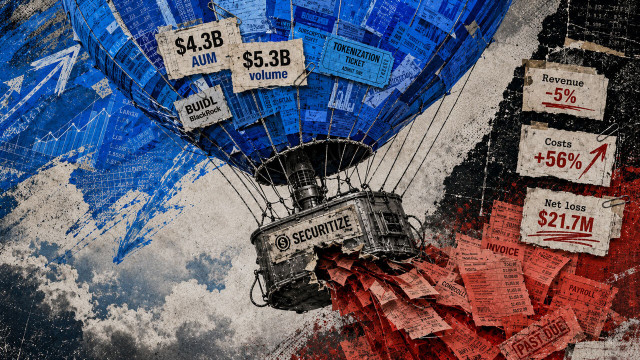
Securitize, the platform that issues and services tokenized securities, more than doubled its transaction volume in the second quarter. The company's revenue fell anyway.
Average tokenized assets under management reached $4.3 billion, up 16% from a year earlier. Aggregate transaction volume climbed 147% to $5.3 billion, according to the company's quarterly results. Securitize defines that volume as investments, redemptions, dividends and cross-chain asset movements. The increase was driven mainly by subscription and redemption activity in BlackRock's BUIDL and BUIDL-I funds, along with a $250 million subscription to the Securitize Tokenized AAA CLO Fund, according to the company's management discussion.
Revenue still came in at $14.4 million, down 5% from a year earlier. Tokenization revenue dropped 12% to $7.8 million. Management attributed the decline primarily to fewer completed on-chain integrations. Asset-servicing revenue rose 3% to $6.6 million. The roughly $200,000 gain was not enough to offset the tokenization shortfall.
The first quarter showed a similar pattern. Securitize then generated $19.5 million of revenue and positive adjusted EBITDA of $800,000 on lower average AUM of $3.2 billion and lower transaction volume of $1.9 billion. Higher platform activity in the second quarter did not translate into higher sales.
Operating costs and expenses jumped 56% year over year to $24.1 million. Selling, general and administrative expenses rose by $4.7 million, reflecting higher professional, consulting, accounting and public-company readiness costs. Compensation and benefits increased by $2.5 million as Securitize added staff, including employees from its MG Stover fund-administration acquisition. The expected credit-loss provision rose by another $1.2 million after a specific customer receivable was written off.
Those costs pushed the operating loss to $9.7 million from about $200,000 a year earlier. Adjusted EBITDA, a company-defined non-GAAP measure, swung from a $1.8 million profit to a $5.5 million loss. The reversal showed that the deterioration extended beyond the liability remeasurements that affected the headline net loss, the company's reconciliation indicated.
The $21.7 million GAAP loss included a net $11.7 million adverse fair-value movement. A $29.3 million option-liability loss and a $4.3 million loss on simple agreements for future equity were partly offset by a $21.8 million derivative-liability gain. These non-cash remeasurements were excluded from adjusted EBITDA.
The balance sheet changed materially after the quarter ended. Securitize had $33.6 million in cash on June 30, one day before completing its business combination with Cantor Equity Partners II. An unaudited pro forma balance sheet, treating the transaction as if it had closed on June 30, showed $352.6 million of combined cash and no borrowings after convertible notes and related instruments converted into equity. The same pro forma statement still showed $118.5 million of total liabilities, including earnout liabilities and interest payable.
The next test is whether Securitize can convert rising platform use into more integration and asset-servicing revenue while keeping its expanded public-company cost base from outpacing sales. The company's results come as the tokenized equity market grows, with platforms like Bybit adding Meta and Tesla xStocks as tokenized assets hit $1.48 billion.