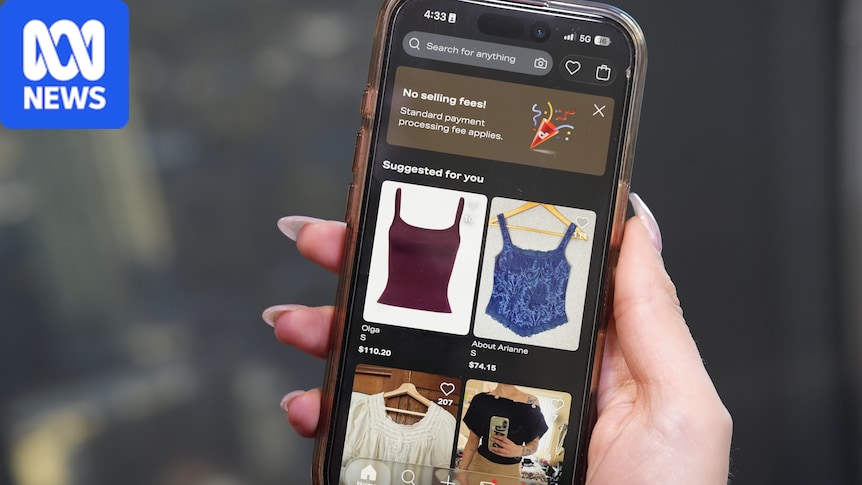
Australia has emerged as a fast-growing market for second-hand clothing apps, catching the attention of global platforms like Depop and Vinted as they compete for Gen Z users in the country.
The second-hand market is estimated to reach $1.5 billion by 2032, according to Credence Research. That projection has drawn new entrants and reshuffled ownership. Depop, popular with younger shoppers, was sold from Etsy to eBay earlier this year. Rival Vinted launched in Australia in July with no selling fees and temporarily discounted shipping.
"There's a big money spend happening behind the apps right now and they're focusing on the Australian market specifically," said Lillian Scott, a second-hand seller and micro-influencer. "It does feel quite cool to be in the centre of all that and this industry being recognised as a place of massive growth."
Vinted's communication manager Guen de Mello said the company was "confident we have a strong proposition for Australian consumers," pointing to its international sale connections. "There might be Australian brands and styles with cultural cachet that aren't easy to find in the UK or vice versa, and the second-hand market is often exactly where that discovery happens."
Writer and podcaster Maggie Zhou called Vinted's arrival a milestone. "They are one of the biggest resale platforms, especially over in Europe," she said.
The growth comes at a time when Australia already has an outsized appetite for clothing. In 2024, think tank The Australia Institute found the country was buying more clothes per person than any other, surpassing the United States as the world's biggest consumer of textiles per capita. Australians bought an average of 56 new clothing items a year, much of it fast fashion destined for landfill, the group said.
Jess Gilliland, who buys and sells on Depop, eBay and Vinted, said she has bought about 200 items over the past six years. Most of her wardrobe is pre-loved. The appeal, she said, is convenience. "I don't want to spend eight hours on a Saturday or Sunday going between stores."
The platforms offer the same reward as finding a piece at an op-shop but without leaving home. Their algorithms present endless options on social media-like grids. "The good thing about doomscrolling on resale apps is that it's a bit less chaotic for the mind," Gilliland said. "Not getting the rage bait and slop content I'm getting on other platforms."
Still, the sustainability pitch has limits. While these apps promote circular fashion, they can also drive overconsumption. "I think that this is still applaudable, the fact that a lot of us are buying more second-hand clothing," Zhou said. "But I don't think it is replacing our desire to buy fast fashion. I think a lot of us are guilty of overconsumption, whether that is for new or second-hand clothes."
Gilliland said it is easy to buy things on impulse and regret it later. "Like it comes two weeks later and you're like, 'Oh, I should have waited on that.' Especially for people that are as impulsive as I am."
Depop users are currently adapting to a raft of changes, including the removal of PayPal and a shift to a buyer marketplace fee of up to 5% on orders. Selling fees were eliminated in July. The updates have been divisive online. A spokesperson acknowledged they could "take time to adjust to" but said the goal is to make buying and selling second-hand "as straightforward as possible."
Scott, who scours thrift stores and flea markets for items to resell, is expanding across three platforms to keep up. "I feel a lot of pressure to keep up with it all," she said. "I think the saturation of the industry potentially, the outcome will be more work for us as a seller, like, it would just make things more complicated."
Despite her grievances, she said the apps had "cultivated something quite unique and special" for the community.