SBI's retail chief says India's payment rail must now focus on credit access, fraud prevention and inclusion, not just transaction volume.
State Bank of India's retail banking chief marked the tenth anniversary of the Unified Payments Interface with a reflection that was part celebration, part warning. Challa Sreenivasulu Setty, managing director for retail business and operations at the country's largest lender, wrote in The Hindu BusinessLine that UPI has become "the highest compliment any infrastructure can receive" – it has become invisible.
Launched on 11 April 2016 with 21 banks, UPI processed more than 24,000 crore transactions in the financial year that ended in March 2026. That is a nearly 12,000-fold increase in volume over its first decade. India now accounts for roughly half of all real-time payment transactions globally.
The scale is staggering. Setty focused on what sits underneath the raw numbers: trust at population scale. That trust, he argued, was built by making tiny payments effortless. Government data for FY2025-26 shows 86% of person-to-merchant UPI transactions were below 500 rupees. The architecture succeeded not because it made large payments possible – banking could already do that. It succeeded because it made a 35-rupee bus fare as simple to process as a 35,000-rupee transfer.
SBI itself is a pillar of that infrastructure. In the first quarter of FY2027 alone, the bank handled more than 25% of all UPI remittances in India. Its unique UPI user base grew from about 210 million in June 2025 to more than 250 million by June 2026, according to the article. Setty said the bank's role is not merely to process transactions. It is to carry digital trust to the breadth of India.
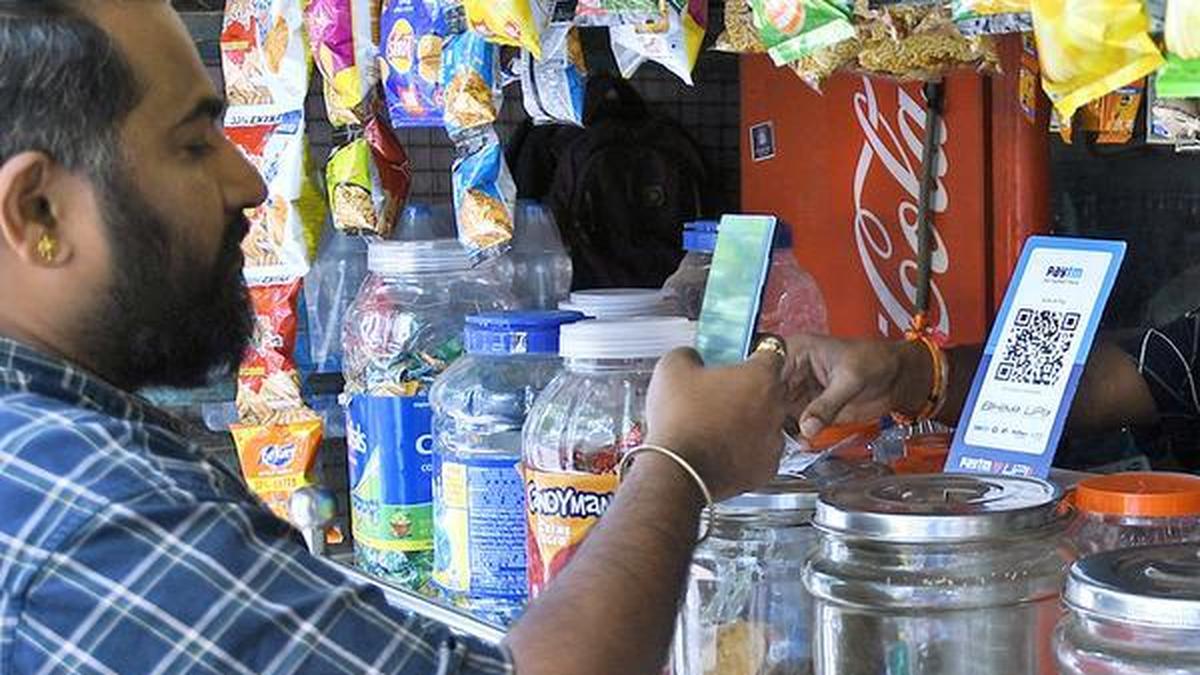
That democratisation is UPI's defining feature. A QR code at a roadside tea stall, Setty wrote, is perhaps the smallest branch of India's financial system. It connects a micro-merchant to the same national payment rail used by the largest enterprises, with no marble floor and no fixed operating hours. The pandemic accelerated adoption. The key insight Setty drew is that convenience proved durable. What began for many as an alternative became the default.
UPI did not simply digitise cash. It digitised trust. For generations, trust in money was reinforced by physical evidence – a bank branch, a passbook, a cheque. UPI changed that grammar by making a mobile number or a QR code sufficient to complete an economic promise between strangers. The system now includes 741 banks. The interoperability built into its design is one of the most powerful economic choices India made, according to Setty. Interoperability gives the customer freedom. It prevents innovation from becoming captivity.
Alongside ordinary payments, new use cases are emerging. In July 2026 alone, more than 800 million UPI transactions valued at over 35,000 crore rupees were authenticated using fingerprints or facial recognition. Biometric authentication is beginning to reduce friction. RuPay credit cards now ride on UPI, with the majority of their transactions flowing through the interface. UPI has also been linked to the central bank digital currency ecosystem and to ATM networks for cash withdrawals.
Setty described UPI as part of a much larger achievement: India's digital public infrastructure, the JAM trinity of Jan Dhan, Aadhaar and mobile, layered with the Account Aggregator framework, e-KYC and DigiLocker. The public and private sectors did not compete to build closed fortresses, he wrote. They collaborated on interoperable rails and then competed on the quality of services built on top of them.
The next decade will be defined as much by resilience as by innovation, Setty warned. As transaction volumes multiply, the ecosystem must continually invest in capacity, cyber security, fraud prevention, dispute resolution and high availability. Criminal ingenuity evolves alongside technological ingenuity. Social engineering, mule accounts, synthetic identities and AI-enabled fraud can erode confidence much faster than technology can build it.
His formulation was blunt. "Convenience without security is fragile. Security without convenience is exclusionary. India's achievement has been to pursue both; our responsibility is to preserve that balance." He called for stronger systems combined with more alert citizens.
Internationally, UPI now has a footprint across nine countries, with Cambodia becoming the latest addition in 2026. Setty argued the larger export is not a payment brand. It is an idea: digital infrastructure designed as a public capability on which markets innovate. For emerging economies, this offers a third path between slow legacy systems and closed proprietary ecosystems.
Yet the most important frontier remains domestic. There are still citizens who need greater digital confidence, merchants who require easier onboarding, regions where connectivity must improve, elderly customers who need assisted journeys and fraud victims who need faster resolution. Inclusion should never be measured merely by the number of people technically connected to a system, Setty wrote. The meaningful test is whether they can use it confidently, safely and independently.
The questions for the next decade are larger. Can a small business's digital footprint help it obtain timely formal credit? Can payments become safer even as they become invisible? Can the payment infrastructure support commerce conducted increasingly by machines and AI agents while preserving human consent? Setty believes the answer to each can be yes, provided India remembers what made the first decade successful: ambition combined with simplicity, technology with policy, competition with collaboration, and innovation with trust.
Prepared with AlphaScala editorial tooling from the source reporting linked above. Indexable analysis may include a cited Alpha Score value. Publishing checks screen each story before release. Educational coverage, not personalized advice.