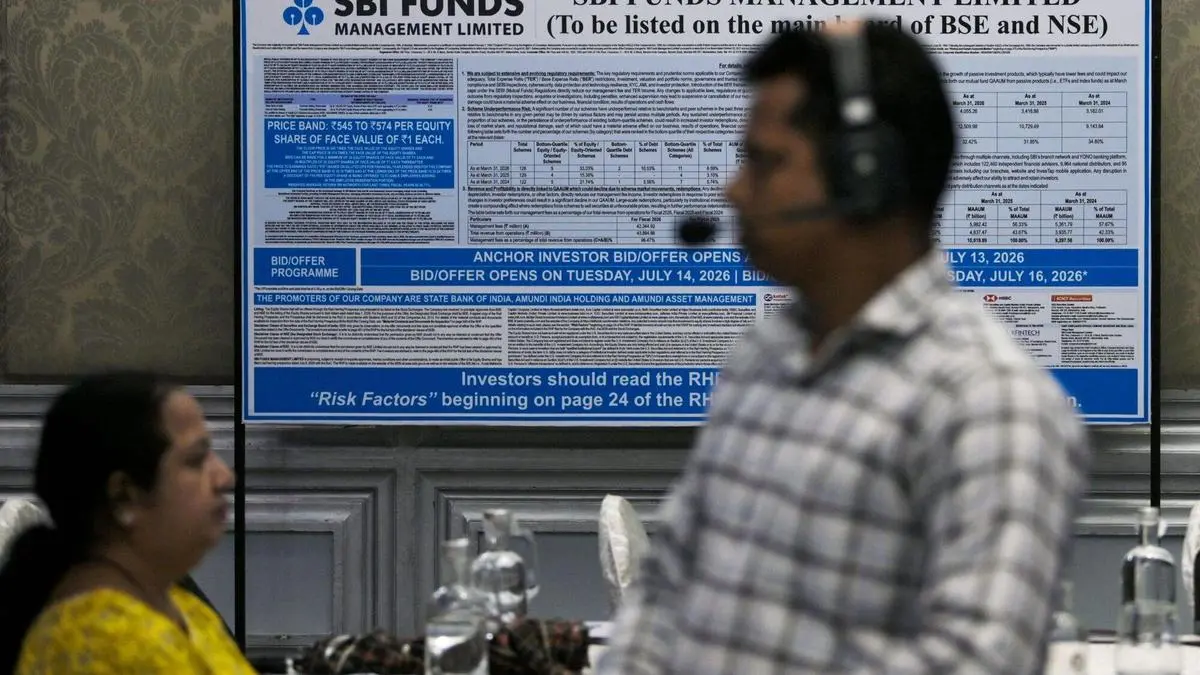
SBI Funds Management, India's largest asset manager by quarterly average AUM, launches its IPO on July 14. The price band is fixed at ₹545 to ₹574 per share. At the upper end, the offer raises roughly ₹9,813 crore for selling shareholders State Bank of India and Amundi Asset Management. The IPO is an entirely offer-for-sale structure, so the company itself receives no proceeds.
Promoters will hold 88.2 percent after the issue, with SBI retaining 55.6 percent. The implied market capitalisation is about ₹1.17 lakh crore, which would place it behind ICICI Prudential AMC and HDFC AMC.
At the upper end, SBI Funds trades at a price-to-earnings multiple of around 38 times on a trailing twelve-month basis, per Bloomberg. That is below ICICI Pru AMC (47 times), HDFC AMC (39 times) and Nippon India (48 times). The discount partly reflects the compressed revenue yield from its large EPFO-managed portfolio, where fee structures are thin.
The company managed ₹29.46 lakh crore in AUM as of March 2026, with mutual fund assets at ₹12.5 lakh crore. Active equity and hybrid schemes contributed roughly three-fourths of mutual fund management fee income in fiscal 2026. Operating revenue yield stood at 35 basis points, versus 44 bps for HDFC AMC and 52 bps for ICICI Pru AMC.
SBI Funds has a 1.32-lakh-strong distributor network and 1.62 crore live SIP accounts. Nearly 98 percent of those accounts have been active for over 37 months. That stickiness provides predictable recurring cash flows and reduces reliance on lump-sum inflows. Operating cash conversion reached 81.1 percent in fiscal 2026, up from 69.4 percent two years earlier.
The main risks to the thesis are structural. Management fees depend on market levels; a prolonged bear market would compress AUM and revenue. The Securities and Exchange Board of India could cut mutual fund management fees further, as it has discussed in the past. Passive products now represent nearly one-third of SBI Funds' mutual fund assets but earn lower fees than active funds, and their share is growing. Scheme concentration is another factor – the top five and ten schemes account for a large portion of assets, so underperformance or redemptions from those few schemes could hit revenue disproportionately.
What would weaken the risk picture. If equity markets rally and fresh retail inflows accelerate, the AUM base and fee income would expand quickly, reinforcing operating leverage. A regulatory fee cut that is smaller than feared, or a clear timeline from SEBI, would remove the largest policy overhang. Continued SIP growth above 15 percent per year, combined with stable persistency rates above 90 percent, would support revenue visibility.
What would amplify the risk. A sharp and sustained correction in Indian equities, especially if retail investors redeem, would directly reduce management fees. A regulatory fee cut of 10 percent or more would compress margins. A departure of senior fund managers, or a material compliance breach, could trigger outflows and erode the trust advantage SBI Funds enjoys.
The IPO closes on July 16. Allocation to anchor investors has already raised ₹1,655 crore at ₹574 per share from 30 investors, indicating institutional appetite at the top end.