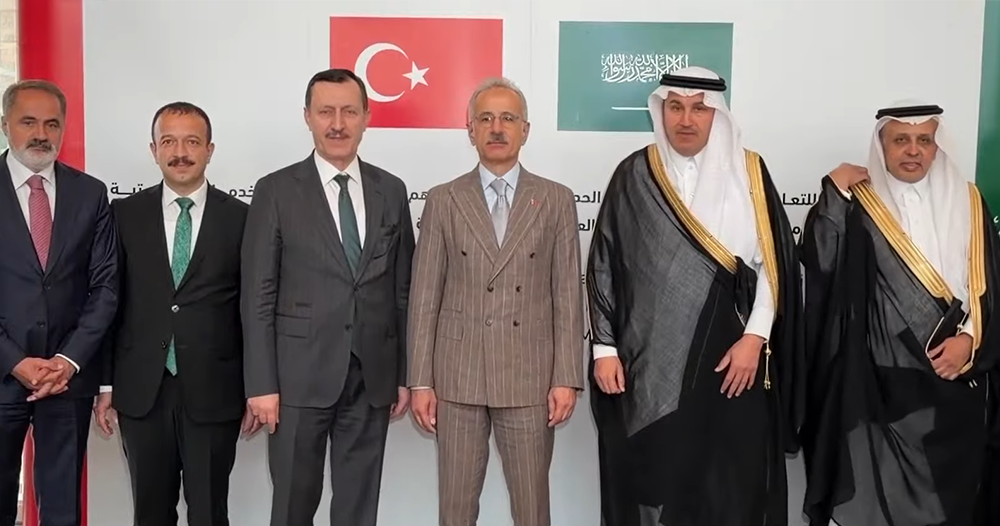
Saudi Arabia and Turkey signed two MoUs on logistics and rail, opening a potential land corridor that could bypass the Suez Canal and reshape Middle Eastern trade flows.
Saudi Arabia and Turkey signed two memoranda of understanding on Tuesday, one covering logistics services and one for railway connectivity. The deals open a formal infrastructure cooperation channel between two regional powers that have rebuilt ties after years of estrangement.
Saudi Minister of Transport Saleh Al-Jasser said on the sidelines of the signing that both sides discussed ways to strengthen cooperation across road, air, maritime, and rail connectivity. He noted a shared interest in expanding collaboration. No budget or timeline was disclosed in the announcements.
The logistics services MoU targets customs facilitation, port coordination, and multimodal freight handling. The railway connectivity MoU initiates feasibility studies for a rail link that could connect the Gulf Cooperation Council rail network to Turkish lines and onward into Europe. Neither document carries binding financial commitments. They set up joint working groups and data-sharing protocols instead.
Al-Jasser did not specify timelines or budgets. MoUs in the Gulf context typically precede tenders by 12 to 18 months, if they proceed at all. The Saudi side has a stronger track record of following through after the launch of the National Industrial Development and Logistics Program under Vision 2030.
The railway piece draws the most attention. A direct rail connection from Saudi Arabia through Jordan, Syria, and Turkey would bypass the Suez Canal for land-based freight from the Gulf to Europe. That corridor competes directly with the UAE's port-and-rail model at Khalifa Port and the Qatar-Turkey air bridge that developed after the 2017 blockade.
For Turkey, the deal offers a way to deepen economic ties with the Gulf without being locked into the UAE-Qatar rivalry. Turkey's logistics sector, already a major employer, gets a potential pipeline for Saudi industrial goods, petrochemicals, and construction materials. For Saudi Arabia, the rail link is a hedge against maritime chokepoints in the Strait of Hormuz and the Bab el-Mandeb.
Rail requires massive capital expenditure, land acquisition, and cross-border customs agreements with Jordan and Syria. Syria's political instability and infrastructure damage from the civil war make that segment the hardest to execute. Saudi Arabia has the financial capacity to fund its portion. Turkey has the construction expertise. The missing piece is a Syrian government willing to allow passage.
The logistics MoU faces fewer obstacles. Customs facilitation and port coordination can advance without the same capital commitment. Saudi Arabia has already streamlined its port operations under the Saudi Ports Authority, and Turkey's logistics sector has deep experience in multimodal freight. The working groups can make progress here faster than on the rail side.
The most immediate follow-up is the formation of the joint working groups. Saudi Arabia and Turkey both have sovereign wealth funds – the Public Investment Fund and the Turkey Wealth Fund – that could co-finance the rail feasibility study. A tender for the study within six months would be a concrete step. No tender means the MoUs remain aspirational.
For traders, the sector read-through is twofold. Saudi-listed logistics companies could benefit from customs facilitation and port upgrades. Turkish construction and cement stocks would have a direct revenue line if the rail project advances. The absence of a committed budget in the MoUs means these names should not be bought on the headline alone.
Saudi Arabia and Turkey both need this corridor. Saudi Arabia needs to diversify export routes away from the Suez Canal, a chokepoint that carries a major share of global trade. Turkey needs to re-establish itself as a logistics bridge between Europe and Asia after years of being sidelined by Gulf rivalries. The MoUs are the first step. The next 12 months will show whether they were a handshake or a blueprint.
Prepared with AlphaScala research tooling and grounded in primary market data: live prices, fundamentals, SEC filings, hedge-fund holdings, and insider activity. Each story is checked against AlphaScala publishing rules before release. Educational coverage, not personalized advice.