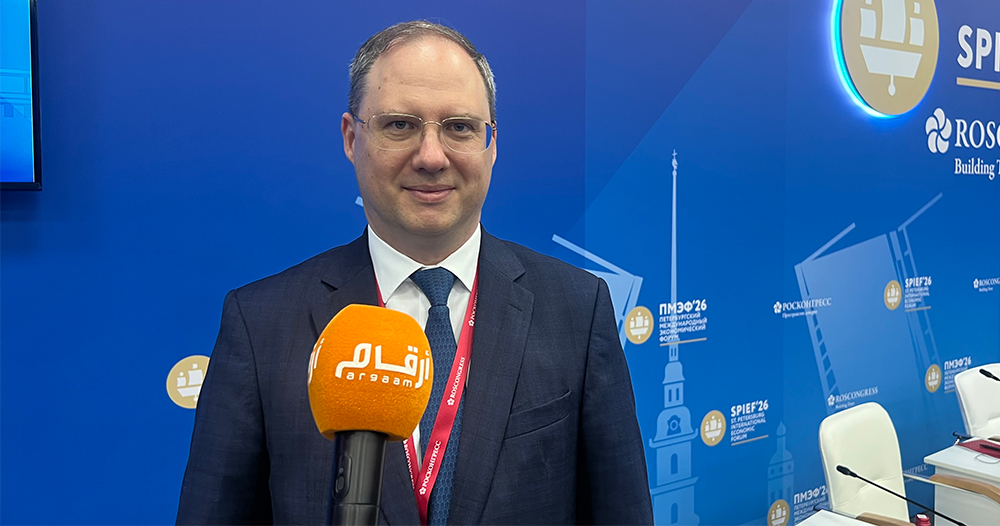
Russian Deputy Minister of Industry and Trade Alexey Grozdev said bilateral trade between Saudi Arabia and Russia has surpassed $4 billion. Speaking at the St. Petersburg International Economic Forum, Grozdev described the figure as reflecting rapidly expanding economic relations, with untapped potential well above current levels.
The trade number itself is modest relative to Saudi Arabia's total external trade. The direction matters more. Grozdev explicitly linked the cooperation to an alignment of Saudi Vision 2030 and Russia's industrial strategy, a statement that gives investors a sector-level roadmap for where both governments see strategic overlap.
Chemicals, Mining, and Energy Equipment as the Near-Term Read-Through
Grozdev named transportation technologies, unmanned aerial vehicles, chemicals, mining, construction materials, and energy equipment as priority sectors. These are not aspirational categories. They map directly onto existing Saudi industrial champions and supply chains.
Chemicals and mining are the most direct read-through. Saudi Arabia's petrochemical and mining sectors are dominated by state-linked players that already operate in global markets. A joint project or technology transfer with Russian counterparts would give those companies an additional channel for expansion, bypassing traditional European supply chains.
Unmanned aerial vehicles and energy equipment are newer areas where Saudi Arabia has been actively building domestic capacity. A Russian partnership in drones would mark a shift from the Kingdom's historical reliance on Western and Chinese suppliers. For energy equipment, the overlap with Russian expertise in oil and gas infrastructure is obvious.
Healthcare Cooperation – Longer Tail, Higher Barrier
Grozdev said Russia has invested heavily over the past two decades to reduce dependence on major global pharmaceutical companies. He outlined Saudi-Russian healthcare cooperation covering pharmaceuticals, medical equipment, joint research and development, and local production in the Kingdom.
This is the longest-tail opportunity among the named sectors. Russia's push to strengthen domestic pharma capabilities creates an opening for Saudi-based manufacturing of generics and medical devices. The read-through is for Saudi entities with existing production lines that could absorb Russian technology or co-invest in local facilities. The timeframe for such a partnership to become material is measured in years, not quarters.
What Confirms or Weakens the Strategic Setup
The $4 billion trade figure and the ministerial statements remain diplomatic framing until a signed memorandum of understanding or joint venture announcement appears in one of the named sectors. Without a project-level commitment, the read-through is thematic rather than tradable.
A weakening signal would be a public disagreement within OPEC+ on production quotas. Oil policy coordination is the foundation of the Saudi-Russia economic relationship. Any strain there would slow the industrial cooperation agenda, regardless of ministerial enthusiasm.
For now, the read-through is sector-level. Investors tracking Saudi industrial policy should watch for project announcements in chemicals, mining, and healthcare over the next two quarters. The absence of such announcements would confirm that the $4 billion trade figure is a baseline, not a breakout.