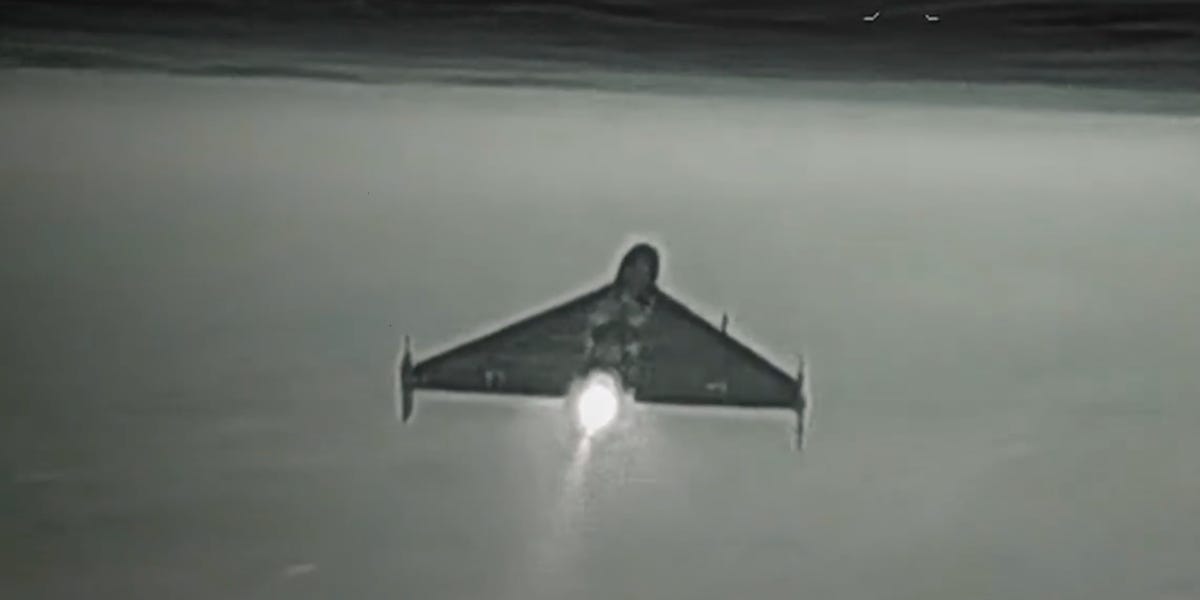
Jet-powered drones now account for up to two-thirds of some Russian attacks on Ukraine, forcing Kyiv to accelerate development of faster interceptors as Western aid slows.
Russia is packing more of its drone strikes with jet-powered models, forcing Ukraine's air defenders to chase faster, harder-to-intercept threats. Col. Yurii Ihnat, the spokesperson for the Ukrainian Air Force, told Business Insider on Thursday that jet-powered drones now account for as much as two-thirds of all drones used in some Russian attacks. That estimate is the highest publicly disclosed share yet.
Earlier this year, the figure stood at about 20%. In June, Gen. Oleksandr Syrskyi, then Ukraine's commander in chief, warned that Russia planned to push the proportion to 50%. “This presents us with new challenges that require a timely response,” he said at the time.
Russia has long relied on the Geran-2, a propeller-driven copy of the Iranian Shahed-136 that cruises at roughly 115 mph. Newer variants use mini turbojet engines. The Geran-3 can fly over 200 mph. The Geran-4 reaches 310 mph. The Geran-5, the newest model, can hit 375 mph and lacks the delta-wing shape of its predecessors, more closely resembling a cruise missile. All carry explosive payloads for hundreds of miles.
Yehor Cherniev, deputy chairman of the Ukrainian parliament's national security committee, said Ukraine has intercepted more than 90% of Russian cruise missiles and Geran-2 drones. Russia's response, he said, has been to lean harder on jet-powered drones and ballistic missiles – far more challenging threats.
Ukrainian President Volodymyr Zelenskyy said Thursday that a Russian jet-powered drone struck a passenger train in the Odesa region, killing at least two people.
The shift in Russian tactics comes as Ukraine grapples with worsening ballistic missile attacks and depleted stockpiles of Western-made interceptors. Ukraine's GUR military intelligence agency said in May that Russia was ramping up jet-drone employment in response to the effectiveness of Ukrainian interceptor drones, while also improving the drones' maneuverability.
Ukrainian defense companies are racing to adapt. Skyfall, a Ukrainian firm, told Business Insider that its new P1-Sun JetKiller interceptor had downed more than a dozen jet-powered threats by late July. The company said it planned to begin mass production this month, with other developers pursuing similar timelines. Beyond interceptors, Ukrainian forces rely on mobile air defense units, electronic warfare systems, fighter jets, and missiles to engage the drones.
Russia has also expanded infrastructure at its air bases to support jet-powered drone launches, which require long rails to accelerate to flight speed before the engine takes over.
The risk for Ukraine is that the faster drones overwhelm its existing defenses, especially as Western interceptor supplies thin. The counter-risk for Russia is that Ukrainian industry delivers a new generation of interceptors that close the speed gap. Skyfall's timeline suggests that race is already underway.
Drafted by a large language model from the source reporting linked above, then screened by automated publishing checks. It is not read by a journalist before publication. Some articles cite our Alpha Score. Verify prices and figures against the original source. Educational coverage, not personalized advice.