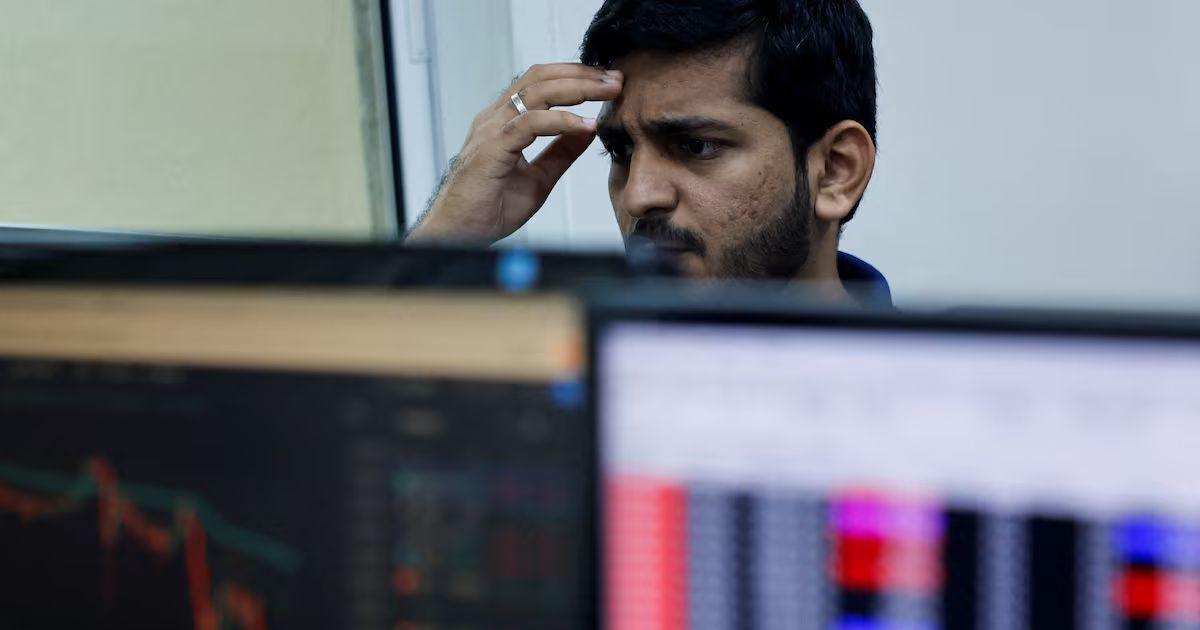
The Indian equity landscape is currently recalibrating as the confluence of a record-weak rupee and escalating geopolitical friction in the Strait of Hormuz forces a retreat from recent post-election optimism. On Tuesday, the benchmark BSE Sensex shed 251.61 points, or 0.33 percent, to close at 77,017.79, while the NSE Nifty fell 86.50 points, or 0.36 percent, to 24,032.80. This pullback reflects a broader shift in risk appetite as the market pivots from domestic political narratives to the external pressures of energy costs and currency depreciation.
The Transmission of Energy and Currency Risk
The primary mechanism driving this volatility is the direct correlation between Brent crude prices and the Indian rupee. With Brent crude trading near USD 113 per barrel, the import bill for India swells, placing structural downward pressure on the currency. The rupee’s slide to a record low of 95.25 against the US dollar is not merely a headline figure; it acts as a tax on corporate margins and a deterrent for foreign capital inflows that are sensitive to currency-adjusted returns. When the rupee weakens, the cost of servicing dollar-denominated debt and importing raw materials rises, which disproportionately impacts sectors like financial services and manufacturing.
ICICI Bank, which currently holds an Alpha Score of 57/100, was among the notable laggards in the recent session. Investors should monitor the IBN stock page to assess how the bank manages net interest margins in an environment where currency volatility and elevated oil prices could force a more hawkish stance from the Reserve Bank of India. The financial sector often serves as a proxy for broader economic health, and the current selling pressure suggests that institutional participants are hedging against potential margin compression.
Sectoral Divergence and Institutional Positioning
While the headline indices struggled, the market displayed significant internal dispersion. The laggards included heavyweights like Tech Mahindra, Axis Bank, Bharti Airtel, and Larsen & Toubro, signaling that capital is rotating out of sectors sensitive to global growth and interest rate fluctuations. Conversely, Mahindra & Mahindra, UltraTech Cement, and the Bajaj twins (Bajaj Finserv and Bajaj Finance) managed to buck the trend, suggesting that selective bottom-fishing is occurring in names with strong domestic demand profiles.
This behavior highlights a market that is no longer moving in lockstep with the post-election narrative. Instead, the focus has shifted toward earnings quality and the ability of firms to pass on input costs. As noted by Vinod Nair of Geojit Investments Limited, the ongoing earnings season has provided a floor for the indices, with results coming in slightly ahead of expectations. However, this support is currently insufficient to overcome the geopolitical risk premium associated with the Strait of Hormuz.
Macro Transmission and Future Catalysts
For traders, the current setup requires a distinction between short-term noise and structural shifts. The geopolitical risk in the Strait of Hormuz is a binary event risk; any de-escalation could lead to a rapid reversal in crude prices, which would immediately alleviate pressure on the rupee and provide a tailwind for the Nifty 50. Conversely, if the tension persists, the market will likely continue to favor defensive positioning over high-beta growth stocks.
Foreign Institutional Investors (FIIs) remain a critical variable. Despite the volatility, FIIs were net buyers of Rs 2,835.62 crore on Monday. This suggests that while local sentiment is cautious, there is still appetite for Indian equities at lower levels. The next concrete marker for the market will be the trajectory of the rupee against the 95.25 level. A sustained breach of this support could trigger further institutional outflows, whereas a stabilization would likely confirm that the market has priced in the current geopolitical risk premium. For deeper insights into these shifts, refer to our market analysis and ongoing stock market analysis to track how these variables evolve in the coming sessions.