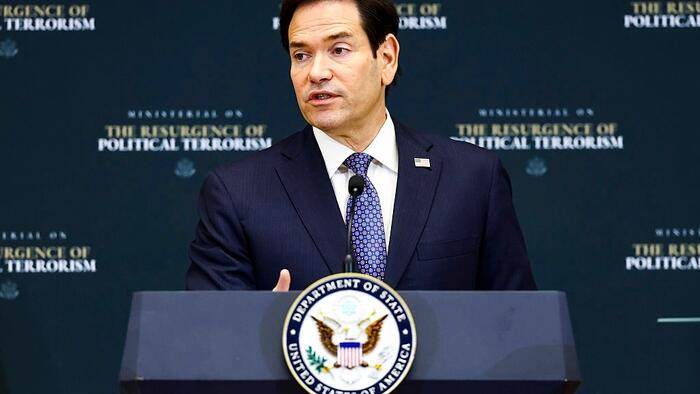
Secretary of State Marco Rubio on Tuesday slapped financial and visa sanctions on International Criminal Court President Tomoko Akane and Senior Trial Lawyer Abdoulaye Seye, intensifying the Trump administration's push against the Hague-based tribunal.
"These individuals have directly engaged in efforts by the ICC to investigate, arrest, detain, or prosecute officials whose government has not consented to ICC jurisdiction," Rubio said in a statement.
The United States has never ratified the Rome Statute that created the court in 2002. More than 120 countries have signed on. Washington argues the ICC has no authority over U.S. citizens or nationals of other nations that have not consented to the treaty.
Rubio said the sanctions were issued under an executive order President Donald Trump signed last year. That order authorized broad financial restrictions and visa bans against ICC personnel involved in investigating or prosecuting U.S. or allied personnel.
"Our whole of government campaign to dismantle the threat posed by the ICC to national sovereignty will be sweeping," Rubio added. "We expect more countries to join our campaign by ending their funding and participation in this politicized and unaccountable court."
The sanctions follow the ICC's 2024 decision to issue arrest warrants for Israeli Prime Minister Benjamin Netanyahu and former Defense Minister Yoav Gallant. The court alleged the Israeli government carried out improper actions during its war in Gaza. Israel is not a member of the ICC. The court has argued the Rome Statute gives it jurisdiction over war crimes committed on the territory of member states by nationals of non-member states.
Three sitting ICC judges sued Trump and the administration in January over the earlier sanctions, calling the measures unlawful. Earlier this month, multiple human rights groups led by Human Rights Watch filed a separate suit describing the sanctions as unconstitutional.
"The plaintiffs are seeking an end to this sanctions regime, which transgresses the president's authority and violates international and U.S. law, including the rights to freedom of expression and religion," said lead counsel Andrew Loewenstein in a statement carried by Human Rights Watch.
Rubio said in July the administration would seek to dismantle the ICC through visa revocations, financial sanctions, targeting of individuals, and diplomatic pressure on countries to withdraw from the body. The State Department did not say Tuesday whether additional individuals or entities would be added to the sanctions list.
"The American people never agreed to any of this, and they never will," Rubio said last month. He invoked the Declaration of Independence, arguing the ICC's asserted jurisdiction resembles a foreign power trying U.S. citizens overseas.
The ICC did not respond to a request for comment.