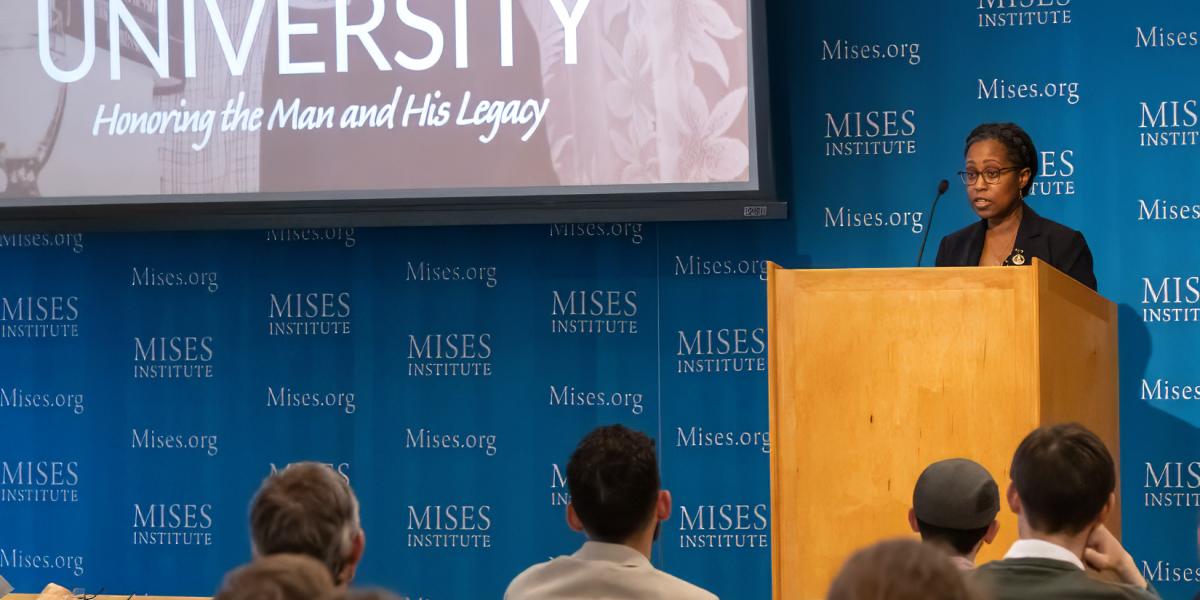
Dr. Wanjiru Njoya argues that Rothbard's political philosophy is the essential second pillar of his economics, and that correcting Piketty's spreadsheets isn't enough without making the moral case for liberty on philosophical grounds.
Dr. Wanjiru Njoya, speaking at the Mises Institute in Auburn, Alabama, delivered a direct challenge to the separation of economic analysis from its moral foundations. The talk, recorded on May 14, 2026, argued that Murray N. Rothbard's political philosophy is not a peripheral add-on to his economic work. It is the essential second pillar of an integrated system, and that system is precisely what is needed to confront the egalitarian premise at its root.
The simple read is that Rothbard's libertarian ethics and his economics are often treated as separate domains. One can admire his contributions to Austrian business cycle theory while dismissing his normative claims about the state. Dr. Njoya rejects that compartmentalization. The better market read recognizes that economic models always embed a moral framework, whether acknowledged or not. When policy debates center on correcting Piketty's spreadsheets with better data, they accept the egalitarian framing that inequality is the problem to be solved. Rothbard's system, by contrast, makes the moral case for liberty explicit and on philosophical grounds. That shifts the entire terrain of debate from technical adjustments to first principles.
Dr. Njoya's guidance is that the moral case for liberty cannot be outsourced to econometric rebuttals. The egalitarian premise survives empirical challenges because it is rooted in a prior ethical commitment. An integrated Rothbardian approach forces that commitment into the open. For investors and analysts, this has a practical implication: policy regimes that rest on egalitarian assumptions will continue to generate interventions regardless of their measured efficiency. The moral case for liberty is not a luxury; it is a prerequisite for a stable private property order. Without it, every spreadsheet victory is temporary.
The talk's structure itself demonstrates the integration. Rothbard's economics provides the positive analysis of how intervention fails. His political philosophy provides the normative standard by which failure is judged. Separating them leaves economics as a value-free toolkit that can serve any master. Dr. Njoya's presentation insists that value-free economics is a myth. The very choice of what to measure and how to model reflects a prior ethical stance. The Mises Institute's mission, promoting the Austrian School tradition, rests on this inseparability.
The current intellectual climate supplies a steady stream of egalitarian policy proposals. Demand for liberty, in the Rothbardian sense, is constrained by the reluctance to make moral arguments. Dr. Njoya's talk diagnoses this as a self-imposed handicap. When defenders of markets limit themselves to efficiency claims, they cede the moral high ground. The result is a policy equilibrium that drifts toward statism, even when technical arguments against it are sound. Rebalancing that equilibrium requires a deliberate shift in intellectual supply, exactly the shift the Mises Institute advocates.
A market that prices assets on the assumption of a stable property rights regime is implicitly valuing a moral framework it rarely examines. Dr. Njoya's argument suggests that this is a mispricing of risk. If the philosophical defense of property is thin, the legal and regulatory foundations can erode without a corresponding repricing until it is too late. The integrated Rothbardian system offers a way to assess that risk explicitly. It treats the moral case for liberty not as a separate discipline but as a core component of any durable economic order.
For those tracking the intersection of ideas and markets, the next decision point is whether this integrated approach gains traction beyond academic circles. The Mises Institute's non-partisan, non-PC stance positions it as a persistent source of that integration. If Dr. Njoya's call to make the moral case explicitly is taken up, the intellectual climate could shift in ways that revalue assets tied to the current egalitarian policy trajectory. The talk is a reminder that the most consequential market analysis sometimes begins with philosophy.
Prepared with AlphaScala research tooling and grounded in primary market data: live prices, fundamentals, SEC filings, hedge-fund holdings, and insider activity. Each story is checked against AlphaScala publishing rules before release. Educational coverage, not personalized advice.