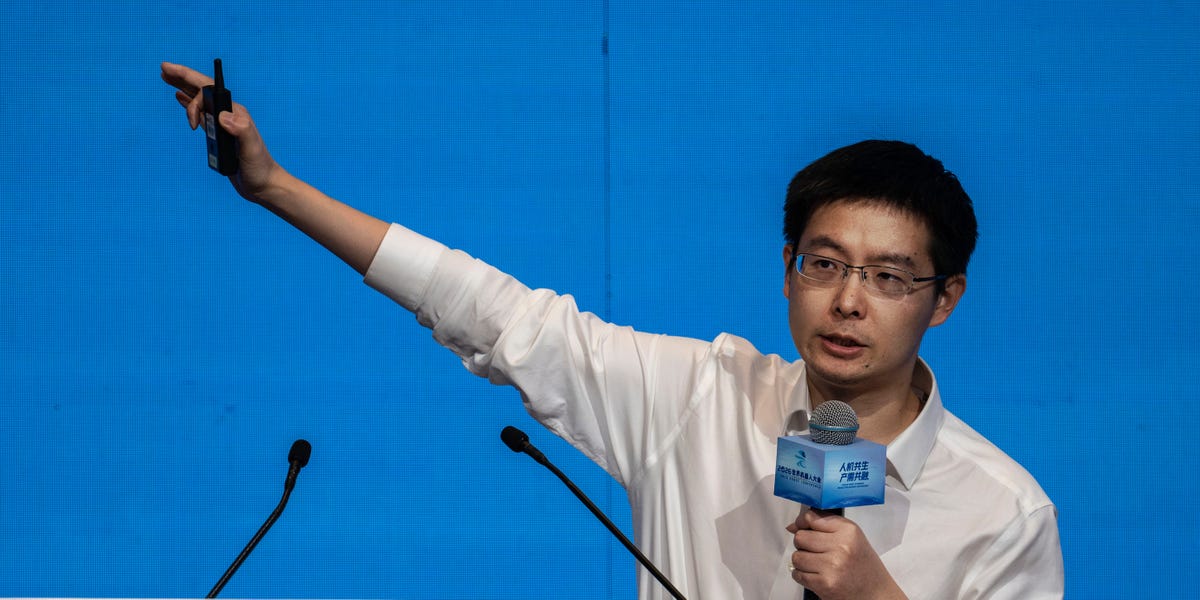
Unitree Robotics CEO Wang Xingxing told the 2026 World Robot Conference in Beijing on Thursday that the industry's "ChatGPT moment" could arrive in two to three years, or take five to 10 years if progress stalls. His definition of that milestone is exacting: a robot must finish about 80% of tasks in a home it has never seen, using only voice or language commands.
"If one day a robot is brought into a completely unfamiliar environment, such as a home it has never seen before, and it can complete about 80% of the tasks just through voice or language commands, then I think we will have roughly reached the 'ChatGPT moment' for embodied intelligence," Wang said.
Wang said the biggest hurdle for household robots is getting AI to interact reliably with the physical world. Generalization, the ability to handle situations a system has not been trained on, is the skill his 80% test measures. Unitree has tested robots in automotive factories and its own facilities; efficiency and the ability to generalize across tasks remain a major bottleneck, he said. Wang's own account places industrial deployments first, households later.
Unitree was founded in 2016 and first became known for four-legged robot dogs before expanding into humanoids. Its humanoids turned the company into one of the most recognizable names in the global robotics boom and drew attention to China's competitive advantage in the physical AI race.
The keynote came days after Unitree's Shanghai public debut, which raised about $900 million and was heavily oversubscribed. Shares surged 460% on the first day of trading, valuing the company at roughly $50 billion.
Wang's outlook ran more conservative than those of several prominent figures in the sector. Venture capitalist Vinod Khosla said last year that robotics would have its ChatGPT moment within two to three years, close to the fast end of Wang's range. "Almost everybody in the 2030s will have a humanoid robot at home," Khosla said. He described the earliest machines as "something narrow like do your cooking for you," a robot confined to the kitchen. Wang's slow case, five to 10 years out, lands inside Khosla's 2030s.
Khosla has also been more aggressive on price. He estimated that a home humanoid would cost $300 to $400 a month, a price he said was affordable for anyone who already gets house help. Three years of payments at the high end of that range come to $14,400, above the price of Unitree's G1 humanoid, which sells for $13,500 and is considered one of the most affordable humanoids on the market.
Nvidia CEO Jensen Huang gave the opposite answer last month at YC Startup School. "I would say the ChatGPT moment of robots happened a couple of years ago already," Huang said. Taken at face value, that puts the breakthrough around 2024, four or five years ahead of Wang's earliest estimate. Nvidia shares traded at $216.85, down 0.33%, with a Moderate Alpha Score of 74 (NVDA stock page). Huang has estimated physical AI as a $50 trillion market opportunity; humanoid robots alone account for $40 trillion of that.