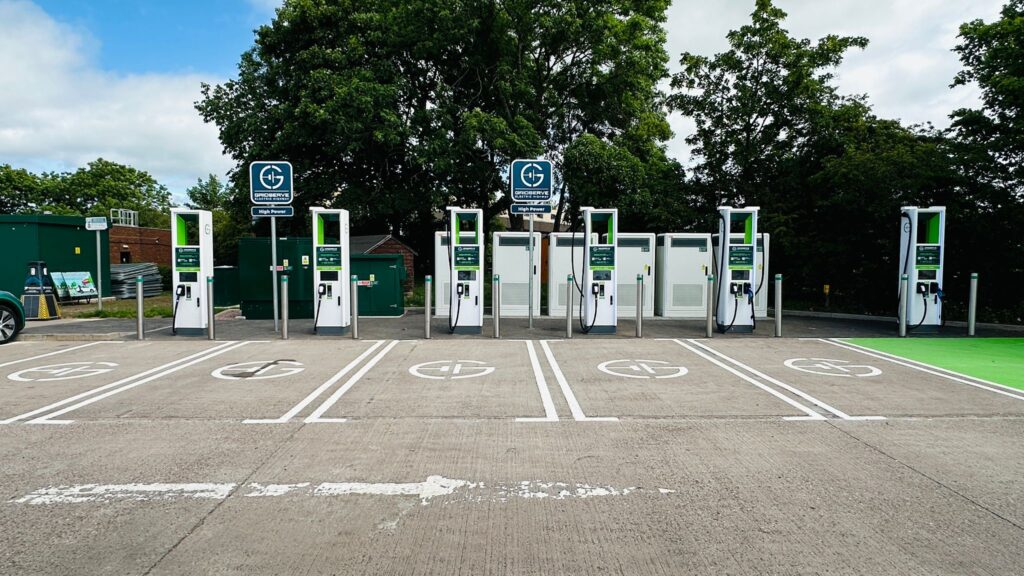
Roadchef added six new EV charging bays at Sandbach North services on the M6, expanding capacity on a key UK corridor. The expansion signals the pace of charging infrastructure investment.
Roadchef added six new electric vehicle charging bays to its Sandbach North services on the M6, a move that expands capacity on one of the UK's most heavily traveled motorway corridors. The additional bays increase the site's ability to handle simultaneous EV charging, a direct response to rising demand for public charging infrastructure.
Roadchef operates a network of motorway service areas across the UK. The Sandbach North site sits between Junctions 16 and 17 on the M6, a stretch that connects the Midlands to the Northwest. Adding capacity there reduces the likelihood of queues forming at peak travel times, a friction point that discourages long-distance EV adoption.
The M6 is the UK's longest motorway, linking London to the Scottish border. Traffic volumes are high year-round, with summer and holiday spikes creating concentrated demand for charging infrastructure. Service areas on this route are natural pinch points. A driver starting a trip from the Midlands to Scotland has limited options for rapid charging. Each new bay at Sandbach North shortens the gap.
Roadchef did not disclose the power output of the new bays or the partner network operator. The source only confirms the count. For context, six bays represent a materially incremental addition at a single site. The effect compounds when repeated across multiple Roadchef locations and rival operators.
The link between charging bay count and EV adoption runs through wait times. A facility with two bays and a queue of four cars creates a 30-minute delay for the last car. Adding six bays drops that delay to near zero at the same traffic level. Lower wait times improve the consumer experience and reduce range anxiety along the route.
Service area operators like Roadchef are also subject to the UK government’s mandate that all motorway services provide at least six rapid chargers by the end of 2023. That target has pushed operators to accelerate installation schedules. The Sandbach North expansion aligns with that regulatory pull.
Roadchef’s addition is a small data point in the broader EV charging infrastructure build-out. It shows that physical capacity continues to expand even as attention focuses on charger reliability and grid connections. Investors tracking the space should treat this as validation that the rollout is proceeding at the service-area level, not just at destination chargers or kerbside units.
The decision point for Roadchef comes next when it announces expansions at other sites or upgrades existing bays to higher power levels. Competitors will likely follow with their own additions on the same corridor, compressing the timeframe for charging bottlenecks to ease.
The Sandbach North addition is not a transformational event by itself. It is, however, a concrete signal that Roadchef is investing to keep pace with demand on a core route. The next catalyst will be an expansion at a neighboring Roadchef site – or a similar announcement from a rival service operator on the M6. Until then, this is a quiet vote of confidence in the UK’s charging network trajectory.
Prepared with AlphaScala research tooling and grounded in primary market data: live prices, fundamentals, SEC filings, hedge-fund holdings, and insider activity. Each story is checked against AlphaScala publishing rules before release. Educational coverage, not personalized advice.