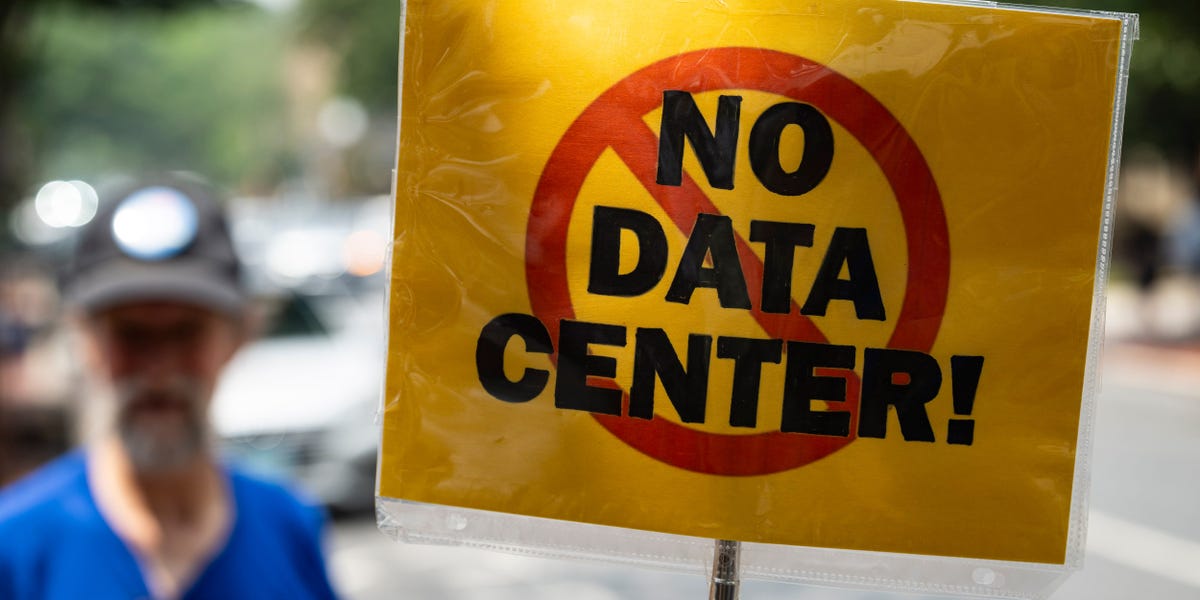
Utah Senate President J. Stuart Adams lost his June primary after approving a data center backed by "Shark Tank" investor Kevin O'Leary. Lee Perry, a former Box Elder County commissioner, said the same project cost him his election. "Do I think that the data center vote cost me the election? Yes, I do," Perry told The Salt Lake Tribune.
That pattern is spreading. A Gallup survey this year found 70% of Americans oppose AI data centers in their local area, including 48% who are strongly opposed. Democrats account for most of the resistance, according to the poll. Republicans are close behind.
The numbers create a dilemma for GOP governors and lawmakers. They answer both to Trump, who has made winning the AI race a central priority, and to constituents who complain about strained power grids, water use, noise, and rising utility bills.
The White House accelerated federal permitting and backed the $500 billion Stargate Project, an OpenAI initiative to expand AI infrastructure. The administration's 28-page AI action plan, published in July, says: "Simply put, we need to 'Build, Baby, Build!'"
In July, Americans attended a nationwide protest against AI data centers organized by Humans First, a conservative nonprofit led by Amy Kremer, a MAGA activist who helped organize the "Stop the Steal" rallies. "This technology has been built on American data with American taxpayer dollars invested into these companies with American energy and American land," Kremer told Business Insider. "We have no voice in how the technology is used or how it impacts our lives, and that's not right."
Republican governors are now breaking with the administration. In Texas, Gov. Greg Abbott initially went all in. In November 2025, he announced a $40 billion investment from Google. Meta, Microsoft, OpenAI, Amazon, and SpaceX are all building massive AI data centers in the state. Then residents in Abilene, Texarkana, and Lubbock protested. San Marcos became the first Texas city to enact a data center ban in June. Henderson County officials axed a planned project after local pushback.
Abbott changed course. He directed the local utility commission and the state's electrical grid operator to shield residents from data center infrastructure costs. He called for a ban on data centers in rural Texas communities and said all projects must undergo an audit before moving forward. "Governor Abbott's top priority is to protect Texans' safety and quality of life and ensure the integrity of our power grid and water supply," a spokesperson told Business Insider.
Trump called the freeze a "mistake" last week.
Other governors are following suit. In April, Pennsylvania Republican Sen. Jarrett Coleman and State Rep. Jamie Walsh proposed bills to repeal a state tax break for data centers and impose a moratorium on applications. Florida Gov. Ron DeSantis signed a bill in May that gives local governments the authority to approve or reject data center proposals. Nebraska Gov. Jim Pillen signed an executive order ending data center tax breaks and called for a pause on new construction.
Vivek Ramaswamy, the Republican nominee for governor of Ohio, pledged Thursday to implement an "Ohioans-first" policy. He said residents would not pay for electricity at home if a data center is built in their community. They would pay lower property taxes, and the data center would have to meet environmental requirements. "I will further issue an executive order on my first day in office to immediately halt the approval of any new data center project announcements in Ohio, until the above-mentioned data center legislation takes effect."
Even Trump made a small concession. Last month, his administration expanded the Ratepayer Protection Pledge, which aims to keep electricity bills low. "The United States never settles for second, and we don't under this administration," Trump said in a press release. "We live by the motto 'America First.'"
For stock market analysis, see AlphaScala's coverage of the sector.
Microsoft (MSFT), with an Alpha Score of 72/100 (Moderate), is one of the Big Tech builders facing the regulatory crosswinds.