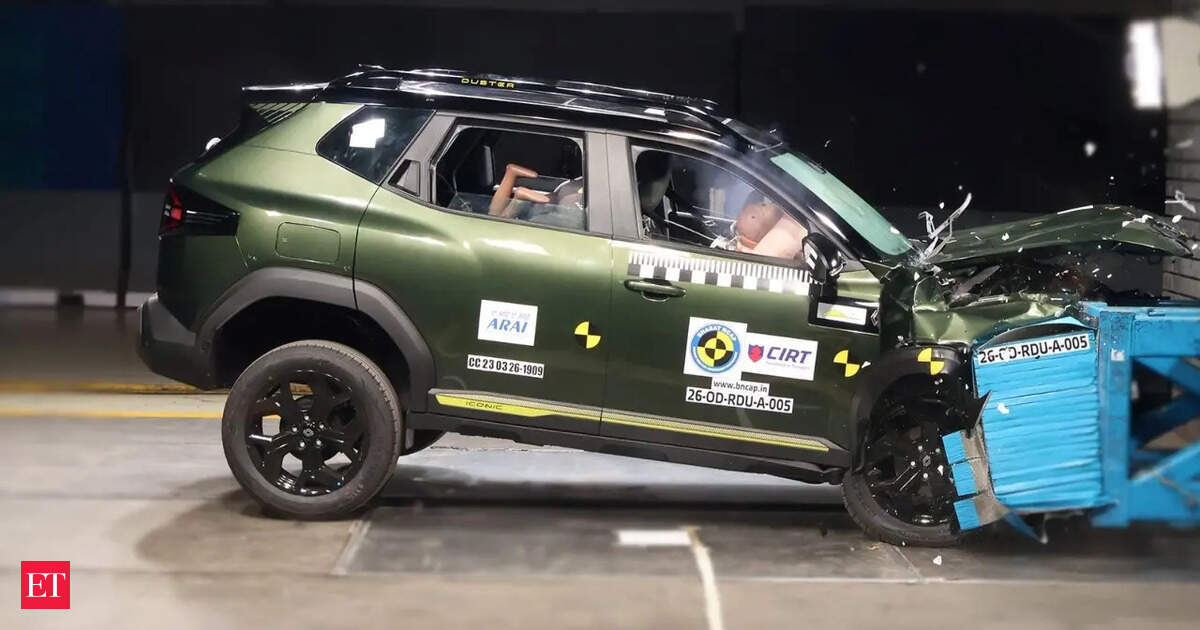
Renault Duster Safety Rating Shifts Competitive Landscape in SUV Segment

The Renault Duster's new 5-star BNCAP safety rating elevates its competitive standing in the SUV segment by validating its structural integrity and advanced driver assistance systems.
Alpha Score of 45 reflects weak overall profile with strong momentum, poor value, poor quality, weak sentiment.
Alpha Score of 47 reflects weak overall profile with moderate momentum, poor value, moderate quality. Based on 3 of 4 signals — score is capped at 90 until remaining data ingests.
Alpha Score of 55 reflects moderate overall profile with moderate momentum, moderate value, moderate quality. Based on 3 of 4 signals — score is capped at 90 until remaining data ingests.
Alpha Score of 57 reflects moderate overall profile with moderate momentum, moderate value, moderate quality, moderate sentiment.
The Renault Duster has secured a 5-star safety rating from the Bharat New Car Assessment Program (BNCAP), marking a significant milestone for the model's market positioning. This rating, which covers multiple variants of the SUV, is based on high performance in both adult and child occupant protection assessments. The validation of the vehicle's structural integrity serves as a primary differentiator in a crowded segment where safety benchmarks are increasingly influencing consumer purchasing decisions.
Structural Integrity and Advanced Safety Integration
The BNCAP certification highlights the effectiveness of the Duster's current structural design. Beyond the core chassis performance, the vehicle's safety profile is bolstered by the inclusion of advanced driver assistance systems (ADAS). These features, which include autonomous emergency braking and adaptive cruise control, represent a shift toward higher-tier safety technology in the mass-market SUV category. The presence of electronic stability control (ESC) across the rated variants further contributes to the overall score, signaling a move toward standardizing high-level safety equipment rather than reserving it for premium trims.
Impact on Segment Positioning
This 5-star rating provides Renault with a tangible narrative to counter competitors in the compact SUV space. By aligning with stringent safety standards, the Duster addresses a critical demand for crash-test transparency. The ability to market these results across a broad range of variants allows the manufacturer to maintain a consistent safety value proposition, potentially shielding the model from the pricing pressures often seen when safety features are gated behind higher-cost configurations.
For investors monitoring the automotive sector, this development serves as a proxy for how legacy manufacturers are adapting to evolving regulatory and consumer expectations regarding vehicle safety. While the broader stock market analysis often focuses on electrification and software integration, the fundamental performance of core vehicle platforms remains a primary driver of brand loyalty and market share retention.
AlphaScala data currently reflects a mixed outlook for several major players in the broader consumer and technology sectors, including AS stock page with an Alpha Score of 47/100, NOW stock page at 53/100, and A stock page at 55/100. These scores suggest that while individual product successes like the Duster's safety rating are positive, they must be weighed against broader macroeconomic headwinds and sector-specific valuation pressures.
The next concrete marker for this narrative will be the impact of these safety scores on quarterly sales volume and the potential for similar safety-focused marketing campaigns to be rolled out across the remainder of the manufacturer's regional portfolio. Monitoring whether this rating leads to a measurable shift in market share against competitors who have yet to achieve equivalent BNCAP certification will be essential for assessing the long-term commercial utility of this safety milestone.
AI-drafted from named sources and checked against AlphaScala publishing rules before release. Direct quotes must match source text, low-information tables are removed, and thinner or higher-risk stories can be held for manual review.