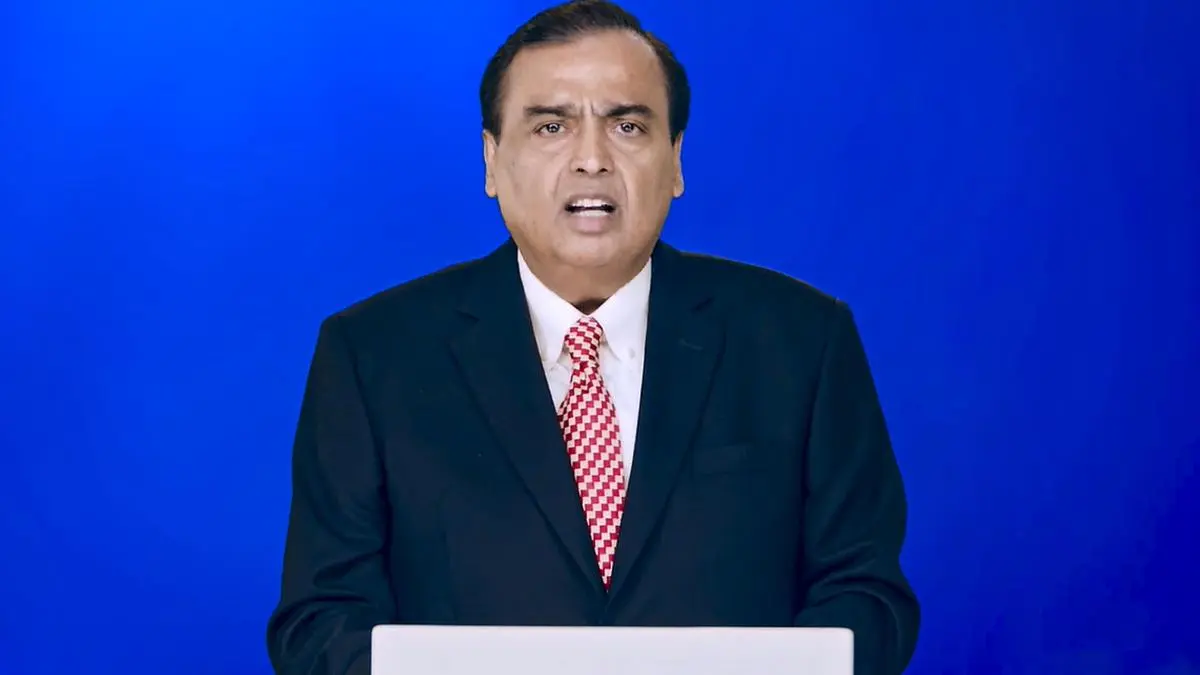
Reliance Industries used its 49th Annual General Meeting to lay out a target that would double its earnings again. Chairman Mukesh Ambani said the conglomerate aims to surpass ₹4 lakh crore in EBITDA by FY31, up from ₹2.08 lakh crore in FY26. The company already doubled earnings over the prior five years from ₹97,580 crore in FY21.
Going from ₹2.08 lakh crore to ₹4 lakh crore in five years works out to roughly a 15% compound annual growth rate. The earnings mix has shifted. Jio Platforms and the retail business now contribute about half of the group's total EBITDA, according to Ambani. That reduces reliance on the oil-to-chemicals cycle. The expansion requires sustained capital spending.
Reliance spent ₹6.48 lakh crore on capital projects over the past five years, including ₹1.44 lakh crore in FY26 alone. The next wave of investment targets several areas. Ambani outlined plans for several large-scale projects. They include one of the world's largest AI computing platforms and a green ammonia export business. A battery manufacturing plant with 120 GWh capacity was also announced. The company also announced an entry into satellite communications with a Low Earth Orbit constellation.
The single most market-moving announcement was the proposed listing of Jio Platforms. Ambani said Jio now has more than 524 million subscribers and a growing 5G and broadband footprint. Brokerage estimates peg the IPO size at roughly $4 billion, which would make it India's largest-ever public offering. A Jio listing would give the market a pure-play digital asset and put a valuation on a business that currently sits inside the conglomerate structure. That could narrow the holding-company discount that Reliance shares have historically carried. Ambani did not provide a timeline for the IPO.
Reliance Consumer Products is targeting ₹1 lakh crore in revenue by FY30. Investments in food parks and supply chains are meant to scale this segment. The FMCG push puts Reliance in direct competition with Hindustan Unilever and Nestle. The advantage lies in distribution reach and the Jio digital ecosystem for direct-to-consumer sales.
The clean energy and AI segments target global and domestic markets. The green ammonia and battery businesses face established competition from Chinese and Middle Eastern producers. The AI platform is positioned as domestic infrastructure. Monetisation will depend on enterprise and government adoption. Ambani did not address competitive dynamics for these segments during his speech.
Ambani's track record of delivering on large-scale projects is strong. The doubling of EBITDA from FY21 to FY26 shows the strategy worked in its first phase. The next phase faces different conditions. Global tech IPO sentiment is mixed. Policy support for green energy is uncertain. Hardware and talent constraints affect AI infrastructure. Ambani did not specify a timeline for the satellite broadband launch or the Jio listing beyond the announcement. The company's 5G network and subscriber base give Jio a strong foundation for an IPO, which brokerages estimate at about $4 billion.