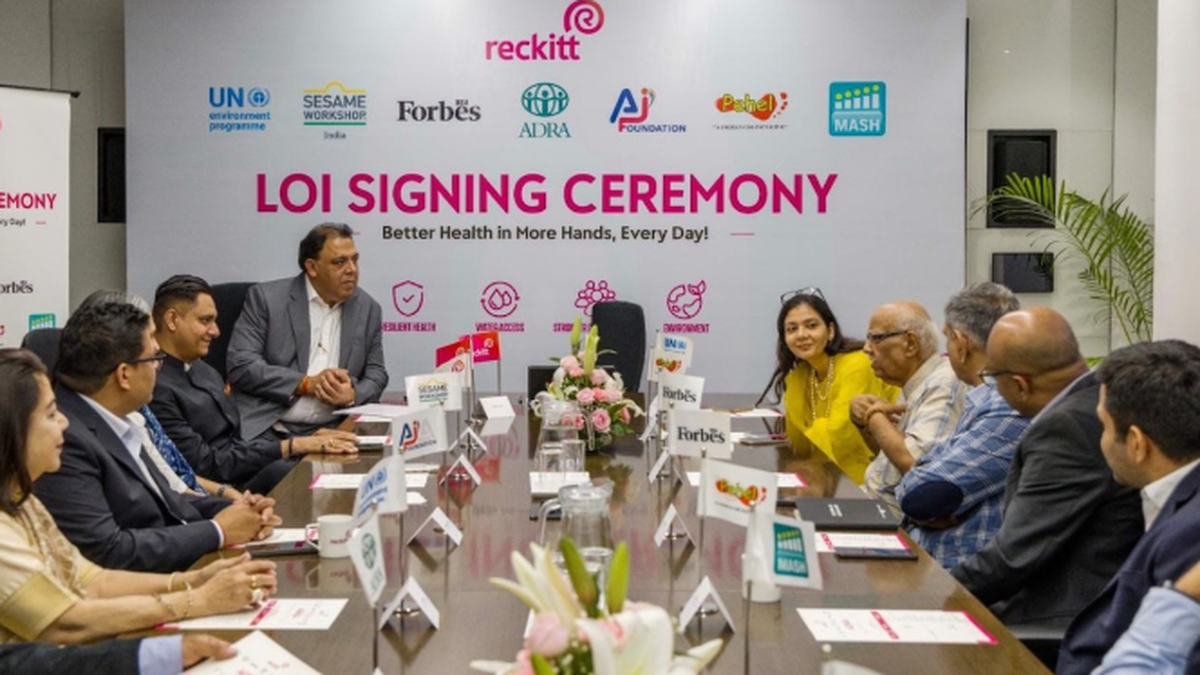
Reckitt signed letters of intent with seven organizations in India, covering health, hygiene, sanitation, adolescent wellbeing, and climate resilience. The three-year alliances running from 2026 to 2029 will scale the company's flagship social programs including Dettol Banega Swasth India and the Durex The Birds and Bees Talk curriculum.
The partners include United Nations Environment Programme India, Sesame Workshop India, Jagran Pehel, ADRA India, Amar Jyoti Foundation, MASH Project Foundation, and Forbes India (Network18). Each was selected to address a specific piece of the execution chain, from early-childhood education to digital delivery and media amplification.
Gaurav Jain, Reckitt's executive vice president for South Asia, said the company's goal is to translate purpose into action at the community level. "We envision an India where no child suffers from preventable diseases and every young person has the opportunity to lead a healthier life," he said.
Divya Datt, deputy head of UNEP India, said the partnership combines Reckitt's community reach with UNEP's environmental science expertise. "A healthy planet and healthy people are not two separate goals," she said.
For Reckitt, the alliances deepen its presence in India's preventive health and sanitation market, a sector that aligns with government priorities including the Swachh Bharat Mission, Jal Jeevan Mission, and the National Education Policy 2020. The company said the partnerships will expand its Dettol Banega Swasth India campaign and the Harpic World Toilet College, among other programs.
The structure includes a three-tier plastic curriculum targeting climate literacy for over 30 million children, along with AI-enabled hygiene education tools that reduce dependence on teacher-led instruction. Reckitt also plans to bring its adolescent wellbeing curriculum to 80% of schools in Delhi, Odisha, and six northeastern states.
Jagran Pehel will introduce gamification and an AI Hygiene Co-pilot, while MASH Project Foundation and Forbes India will run initiatives such as the Parity Project and a Consent Culture Survey to push the youth health narrative onto global platforms including Oxford and Davos, the company said.
Reckitt's social programs have historically been a branding and regulatory tool in emerging markets, where government partnerships can open distribution channels and build consumer trust. The scale of the announced collaborations suggests a strategic push to lock in long-term relationships ahead of India's demographic peak.
India's population of young people is expected to remain the world's largest for at least another decade, making it a critical market for consumer health companies. Reckitt's Dettol brand has a dominant position in antiseptics, but the company faces competition from local players in hygiene and sanitation.
By tying its programs to official government missions, Reckitt positions itself as a partner in national development rather than just a foreign consumer goods company. The three-year commitment also gives the company a consistent platform for brand visibility in schools and communities.
Reckitt's shares trade on the London Stock Exchange under the ticker RKT. The company does not break out India-specific revenue, but the South Asia region has been a growth driver in recent years. The partnerships are not expected to have a material near-term financial impact, but they reinforce the company's moat in a market where regulatory goodwill and distribution density matter more than product differentiation.
Jain's comment that the company aims to "leave no one behind" echoes the language of the UN Sustainable Development Goals, which many multinationals now use to frame their emerging-market operations. The extent to which the partnerships translate into measurable sales growth will depend on execution, particularly in states where infrastructure and literacy rates are low.
The pulse of the commercial case lies in the reach numbers: 30 million children for the climate curriculum, 80% school coverage in three large states for the adolescent health program. If those targets are met, Reckitt will have a captive audience for its products at a formative age.
Reckitt's next quarterly update is expected in July. The company did not provide a revenue target for the partnerships.