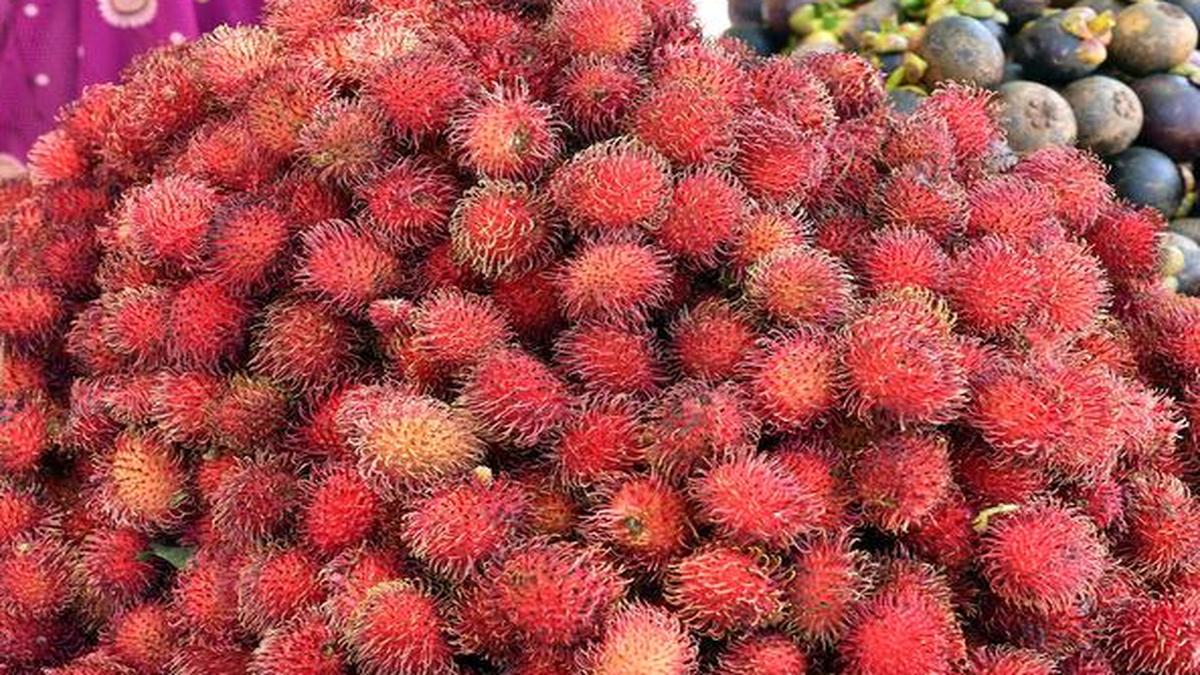
Rambutan now covers 25,000 acres in Kerala, yielding Rs 1,000 crore this season. Farmers in the rubber belt are switching to the fruit as prices and labour for rubber dwindle.
Every June, monsoon clouds gather over central Kerala. Patches of the state's rubber-growing landscape turn bright red. Thousands of rambutan trees burst into fruit, their hairy crimson shells hanging from branches that until a few years ago would have yielded latex.
For decades, rubber defined the economy of Kerala's midland districts. Falling prices, labour shortages and erratic weather pushed small farmers to look for another source of income. Many now believe rambutan is the answer.
The fruit, once found only in home gardens, has become one of Kerala's fastest-expanding commercial crops. The Rambutan Mangosteen Farmers' Organisation says the crop now covers nearly 25,000 acres across the state. This season's harvest produced around one lakh tonnes and generated an estimated Rs 1,000 crore in revenue.
The economics work on a single-tree scale. M C Saju, president of the organisation, said the crop starts yielding from the third year. "If a tree produces about 30 kg in the third year, it will produce about 50 kg in the fourth year and about 70 kg in the fifth year. As the years go by, the yield keeps increasing and can reach up to 300 kg per tree," he said.
At Rs 100 per kg, a 300 kg tree generates Rs 30,000 a year. "Whatever crop we cultivate on one hectare, the maximum earning capacity is usually around Rs 2.5 lakh to Rs 3 lakh. Rubber does not reach that level even if the price goes up to Rs 300," Saju said.
A farmer from Ernakulam district said the fruit had transformed his farm's finances. "This season I got Rs 14 lakh from one hectare of rambutan. My total expenditure was only about Rs 60,000. This is the fourth year since I started getting yield," he said.
Farmers said rambutan requires less labour than rubber. An acute shortage of tappers and fewer tapping days caused by changing weather have made rubber cultivation harder. Rambutan orchards, once established, demand far less attention.
The biggest challenge comes after the harvest. Rambutan is a non-climacteric fruit – it ripens only on the tree and has a short shelf life. Without refrigerated transport, cold storage and modern packing facilities, sending the fruit to distant markets is difficult.
Saju said the current market barely scratches the surface. "Right now, if you take the Kuttalam market, around five tonnes can be sold there in a single day. If you take the wholesale market, around 15 tonnes can be sold in a day. So, it has that kind of huge potential."
The fruit is sold mainly in Chennai and Bengaluru. Major markets further north remain largely untapped. "If we can expand it further to markets like Hyderabad and other North Indian markets, and also to the APMC market in Navi Mumbai and the markets in Delhi, it will create tremendous opportunities," Saju said.
He added that with the right refrigerated logistics, even if the whole of Kerala ramps up production, the Rs 100 per kg price could hold.
Farmers also see export opportunities, particularly in Gulf countries, where the Kerala harvest coincides with the peak summer season there. They say the industry's future depends on more than cultivation. They want the government to help build markets beyond south India, strengthen cold-chain logistics, promote value-added products, and counter misinformation that surfaces on social media during every harvest season – including posts linking rambutan with diseases.
To discuss these concerns, farmers, traders, startups and agricultural experts will meet at the Rambutan Conclave 2026 in Koothattukulam on August 8.
Drafted by a large language model from the source reporting linked above, then screened by automated publishing checks. It is not read by a journalist before publication. Some articles cite our Alpha Score. Verify prices and figures against the original source. Educational coverage, not personalized advice.