Punjab fiscal risk: DA parity pledge, ₹14,191 crore arrears challenge
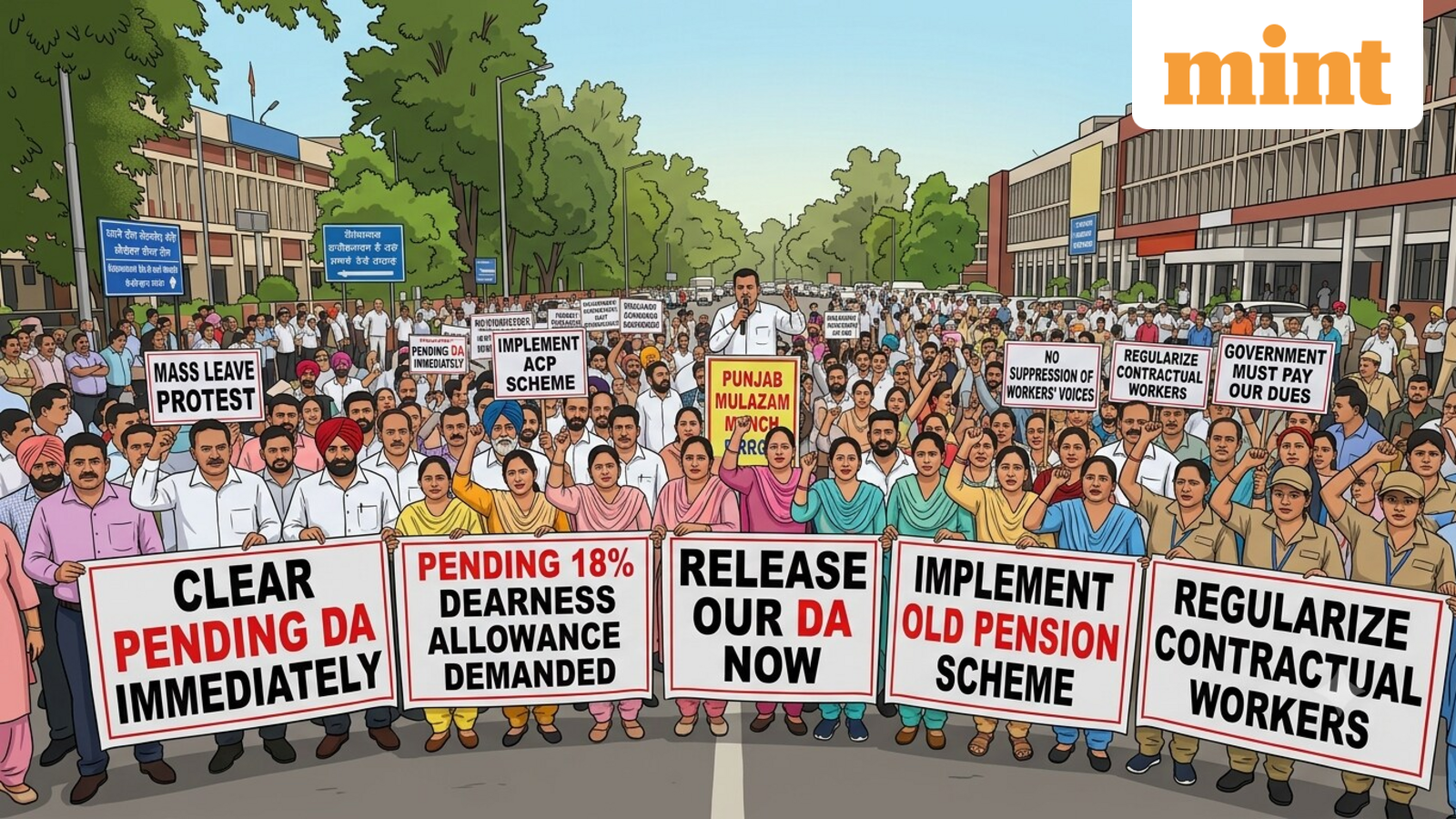
Punjab offers to match Centre's compensation as it fights ₹14,191 crore DA arrears order in Supreme Court. Employee unions demand withdrawal of disciplinary action before talks.
Alpha Score of 65 reflects moderate overall profile with strong momentum, moderate value, moderate quality. Based on 3 of 4 signals – score is capped at 90 until remaining data ingests.
Punjab Finance Minister Harpal Singh Cheema said Thursday the state government will match the Centre's overall compensation package for its employees, including dearness allowance, if workers seek parity, PTI reported. The offer came as the state fights a Punjab and Haryana High Court order to clear pending DA and dearness relief arrears within 15 days, a sum the state calculates at ₹14,191 crore.
Cheema, appearing with Industries Minister Aman Arora and Social Security Minister Baljit Kaur, said Punjab government workers already draw among the highest salaries in the country, and in several categories their take-home pay exceeds that of central government counterparts. The Aam Aadmi Party government, he said, raised employee DA from 28% to 42%.
The state this week moved the Supreme Court to set aside the High Court's August 3 order, arguing it is "constitutionally impossible" to pay the total arrears in such a short period. The state's plea contends that DA should be assessed on the basis of the total salary package, not mechanically matched to the Centre's percentage, and that Punjab's own pay rules leave the matter to the state government's discretion. The High Court also restrained the state from incurring unproductive expenditure, a direction the state says was not supported by evidence.
Arora asked employee unions to engage through dialogue rather than confrontation. "Employees are the backbone of good governance. We appeal to the unions to recognise the political opportunism of opposition parties, which made promises before elections without making corresponding financial provisions," he said. "We are ready to resolve outstanding issues across the table with Chief Minister Bhagwant Singh Mann so that the interests of employees are protected without placing an unbearable burden on the people of Punjab."
Sukchain Singh Khera, leader of the Punjab Sanjha Mulzam Morcha, said a meeting with the state government would be possible only if it withdraws disciplinary action against employees who remained absent on August 27. On that day, over three lakh state employees took mass leave to demand immediate clearance of pending DA and other issues, affecting public services. More than 150 employee organisations presented a united front, and over 3.50 lakh pensioners participated in the "maha hartal".
The employee demands include payment of pending 18% DA, implementation of the Old Pension Scheme, regularisation of contractual employees, minimum wages for mid-day meal workers, ASHA and Anganwadi workers, restoration of the ACP scheme, and extension of Punjab pay scales to employees recruited after July 17, 2020.
The Supreme Court challenge and the government's offer of parity create a two-track situation. If the court upholds the High Court order, the state faces a ₹14,191 crore payout in a short window, straining its fiscal position. If the court grants the state discretion, the government can phase the arrears but risks further confrontation with unions. The offer to match the Centre's package, if accepted, would set a new baseline for future DA payments, potentially increasing the recurring salary burden.
Punjab's own tax revenues have lagged, and the state has one of the highest debt-to-GSDP ratios among Indian states. A large, compelled payout could crowd out capital expenditure or force additional borrowing. The state's argument that DA should be based on total compensation rather than a fixed percentage reflects its effort to contain the fiscal impact while defusing the political risk of prolonged employee unrest.
Drafted by a large language model from the source reporting linked above, then screened by automated publishing checks. It is not read by a journalist before publication. Some articles cite our Alpha Score. Verify prices and figures against the original source. Educational coverage, not personalized advice.