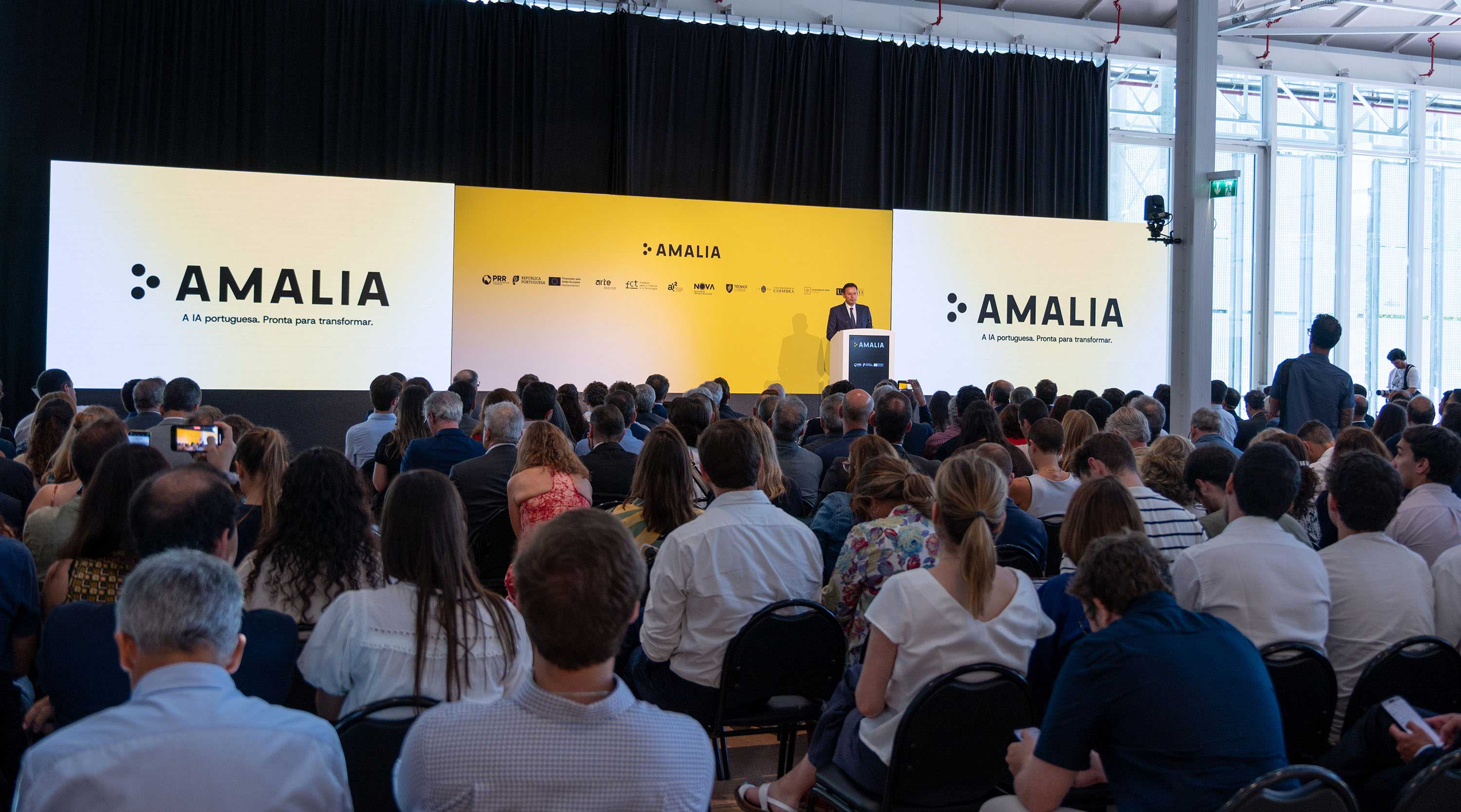
Portugal launched a large-language model named AMALIA on July 1, betting that a publicly funded, open-source AI can serve as shared infrastructure for the economy. The project was developed by a consortium coordinated by NOVA University Lisbon and financed with €5.5 million in public funds, with an additional €1.5 million committed through 2027, the consortium said.
The model is named after Amália Rodrigues, a celebrated Fado singer, and is designed to support Portuguese language and culture. AMALIA has 9 billion parameters, making it far smaller than the systems behind ChatGPT or Claude. The consortium said the model is not meant for direct public use. Instead it is a foundational technology that public institutions, universities, companies, and researchers can adapt for their own needs. The model is open-source and its training complies with EU data and privacy legislation.
The consortium framed the project as a response to a market failure. Portuguese is the fifth most spoken language in the world, with about 260 million speakers, yet it accounts for roughly 2 percent of the web data used to train large models, the consortium said. Private developers have little incentive to build an open model that captures the language and its culture faithfully, because the benefits spread across every school, firm, and public agency that uses it. Where private developers have tried, as in Brazil, the result is a closed commercial product, the consortium noted.
The project treats AI as a public good. A public good is one whose use by one party does not diminish its availability to others and from which no one can easily be excluded. An open-source foundation model meets those criteria, the consortium said. A hospital that fine-tunes AMALIA for clinical use takes nothing away from a university that uses it for education or a court that relies on it for legal proceedings. The open license means no gatekeeper can shut anyone out.
The approach contrasts with the dominant U.S. model, where the most capable AI systems are private goods: their inner workings are closed, access is sold on a subscription basis, and the terms can be revoked or repriced at will. The United States has no comprehensive federal legislation governing how these systems are trained or deployed, leaving governance to the firms themselves. Even open-weight models released by U.S. companies are instruments of corporate strategy, the consortium said.
The consortium argued that the U.S. model inverts the historical pattern for general-purpose technologies. The internet began as a Pentagon research project. GPS was built and is still operated by the U.S. government. The basic science behind modern computing flowed out of federally funded laboratories and universities. With AI, the foundational layer is privately owned, and the public sector lines up as a customer.
The public already carries the cost of the industry, the consortium said. Data centers receive tax abatements, subsidized land, and priority access to power and water, with grid upgrades financed partly by ordinary ratepayers. Those same households bear noise pollution, water scarcity, and higher electricity bills. The inputs of AI are socialized while the outputs remain proprietary, the consortium said.
The consortium acknowledged risks. The model could age while the frontier advances. Budget needs might not be met over time, especially in a challenging political environment. Users might have an incentive to use other models, depriving AMALIA of improvements they could otherwise make to it. The test of a foundational technology is whether anyone builds on the foundation. That is what deserves watching over the next two years, the consortium said.
For roughly €7 million, less than the cost of a highway interchange, Portugal has bought itself a public stake in a technology its economy will increasingly run on. Once upon a time, the United States understood this logic better than anyone. It has now chosen to rent from its own companies instead, and on their terms.