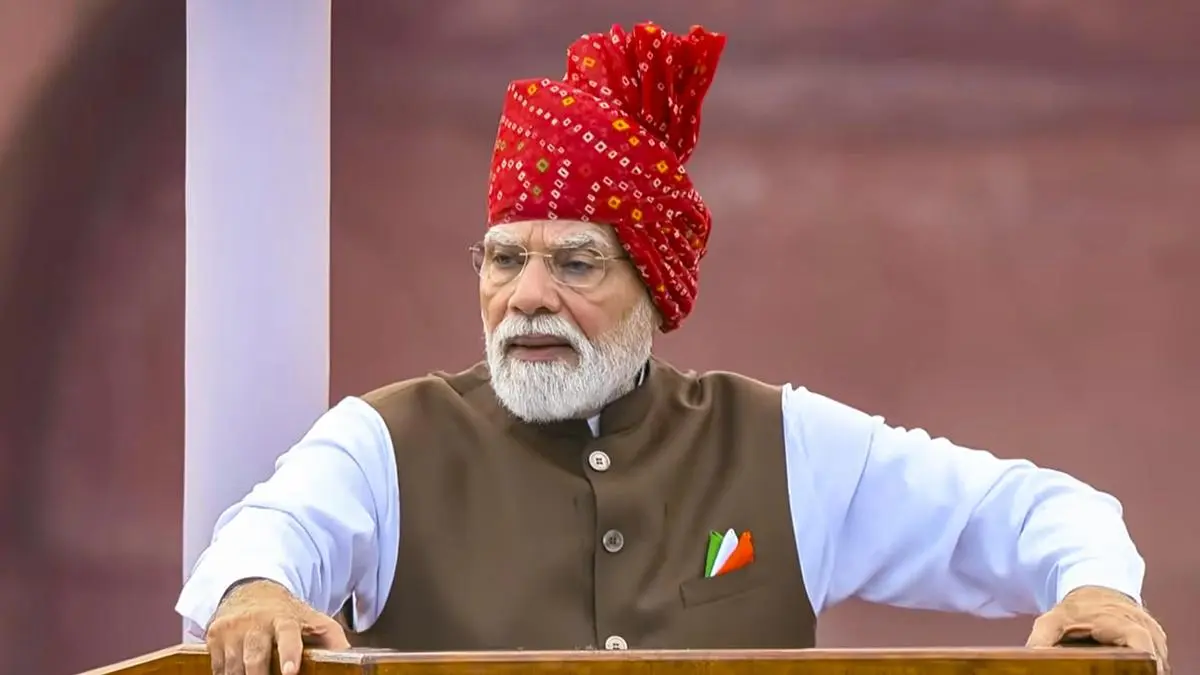
Prime Minister Narendra Modi used the 80th Independence Day address from the Red Fort to lay out 'Saptdharas', or seven streams of economic and strategic focus, that the government will push to turn India into a developed nation by 2047. The seven streams are manufacturing power, agriculture and food processing, technology and innovation, Gatishakti (infrastructure connectivity), defence power, green economy, and soft power.
The speech came with specific numerical targets that give investors a clearer sense of policy direction over the next decade. Modi said India aims to reach 100 gigawatts of nuclear power capacity and start five new nuclear reactors in this decade, enabled by the recently passed SHANTI Act. The goal is a major ramp-up from current capacity of about 8 GW. Companies involved in nuclear equipment, reactor construction, and uranium supply could see a sustained order pipeline. Larsen and Toubro, which has a joint venture with NPCIL for critical reactor components, is the most direct play. State-owned nuclear operator NPCIL remains the sole developer, but the amendment allows private firms to supply fuel and components, expanding the addressable market.
On infrastructure, Modi said India has achieved 100% railway electrification, up from just 30% electrification in nearly 90 years since 1925. That means the diesel locomotive segment is structurally shrinking, while electric locomotive suppliers and railway electrification contractors face a completed build-out. The focus shifts to rolling stock renewal and high-speed corridors. Indian Railways' capital expenditure trajectory will determine how much that pivot matters for companies like BHEL and Siemens India.
The PM cited a 21-fold increase in modern railway coach production and a 33-fold surge in mobile phone production since 2014. Electronics manufacturing has grown nearly sevenfold. Those numbers point to the production-linked incentive (PLI) schemes driving capacity additions. Contract manufacturers such as Dixon Technologies and Amber Enterprises are the direct beneficiaries, but the read-through extends to component suppliers and packaging firms that feed into the mobile and electronics supply chain.
Defence production has risen nearly fourfold in 12 years. Modi emphasised that sectors once seen as 'No-Go Areas' are now 'Go-Ahead Areas'. The government has eliminated thousands of compliance requirements and repealed hundreds of archaic laws. For defence primes like HAL, BEL, and BDL, the policy shift means faster procurement cycles and higher private-sector participation. The listing of key defence PSUs over the past few years also means public market investors have direct exposure to this growth.
From a sectoral lens, the Saptdharas framework points to sustained government spending in power, railways, defence, and electronics. Modi called for factories to be competitive on cost, quality, and scale. "One cannot march into the 21st century relying on laws from the last century," he said during his address. The regulatory easing matters for foreign portfolio investors assessing India's ease of doing business score. Gas connections have been provided at six times the previous annual speed, and housing for the underprivileged at three times the previous rate.
Energy security dominated the economic agenda. Modi said India has achieved 100% railway electrification, cutting dependence on imported diesel, and launched its first hydrogen-powered train. The green economy stream of Saptdharas includes hydrogen, nuclear, and renewable energy. Companies with exposure to solar manufacturing, battery storage, green hydrogen electrolysers, and nuclear componentry are on the watchlist. Reliance Industries' New Energy business and Tata Power's renewable push align with the stated goals.
The village industries output has grown nearly fivefold since 2014, while digital transactions have grown a hundredfold, and patent grants have increased fourfold. The digital infrastructure built through UPI, Aadhaar, and DigiLocker has enabled financial inclusion at scale, and that ecosystem now supports formal sector growth. For internet-age startups and fintech firms, the quadrupling of internet users means the addressable user base continues to expand even if urban penetration is high.
Modi also reiterated the call for a 33 per cent reservation for women in Parliament and Assemblies, though he framed it as an appeal to political parties rather than a legislative timeline. That has no direct near-term market impact but signals continued focus on gender-inclusive policy.
The Saptdharas provide a policy roadmap for the remaining years to 2047. For equity markets, the sectors named in the seven streams -- manufacturing, power, defence, green energy, railways, electronics, and technology -- are where government capex and regulatory tailwinds are likeliest to concentrate. The nuclear power target alone implies a multi-year ordering cycle for heavy electrical equipment. Investors tracking India's growth story now have a named framework to map against quarterly capex data and production numbers.
Modi did not provide a specific GDP target for 2047 in the speech, but the goal of becoming a developed nation implies per capita income levels comparable to current upper-middle-income countries. The government's earlier Viksit Bharat vision documents peg the target at a roughly $10 trillion economy. The Saptdharas are the sectoral articulation of how to get there.
The speech ended with a call for self-belief and pride in building an Aatmanirbhar Bharat. Markets will watch the budget cycle and execution momentum for the signals under each of the seven streams.