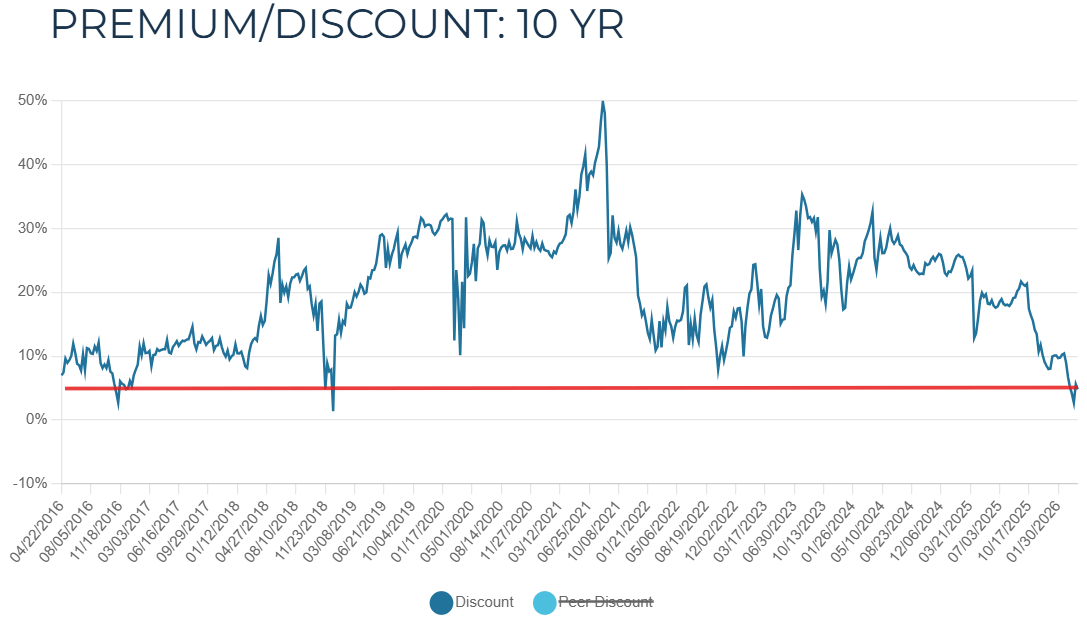
The PIMCO Corporate & Income Opportunity Fund (PTY) has experienced a sustained decline in market value as broader debt markets navigate persistent macroeconomic headwinds. This shift in pricing has brought the fund to a current yield of 11.7 percent while trading at a 4.83 percent premium to its net asset value. For investors, the primary narrative centers on whether the current distribution remains sustainable under existing leverage constraints and the prevailing interest rate environment.
Distribution Sustainability and Leverage
The fund utilizes leverage to enhance its yield profile, a strategy that introduces specific risks during periods of market volatility. PTY relies on the underlying performance of its corporate and income-generating holdings to maintain its dividend payout. Because the fund operates with a premium to its net asset value, the cost of capital and the efficiency of its portfolio management become critical factors for long-term holders. The current yield reflects the high-risk nature of the underlying debt instruments, which are sensitive to credit spreads and the overall health of the corporate bond market.
Investors should monitor the fund's coverage ratios, which provide a window into how effectively the portfolio's net investment income supports the monthly distribution. If the fund is forced to rely on capital gains or return of capital to maintain its payout, the long-term sustainability of the dividend could be compromised. The current premium suggests that the market continues to price in a degree of confidence regarding the fund's ability to navigate these structural challenges.
Interest Rate Sensitivity and Market Positioning
PTY is positioned as a vehicle for those seeking income in a high-rate environment, but its performance is inversely correlated with interest rate movements. A decline in benchmark rates would likely serve as a primary catalyst for the fund, as it would reduce the cost of leverage and potentially increase the value of the underlying fixed-income assets. Conversely, if rates remain higher for longer, the fund faces the dual pressure of increased borrowing costs and the potential for credit deterioration within its corporate holdings.
This dynamic makes the fund a tactical play on the trajectory of monetary policy. While the current yield is attractive, the premium to net asset value requires a disciplined approach to entry. Investors who are optimistic about a pivot in central bank policy may find the current valuation levels compelling, provided they are comfortable with the inherent volatility of a leveraged closed-end fund.
AlphaScala data currently tracks various market sectors, including technology and consumer cyclical, where firms like PLUS stock page and AS stock page maintain mixed Alpha Scores of 51 and 47 respectively. These scores reflect the broader difficulty in navigating current market conditions, much like the challenges faced by income-focused funds such as PTY. As the market continues its stock market analysis of debt-heavy instruments, the next concrete marker for PTY holders will be the release of the next monthly dividend declaration and the subsequent update on the fund's undistributed net investment income. These filings will clarify whether the fund can maintain its current payout trajectory without further eroding its net asset value.