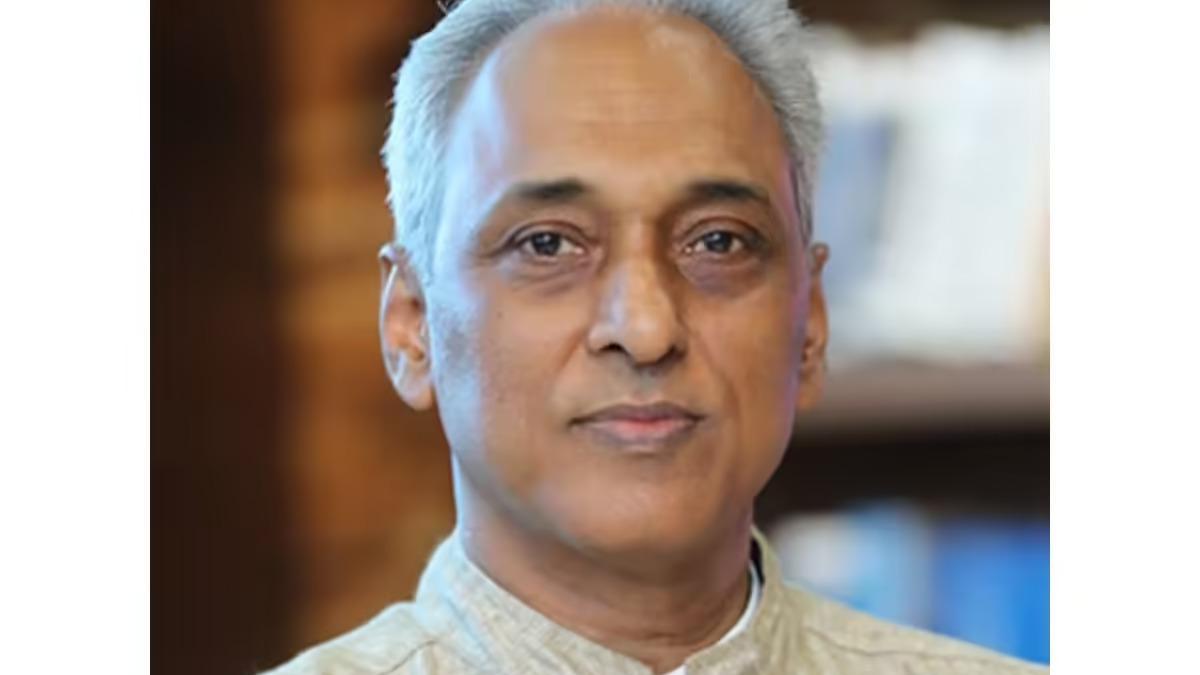
India's retirement-income replacement rate currently runs in the 35–40% range, versus a global norm of roughly 60%, Pension Fund Regulatory and Development Authority Chairman S. Ramann said Friday. The regulator wants to draw 30 crore people into the National Pension System and Atal Pension Yojana over the next four to five years.
"Roughly, the world says your replacement rate should be about 60%. So 60% of your last pay should roughly be the kind of money that you get when you are in retirement mode. In India, it's in the region of about 35% to 40%," Mr. Ramann said during an interaction in Chennai. "So we have to encourage people to invest more. That's the only way."
The question of how much people need to save came up as PFRDA pushes pension coverage beyond government employees. Asked whether the regulator would set an individual savings target, Mr. Ramann called it impossible to predict. Instead PFRDA plans to offer illustrations showing how regular contributions could grow over time.
"If you save 2,000 rupees every month from past performance, I can tell you that it is possible that after 18 years, your corpus may be ₹10 lakhs," he said. The amount someone saves depends on their lifestyle and priorities, he added. "How much you save is totally dependent on your lifestyle and your priorities."
Contributions among NPS subscribers range from ₹200 a month to ₹2 lakh a month, Mr. Ramann said. PFRDA has around 2.2 crore NPS subscribers, including government and non-government segments. The regulator is focused on the non-government sector. APY has around 10 crore customers.
PFRDA is running 350–400 outreach programmes across the country targeting farmers, milk cooperatives, farmer-producer organisations, MSMEs, self-employed people and gig workers.
Digital platforms are central to the expansion. The StAR NPS platform is being developed with BSE, while NPS Tatkal is being developed with NPCI and BHIM. These let banks, pension funds and distributors, including mutual fund distributors, onboard subscribers digitally, with contributions flowing through UPI. PFRDA pays distributors a ₹200 onboarding fee and about 0.3% of assets under management as annual commission.
"Between this, I am confident that we should be able to get people interested because on these digital platforms, it is costing zero to the distributors, be it banks or pension funds to bring in the commission, to bring in the customers," Mr. Ramann said.
On pension reform priorities, he cited "resilience in our returns." He said funds need to diversify across asset classes for better returns with low volatility. The system has around 5% of the corpus in alternative assets including REITs, InvITs and AIFs. PFRDA is examining how funds can develop the capability to make direct investments in companies, citing Canadian pension funds' India investments as a model. The objective is "a good double digit return year after year" with low volatility, he said.
On the Unified Pension Scheme, Mr. Ramann laid out relative costs. "If I were to say NPS costs the government ₹100, UPS may cost government ₹170, ₹180. OPS costs the government ₹450." He called the Old Pension Scheme "unsustainable." Ten to 12 state governments have announced UPS, with individual schemes potentially carrying variations. At the Central Government level, about 1.3–1.4 lakh employees opted for UPS out of roughly 22 lakh.
PFRDA has 14 pension fund managers. Mr. Ramann said greater competition could improve returns and expand reach. "Pension funds do two things. They are largely focused on investment and getting better returns for their subscribers. That is really where the expertise lies and more and more people who come in can provide better competition in terms of the returns."
PFRDA's NPS Vatsalya, which lets parents or guardians build retirement savings for children, has crossed four lakh unique customers. The regulator is also preparing NPS Swasthya, combining pension savings with a dedicated health corpus and top-up health insurance. The proof of concept is done, the product design is finalised, and the product is likely to launch in a month.
The regulator has extended the age limit for NPS investments to 85, alongside changes around entry, exit and scheme selection.
Asked whether Gen Z needs a different approach to pension saving, Mr. Ramann pushed back. "So, you may call yourself Gen Z… you're also going to become old. So, if you do not start saving today, your old age is not going to be very good." The discipline of saving, he said, is "the biggest change that we hope NPS will bring in."
AlphaScala's stock market analysis shows UPS (United Parcel Service Inc.) carries an Alpha Score of 53 out of 100, rated Mixed. More on UPS here.