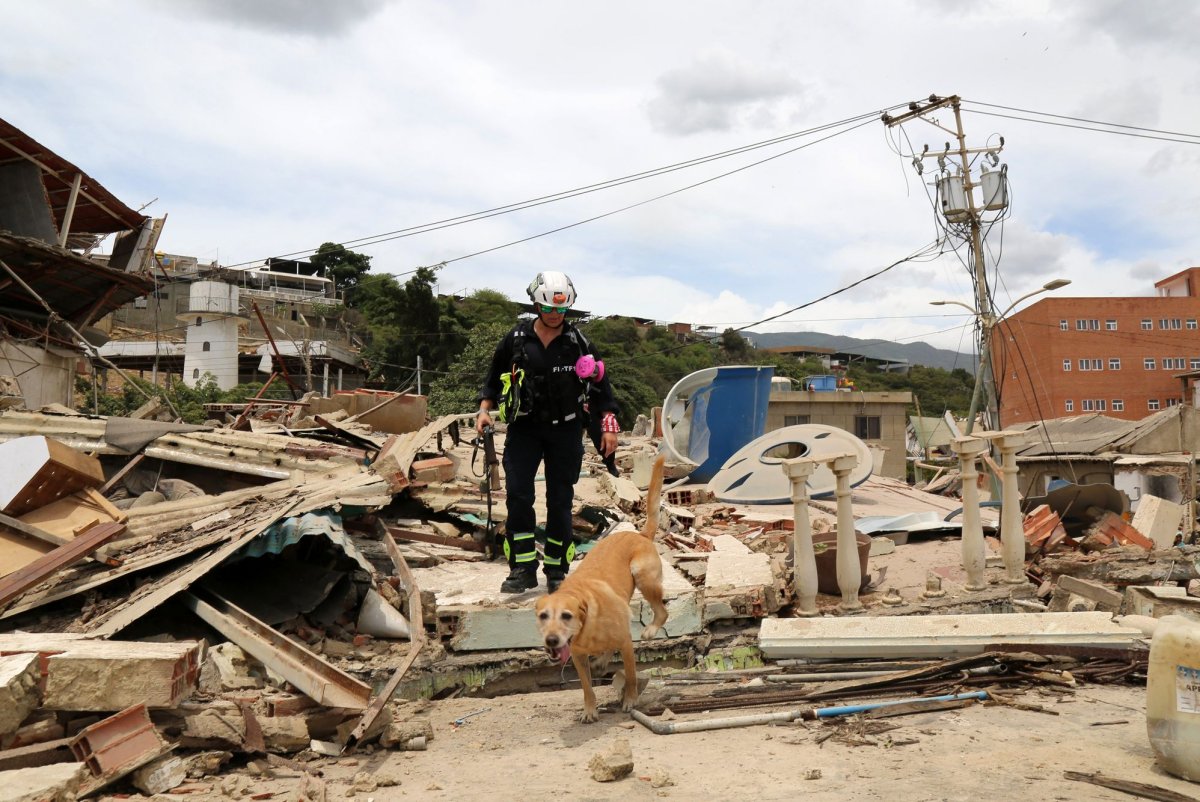
Two major earthquakes in Venezuela and Colombia within roughly seven weeks have sharpened focus on seismic risk further south, where Peruvian seismologists warn that a large share of the energy stored off the country's central coast since the 1746 megathrust event remains unreleased.
Venezuela was hit by magnitude 7.2 and 7.5 earthquakes on June 24. On Aug. 10, a magnitude 7.4 earthquake struck western Colombia. The succession has put the spotlight on Peru's central region, where the National Center for Disaster Risk Estimation, Prevention and Reduction rates seismic risk as very high, particularly around Lima.
Seismologist César Jiménez Tintaya, a professor at the National University of San Marcos, told Peruvian radio station RPP that only about 20% of the energy accumulated in the country's central region since 1746 has been released. "That means a magnitude 8.5 to 8.8 earthquake could occur in central Peru," Jiménez said.
Fabiola Barrenechea, executive director of the Intergeographic Foundation and a disaster risk and climate change expert, told UPI the concerns have a scientific basis. "Off the coasts of Peru and Chile, the Nazca Plate continues to move beneath the South American Plate, and there are areas where they are strongly coupled, causing deformation to accumulate over decades or even centuries," Barrenechea said.
The areas with the greatest potential for a major earthquake are southern Peru and northern Chile, along with Ecuador and southern Colombia, she said. "We can identify where seismic potential exists, we still cannot determine the date of an earthquake," she added.
Experts caution that the recent cluster of events does not by itself demonstrate a broader trend of heightened seismic activity across South America. The earthquakes resulted from different tectonic processes and are not necessarily causally connected.
"We have indeed observed several significant earthquakes over a relatively short period, that does not necessarily mean that South America is experiencing extraordinary seismic activity," Barrenechea told UPI. Earthquakes are not evenly distributed over time, she said, so relatively quiet periods can be followed by periods when several major events occur within weeks.
Reynaldo Charrier, a geology professor at Andrés Bello University in Chile, agreed. The Venezuelan earthquakes are associated with the interaction between the Caribbean and South American plates. The Caribbean Plate moves eastward relative to the continent's northern edge, while the South American Plate moves westward, creating a zone of friction and major geological faults across northern Venezuela.
Those include the Oca-Ancón, San Sebastián and El Pilar faults, which form a fracture system extending more than 620 miles. The faults move about 20 to 30 millimeters, or 0.8 to 1.2 inches, per year, not continuously. "Friction can keep the faults locked for decades until the resistance is overcome and the accumulated energy is abruptly released," Charrier said. He cited major earthquakes associated with those faults in 1812, 1900 and this year, with an average interval of about 100 years.
The earthquake in Colombia had a different origin. It occurred more than 66 miles deep within the Nazca Plate beneath the Pacific Ocean, part of the tectonic system along the Pacific Ring of Fire that sinks beneath the South American Plate. The Venezuelan earthquakes, by comparison, occurred at a depth of about 12 miles.
"It was an intraplate earthquake, with the rupture occurring as the plate bends downward. It normally occurs very infrequently," Charrier said.
Geologist Andrés Folguera, a professor at the University of Buenos Aires, told Argentine news outlet Infobae that both events will be studied to better understand the phenomenon.
Although the earthquakes are not related, Barrenechea said they can alter existing stresses in the Earth's crust. "Earthquakes modify the stress field in the crust, and a major event can even produce small seismic disturbances hundreds or thousands of kilometers away. That has been demonstrated," she said.
There is no scientific evidence that such disturbances could trigger a major earthquake in Peru or Chile, she said. A distant earthquake can produce a disturbance, "today we cannot predict that another major earthquake will subsequently occur," Barrenechea said.
South America has experienced some of the strongest and most destructive earthquakes recorded by the U.S. Geological Survey, including the magnitude 8.8 earthquake that struck Chile in 2010 and the magnitude 7.9 earthquake that struck Peru's Pisco region in 2007.