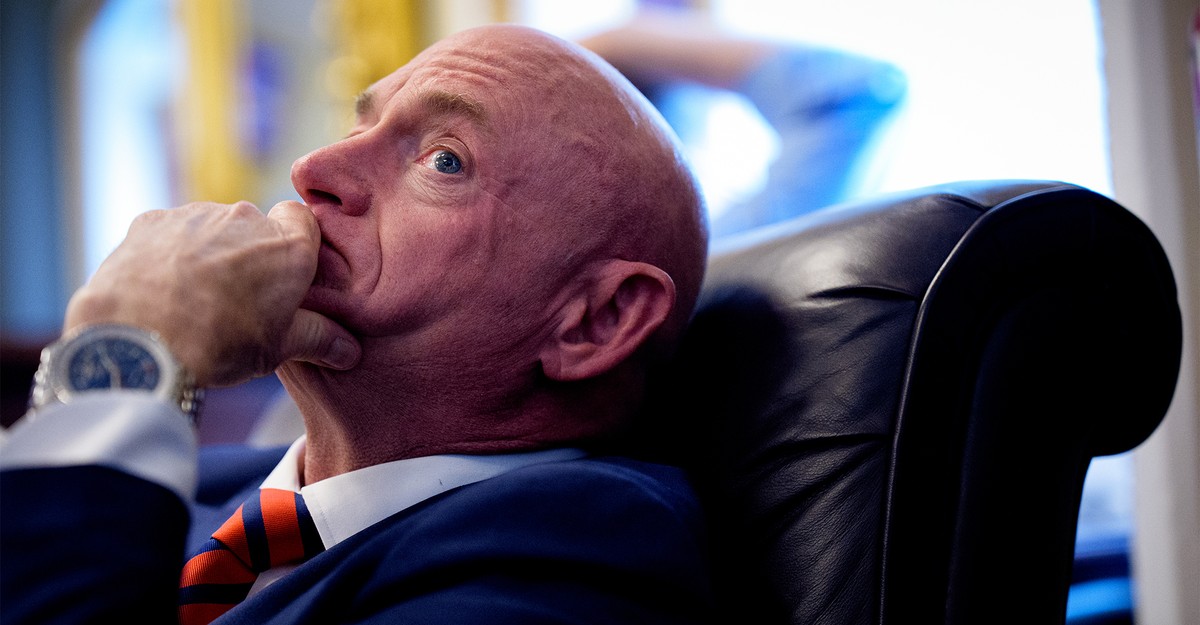
Legal experts call the Pentagon's attempt to demote Sen. Mark Kelly over a lawful-orders video legally dead. The move may still deter other veterans from speaking out.
Secretary of Defense Pete Hegseth's attempt to demote retired Navy captain and Senator Mark Kelly over a video statement about lawful orders is legally vulnerable but politically pointed, legal experts said. The order has little chance of surviving a court challenge, yet it may still chill other veterans from speaking out.
“It's dead on arrival,” Gene Fidell, an expert on the Uniform Code of Military Justice at Yale Law School, told the press. “If this ever gets in front of a judge, the judge is going to say, 'Fuck you.'”
Hegseth announced on X that Kelly was being demoted for a November video in which he and five other Democratic lawmakers reiterated that service members do not have to follow unlawful orders. That statement is a banal recitation of existing law, experts said. Hegseth himself has made the same point publicly in past years.
“There's nothing improper, much less criminal, in what they said,” Fidell said. “It's not conduct unbecoming; it is not seditious.”
Brenner Fissell, a law professor at Villanova and vice president of the National Institute of Military Justice, said the video was “merely a statement of the law, which is: You can disobey unlawful orders. That's factually, legally correct. How can it be a criminal offense to state the law?”
Retiree jurisdiction. The Uniform Code of Military Justice applies to retired service members, allowing demotion after retirement for conduct that occurred while in uniform. That power is usually reserved for misconduct like sexual abuse, not political speech. Kelly's statements were made as a civilian senator, not on active duty.
“Retiree jurisdiction does not need to exist; it's irrational,” Fissell said. “You've got 99-year-old World War II veterans who are still subject to military law.”
Legal scholars say the doctrine dates to an era when all officers remained subject to recall. Its application to the political speech of a sitting senator stretches the code beyond its intended scope. A simple fix would be for Congress to change the law so that military retirees are not subject to restrictions on speech that occurs after they leave uniform. No such bill has been introduced.
Broader chilling effect. The attack on Kelly may be aimed at silencing other service members who might speak out against the Trump administration by threatening their pensions. Veterans without Kelly's platform and social connections may feel their retirement benefits are not worth the risk of criticism.
“One of the things that I'm hoping to do is spread a little truth on the water here, so that people aren't chilled,” Fidell said. Veterans “have as much right as you or I do to speak their minds.”
The other Democratic lawmakers in the video do not draw military pensions, so they are not subject to the code. Still, the administration subjected them to an FBI investigation, despite no clear crime.
Legal risk. The demotion order is likely to be challenged in court if it proceeds. Fidell said a judge would reject it. The Pentagon did not respond to a request for comment. The broader question is whether Congress will act to close the retiree-jurisdiction loophole. Without legislative change, every military retiree who speaks critically of the president faces a potential threat to their pension.
Drafted by a large language model from the source reporting linked above, then screened by automated publishing checks. It is not read by a journalist before publication. Some articles cite our Alpha Score. Verify prices and figures against the original source. Educational coverage, not personalized advice.