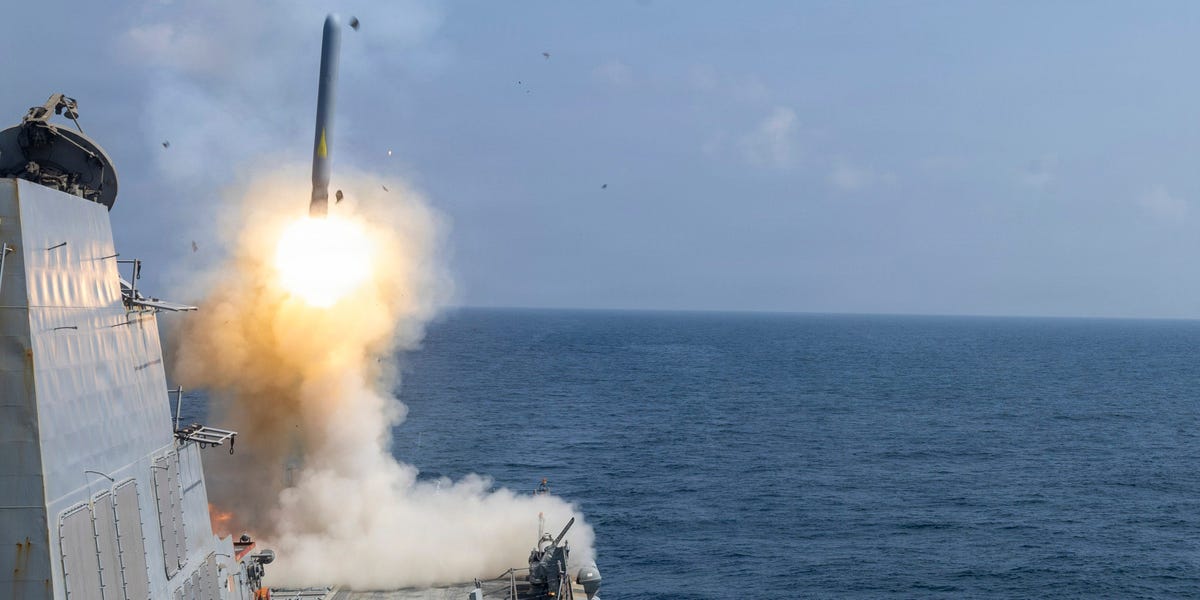
The Pentagon awarded RTX's Raytheon a $22.9 billion contract to build more than 1,000 Tomahawk cruise missiles a year, the Defense Department said Monday, after American forces burned through hundreds of the long-range munitions during the Iran conflict.
The contract runs seven years and follows a framework agreement Raytheon announced in February. The current production line can turn out roughly 600 Tomahawks annually, according to the Center for Strategic and International Studies. The new deal targets 1,000 per year.
Acting Navy Secretary Hung Cao called the agreement a "landmark" munitions contract that "will accelerate Tomahawk missile delivery to our warfighters at unprecedented speed." The department, he said, is "utilizing every available tool to meet the demands of our current operations, ensuring they are equipped to fight, win, and come home safe."
The BGM-109 Tomahawk is a subsonic cruise missile with a standard range of roughly 1,000 miles. It serves with the Navy, Army, and a small number of American allies, and can be fired from surface warships, submarines, and ground-based launchers. A single unit costs up to $3.5 million.
RTX said in February that the Tomahawk, which entered service in the 1980s, had been used in combat more than 2,300 times. The U.S. launched Operation Epic Fury in late February, igniting a fresh conflict with Iran that saw multiple Tomahawk strikes.
CSIS estimated in a May report that American forces had already expended more than 1,000 Tomahawks. The think tank's assessment put annual production capacity at roughly 600 units before the new contract.
Raytheon said Monday it has "invested heavily in recent years to ramp up production" and delivered three times as many missiles in the first half of 2026 as in the same period last year.
U.S. officials and analysts have warned it will take years to refill stockpiles of critical munitions depleted during the Iran war, including the Tomahawk, other standoff weapons, and high-end air defense missiles. Precision munitions like the Tomahawk are seen by military planners as essential for a potential conflict with China.
The contract locks in a seven-year production ramp that will test Raytheon's ability to scale a supply chain built for peacetime rates. The company has not disclosed how much of the $22.9 billion covers new tooling, workforce expansion, or supplier retooling. CSIS noted that the Tomahawk's supply base includes specialized propulsion, guidance, and warhead suppliers that cannot quickly add shifts.
Raytheon's Tomahawk line runs out of its Tucson, Arizona facility. The company has been hiring machinists and engineers there since early 2025, according to local workforce data. A single missile requires roughly 18 months from raw material to delivery, meaning the first batch of the accelerated production would not reach Navy magazines until late 2027 at the earliest.
The Pentagon's decision to commit to a seven-year contract rather than annual renewals signals a shift in procurement strategy. The military typically buys missiles in one-year increments, which limits suppliers' willingness to invest in capacity. The longer horizon lets Raytheon commit to capital spending, the company said.
RTX carries an Alpha Score of 58 out of 100 from AlphaScala, a "Moderate" rating in the Industrials sector. The score reflects the company's exposure to defense spending cycles and its ability to convert backlog into revenue. The Tomahawk contract alone represents roughly two years of RTX's total annual revenue.
The Iran conflict consumed Tomahawks at a rate U.S. planners had not modeled. CSIS estimated the military fired more than 1,000 in the first three months of operations, a burn rate that exceeded the annual production capacity at the time. The new contract aims to prevent that gap from recurring.
Whether the production ramp can sustain 1,000 units per year by the end of the contract depends on the supply of solid rocket motors, guidance electronics, and the titanium components used in the missile's airframe. Raytheon has not said which of those inputs is the binding constraint.