Macro● Neutral
Peace Satellites: Geopolitical Risk Meets Trust Infrastructure
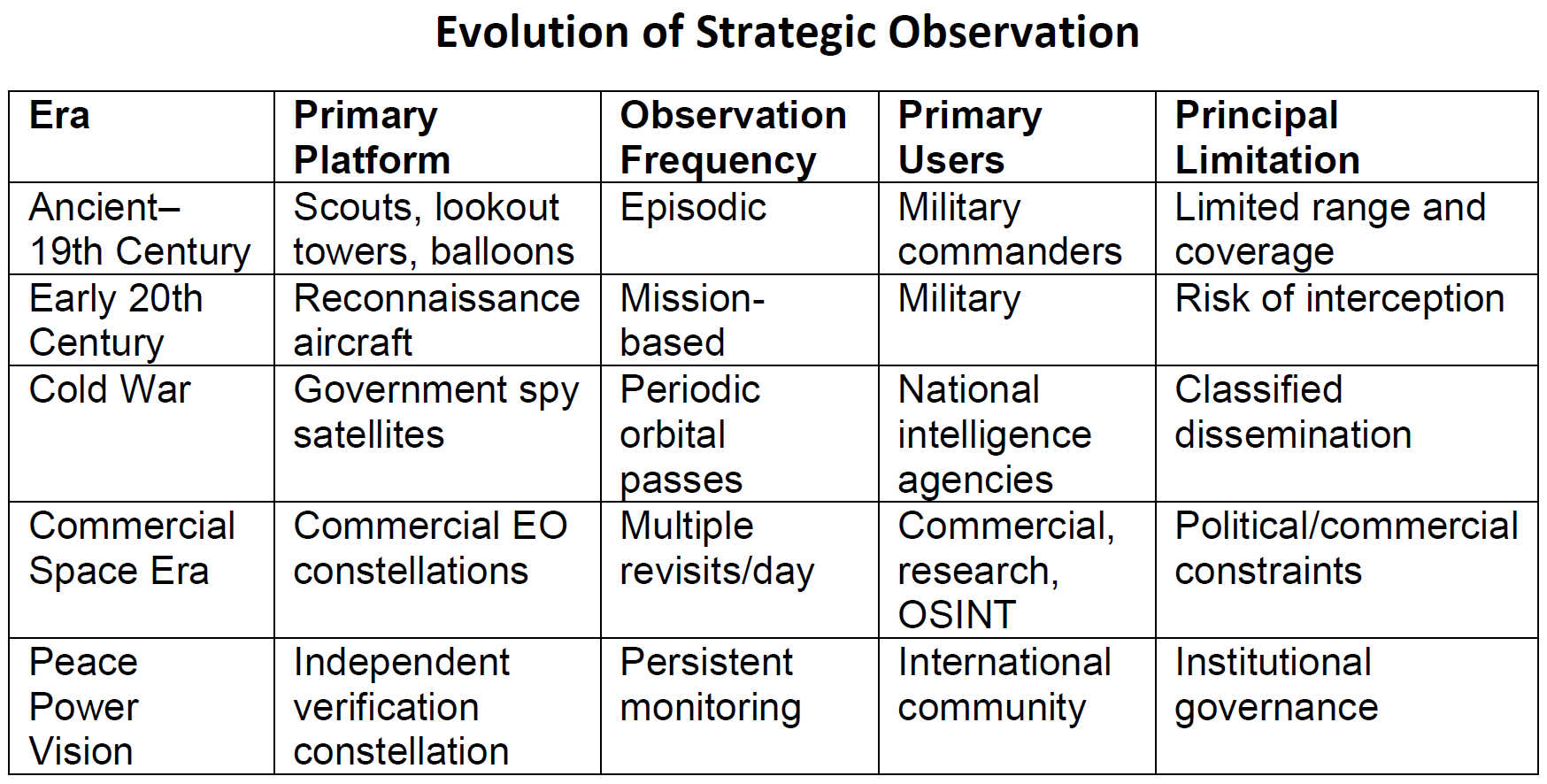
Commercial satellite imagery democratizes observation but remains vulnerable to political pressure. A Peace Power architecture of independent verification could reduce conflict risk by producing trusted public evidence.
Continue with
Modern militaries can observe missile deployments, naval movements, and force mobilizations from orbit with extraordinary precision. The same detailed knowledge that reduces uncertainty for individual governments rarely becomes shared evidence between them. Intelligence remains classified, selectively disclosed, or politically contested. Crises become battles over competing claims about reality.
The evolution of commercial Earth observation has begun to shift this balance. Lower launch costs, satellite miniaturization, and large constellations have put capabilities once reserved for superpowers into the hands of commercial firms, researchers, and open-source investigators. High-resolution imagery is no longer a government monopoly. Multiple providers operating under different national jurisdictions can examine the same events.
Yet commercial ownership does not guarantee institutional independence. The Kyl-Bingaman Amendment restricted high-resolution satellite imagery of Israel and the Palestinian territories for years, relaxed only in 2020. During the recent conflict with Iran, several leading commercial providers delayed or restricted public access to imagery covering the war zone. Some actions followed government requests; others reflected company decisions. The episode showed that commercially operated observation systems remain vulnerable to political pressure precisely when independent evidence is most needed.
The central problem is therefore not technological but institutional. Humanity can observe the planet with persistent, near-real-time coverage using thermal anomaly data from civilian systems like NASA's FIRMS, which open-source investigators have repurposed to corroborate reports of missile strikes and artillery attacks. The missing piece is a governance structure that produces trusted public evidence, not intelligence for one side.
An independent international observation capability would differ from traditional reconnaissance. Its defining characteristics would be operational independence from any single nation, transparency in methods, redundancy across sensors and analytical teams, persistence to turn isolated events into behavioral histories, and open access for governments, humanitarian agencies, and the public. This is the core idea behind the Peace Power framework: institutions deliberately designed to produce trust through verifiable evidence.