A lawsuit over the estate of Malcolm-Jamal Warner has put a familiar problem in front of financial advisors: estate plans that were never finished, or finished and never updated. Warner, the actor, died unexpectedly in July 2025. His widow sued his financial advisor for professional negligence, saying the advisor never finalized draft updates to the estate plans. She also sued Warner's mother, trustee of the family trust, arguing that Warner's daughter should receive trust assets. Some estate-related claims were settled this month, news reports said.
Advisors read the case as a warning about ordinary client files. National Make a Will Month has pushed estate planning back into view, and planners say outdated wills and beneficiary designations remain common. Stephen Dissette, a Trail Creek, Indiana-based registered investment advisor representative of Horter Investment Management, described a teacher who named her sister as the beneficiary of her 403(b) retirement plan. After the teacher married and started a family, she never changed the form. When she died, the sister got the money instead of the husband.
Estate plans let clients decide what happens to those assets, Dissette said.
"You have power from the grave where you can determine who gets what and when they get it and if there's certain criteria," he said. "If you leave it really vague, look out. You're going to have family members fighting, in many cases, and don't be surprised if lawsuits get brought in."
Legal fees can then consume a large share of the inheritance, Dissette said. Relatives who were not part of the deceased person's life sometimes surface to claim a piece. "I have seen things you wouldn't believe. When people pass away, relatives come out of the woods, so to speak. It's like out at sea. ... They smell blood in the water, and here come the sharks," he said. All of it can be prevented with specific beneficiary designations and a will, he said.
Plans do not need an annual review, Dissette said. They need one after marriage, divorce, the birth of a child, or the death of a named beneficiary. Without a will or trust, the state decides in probate, and that process can take months. Advisors also want plans written early, because cognitive decline or incapacity can later make changes difficult or impossible.
David Haughton, vice president of estate planning at Carson Group in Omaha, Nebraska, said everyone has an estate plan whether they want one or not.
"In actuality, everyone has an estate plan, because it's either you wrote it, or your state legislature wrote it," Haughton said. "You don't want to leave that to be a gamble."
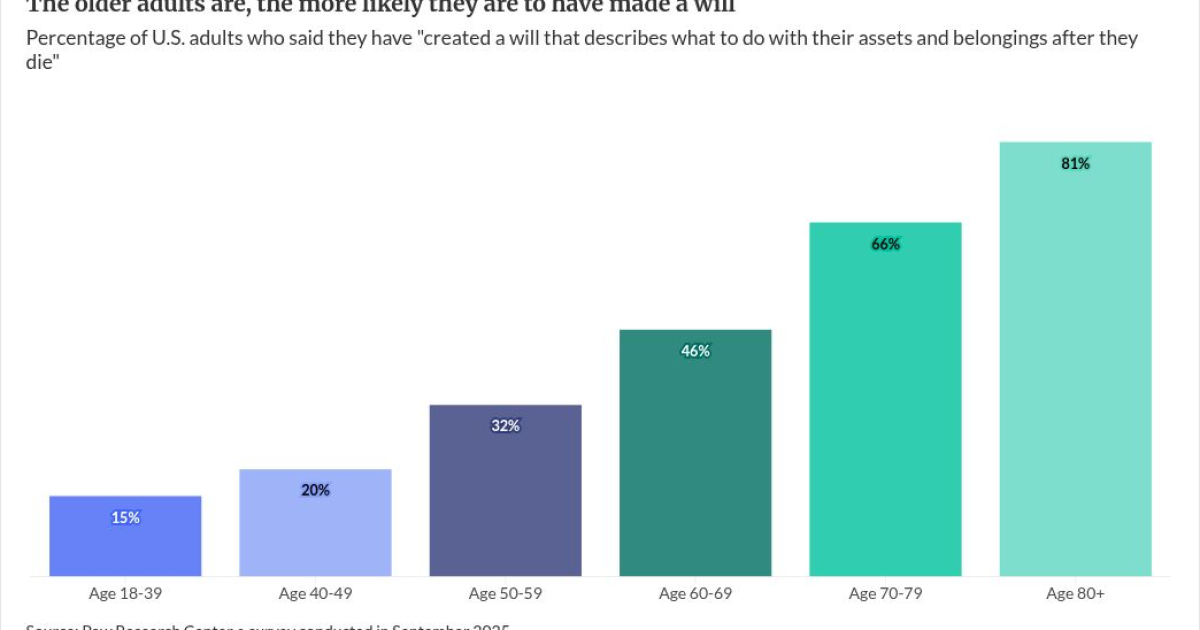
Pew Research Center found in a 2025 survey that 32% of U.S. adults had created a will, with the share rising with age. Haughton said too many people think estate planning is only for married people or parents. "I think everyone needs an estate plan, and I think if they understood what could happen to everything they've built over their lifetime if they don't plan, I don't think they'd be super pleased if they knew the implications of some of the ways that the state guidelines are going to leave the property," he said.
State law can also override expectations. Kristin Yokomoto, a partner at FBT Gibbons in Newport Beach, California, said spouses generally inherit automatically in community property states such as California unless the deceased person explicitly excluded them. Married clients should still record their wishes in a will, she said.
Rebecca Carter, a principal at Friedman, Framme & Thrush in Owings Mills, Maryland, said speculation about a dead person's wishes has no legal weight. "Most of the time, it's going to come down to ... what were the last properly executed documents saying?" she said.
Carter said estate plans are not one-and-done. Remarriage and blended families make the work more complicated, she said. "In a world where there is so much remarriage and children from prior relationships, and split families and things, it can get complicated," she said.
Updates have to cover non-probate assets, not just the will, Carter said. She gave the example of a client who redid a will to leave assets to children. The ex-spouse was still named as the beneficiary on a retirement plan. The retirement plan pays the ex-spouse. It is a direct payout that does not go through court, she said, because "a non-probate asset is a direct payout."
Even lawyers find the conversation hard to have. Carter has spent 25 years in the law. She said she still felt unprepared when managing some account-related details for her own "sandwich generation" family. "No one wants to think about that stuff. There's this emotional aspect," she said.