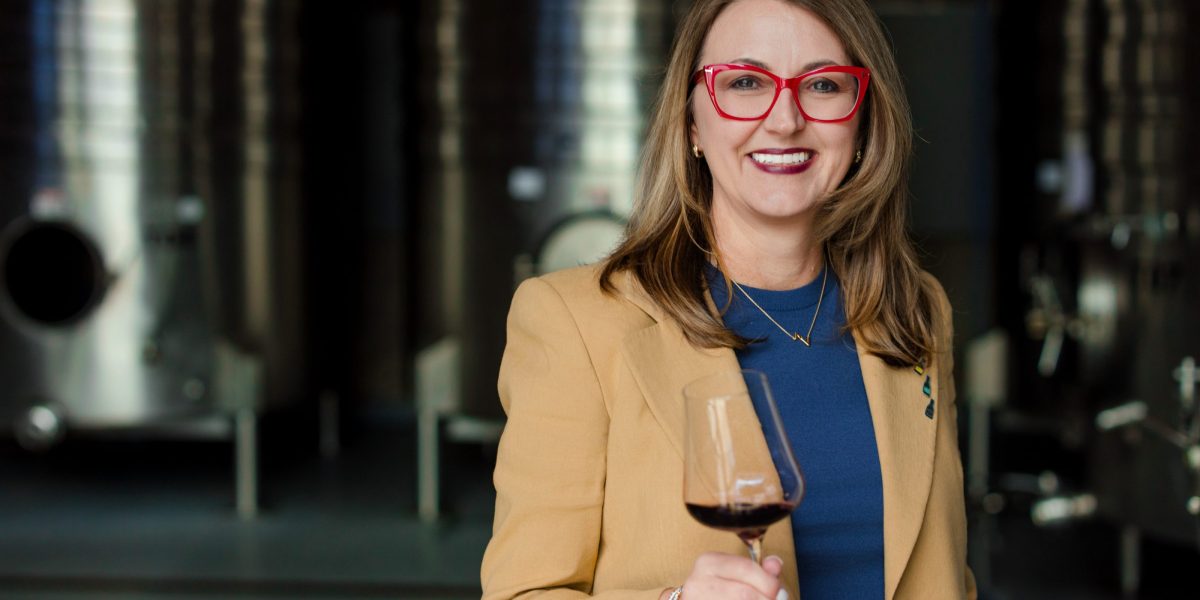
Amy Prosenjak was running inventory for a billion-dollar furniture company in Ohio when her husband asked why she didn't get a job in the wine business. She laughed it off. Who would hire her?
WineJobs.com answered that. A to Z Wineworks, then a small Oregon winery owned by two couples and in the process of buying Rex Hill, needed a chief financial officer. Prosenjak sent her resume "kind of on a whim."
Founder Bill Hatcher, then CEO, asked whether she understood cost accounting. "I'm the director of inventory for a $1 billion furniture company," she told him. "That is my specialty."
"He said, 'Well, I can teach you the wine business,'" Prosenjak recalled. "And he did."
Twenty years later, the 53-year-old is president and CEO of A to Z Wineworks LLC, overseeing A to Z, Erath and Rex Hill. Those three brands account for roughly one in every four bottles of Oregon-origin wine sold in U.S. multi-outlet retail, according to Circana data. The measure covers grocery, mass, club and drugstores. It leaves out restaurants, tasting rooms and most independent wine shops.
The industry Prosenjak learned to scale has turned. After years of expansion, production across the company's brands fell about 32% in 2025 to 550,000 9-liter cases, the company said. A to Z expects to stay around that level in 2026.
"We're going to follow the consumer," Prosenjak said. "If we need to be a slightly smaller company, we will do that because we're going to stay true to our winemaking values. We want to stay profitable."
When Prosenjak arrived at A to Z, the winery was producing about 80,000 cases a year. She had spent her career in corporate settings – furniture, fashion – and found the family-owned environment liberating. Decisions happened in hours, not weeks.
"Within an hour, you could change a policy or do something that benefited your employees," she said.
Her corporate experience gave the growing winery a framework to scale. She moved from CFO to president to CEO, a progression she describes as organic rather than planned.
Growing up, Prosenjak had a poster of Smurfette surrounded by male Smurfs. A doorway on it was labeled "president." The message: girls could do anything.
About 52% of A to Z's roughly 65-person core team identifies as female, as does about 55% of management, she said. Winemaking and viticulture have become more balanced. Distribution remains heavily male-dominated. She still walks into distributor meetings as the only woman in the room.
Those aren't the only rooms she navigates. She keeps a closet of clothes at the winery because her job can take her from a construction site to the office to a community event in the same day.
"You need different outfits, different shoes," she said. "I love shoes."
The company around Prosenjak has transformed. The A to Z she joined was owned by two couples. Today, A to Z Wineworks LLC is wholly owned by private equity firm Sycamore Partners. Sycamore bought Ste. Michelle Wine Estates from Altria for roughly $1.2 billion in 2021. Ste. Michelle acquired A to Z in September 2022. The terms were not disclosed.
Prosenjak and her management team retain operating autonomy, according to the company. She sits on A to Z's board alongside Sycamore representatives and reports results monthly.
"It's different than being family-owned," she said. "It is a different time in the industry cycle."
Scaling a winery presents a problem Prosenjak never encountered in furniture or fashion. Wineries have to plan for grapes years before the resulting wine reaches consumers. If demand doesn't materialize, production can't simply be turned off. The same vineyard can yield different amounts of grapes each year.
"It's not like you're making shampoo where you can say, 'I'm going to make one gallon and that's all I'm going to make,'" she said.
When consumer demand falls faster than production can adjust, unsold wine sits on the balance sheet. A to Z said its 32% production cut reflected changing consumer demand, retailers dedicating less floor space to wine, distributor consolidation and weaker export demand. The company scaled back portions of contracts with all of its growers and reduced its harvest intern needs.
The pressure extends across Oregon. The state's 2025 vineyard and winery census found winegrape production fell 25%, case sales declined 16% and exports dropped 29%. More than half of growers reported leaving fruit unpicked.
Rob McMillan, founder of Silicon Valley Bank's wine division, has been warning about this shift for years. SVB's 2018 industry report cautioned that retiring baby boomers and younger consumers with different preferences would make it increasingly difficult for wineries to raise both prices and volume.
"The industry was doing very well, and had been doing very well for roughly 30 years," McMillan told Fortune. "I think it's probably one of the harder things for any business to do when things are going well: change."
SVB estimates U.S. wine volume fell to about 329.2 million cases in 2025 from 335.9 million in 2024. The bank expects declines to moderate before the market reaches what it calls a "bumpy bottom" in 2027 and 2028.
The pain isn't uniform. "The under-$12 category is the part of the industry that is in greatest distress," McMillan said. Among premium wineries SVB tracks, dollar sales are roughly flat and volume is down about 2%.
McMillan argues the industry's fundamental problem runs deeper than Gen Z. Baby boomers favored wine more heavily when they drank. Younger consumers spread their choices across wine, beer, spirits and other beverages. When an older wine consumer exits the category, one younger consumer doesn't necessarily replace that demand.
"It's not about people not liking wine or not understanding wine," McMillan said. "It's really just about the change in demographics."
When Prosenjak entered the industry, White Claw didn't exist. Today, consumers can choose among wine, beer, spirits, canned cocktails, nonalcoholic drinks, lower-calorie products and cannabis beverages depending on the occasion.
Prosenjak isn't assuming A to Z will return to its old growth trajectory. She also isn't treating the decline as a catastrophe.
"We're trying not to panic in this present tense of like everything's terrible in the industry," she said. "It's hard, for sure. We should try to bring some of the fun, leave room for the fun."