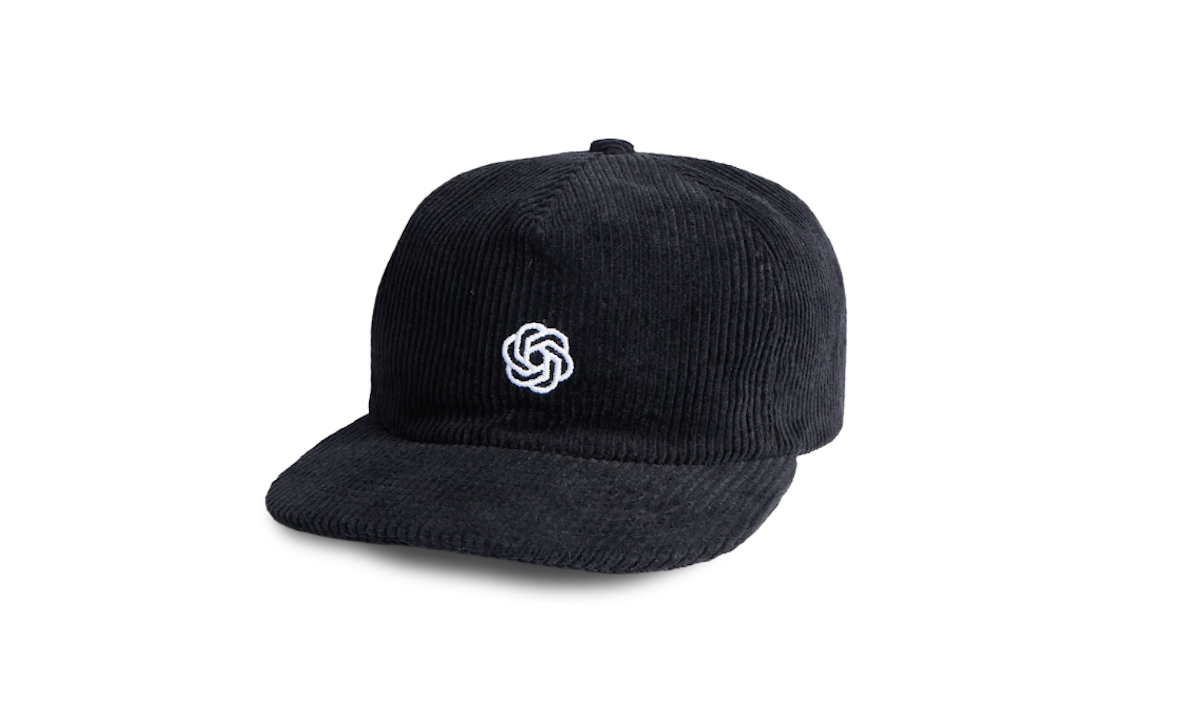
OpenAI opened its Supply Co. merchandise store to the public this week, selling apparel and accessories that were previously reserved for employees. The line includes $15 ChatGPT socks, $40 T-shirts and baseball caps, a $175 quarter-zip and a $70 ChatGPT-branded basketball.
A T-shirt reading "Good research takes time" sold out in every size except XS within hours. The basketball sold out almost immediately after launch, the company said. Items feature phrases drawn from OpenAI's founding charter, including "AGI that benefits all of humanity."
It is the first time OpenAI has made its employee-only apparel available on an ongoing basis. The company had briefly opened the store to the public once before, for a limited window in December to mark its 10th anniversary, Business Insider reported.
The strategy itself is not new. OpenAI joins Figma, Shopify and Palantir in opening branded merchandise stores to the public, Inc. reported. Palantir relaunched its external merchandise store and opened a pop-up in Seoul in October, where the company said Korean customers had become its second-largest international merchandise market.
The merchandise strategy is not about revenue. OpenAI's annualized revenue exceeded $25 billion as of March, Reuters reported, making a $40 T-shirt immaterial to the balance sheet. The point is identity. A person wearing an OpenAI "Thinking deeply" cap is making a statement about affiliation. That is the same mechanism that turned Supreme into a cultural institution and made Nvidia merchandise sought after at developer conferences.
At Nvidia's GTC conference in March, attendees lined up for a $178 sweater printed with "Toy Jensen," a cartoon avatar of CEO Jensen Huang, priced coincidentally close to a single share of Nvidia stock at the time, the Wall Street Journal reported. "Jensen Huang is like the Taylor Swift of Silicon Valley," Hardik Nahata, a software engineer who bought the sweater, told the Journal.
Other AI labs are engineering the same scarcity. Anthropic hosted a pop-up with the Air Mail newsstand in New York, distributing "thinking" caps that ran out before the event ended, Business Insider reported. OpenAI handed out token plaques at its Dev Day. Cursor gave its most loyal supporters "tab" keys. Sunita Mohanty, who attended the Anthropic pop-up, wore her cap on the flight back to San Francisco. At least two strangers stopped her to say they recognized it. "It's a signal that you're in the know," Mohanty told Business Insider. "You feel like you're a part of this movement."
Some of this merchandise has already developed a resale market of its own. A used OpenAI sweatshirt sold for nearly $250 on eBay after the seller found it at a thrift store for less than $15. Boxes of OpenAI Codex swag, including a hat, hoodie and a few small items, have sold for as much as $475, and an authentic OpenAI employee T-shirt fetched $250. Anthropic's branded items are trading on secondary platforms too, including a pen that sold for $39.99 and an employee T-shirt that went for $120, Forbes reported. "I do think these are the vintage concert rock shirts of tomorrow," eBay seller Mitchell Brody told Forbes.
The appetite for tech memorabilia extends beyond wearable merch and into the auction house. A signed Tom Ford leather jacket worn by Nvidia CEO Jensen Huang at a 2023 event sold at Sotheby's on July 17 for $960,000, 16 to 24 times its pre-auction estimate of $40,000 to $60,000 and drew 45 bidders, according to CNBC. An Apple-1 prototype board believed to have been used by Steve Jobs and Steve Wozniak sold for $2.7 million in January, Tom's Hardware reported. An Apple check signed by both founders fetched $2.4 million, RR Auction reported. "I think you're just seeing the start of this for anything that is culturally relevant," Scott Keeney, founder of The Realest, told Yahoo Finance.
AI companies are racing to become part of the culture, not just its infrastructure. Merchandise is one way to stake that claim.