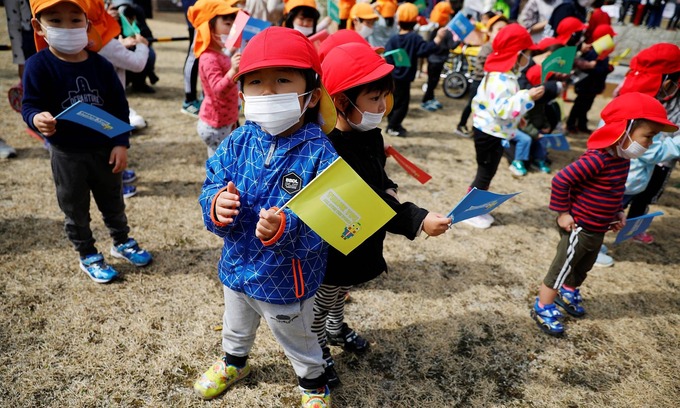
Nagi, a town of about 5,500 in Okayama prefecture, posted a birth rate of 2.95 in 2019, more than double Japan's national figure. The town's rate has eased since the 2019 peak. It has stayed well ahead of the national average, which fell to 1.14 in 2025, its 10th straight annual decline. Births totaled 671,236, the fewest since records began in 1899, according to Kyodo News.
The story starts with a 2002 referendum. Japan was pressing small towns to merge. Nagi's residents voted to stay independent. "We decided to expand child-rearing and education support to maintain the population," Mayor Masachika Oku, 67, a town official at the time, told The Mainichi.
Towns that decline to merge receive smaller central government grants. Nagi cut administrative costs, reducing its assembly from 14 seats to 10, and steered the savings to families.
Families receive a 100,000-yen payment per child. Medical care, school materials, and lunches are free through high school. Because the town has no high school, it pays students to commute elsewhere. In fiscal 2024 it extended its English-language assistant teacher program to infants under 1 year old.
The town opened Nagi Child Home in 2007 in a former kindergarten near the town hall. Six contract staff and volunteers run it, offering drop-in care for 300 yen an hour for children from 6 months old through first grade. Twice a month it hosts "munch-munch time," where mothers make baby food with a staff nutritionist for a 100-yen fee.
Hiroko Kaihara, 55, who helped set up the center, told The Mainichi the team built it without a model. They aimed for "a place where people could gather casually and no one would be isolated."
To keep parents working close to home, a public-private group launched Shigoto Konbini, a "job convenience store," in 2017. Now run by a residents' association, it connects parents and older residents who can spare only short stretches. Tasks range from sorting documents and inserting flyers to farm work and tending graves. The group fields close to 1,000 orders a year.
Sayaka Hanafusa, 37, who moved from Kanagawa Prefecture after marrying, runs a painting class while raising a 2-year-old and a 3-year-old. She told The Mainichi she has helped sow seeds and harvest cabbage between classes. "It's nice to be able to work in your free time," she said.
The group keeps client fees low and leans on town subsidies to maintain pay. "We're able to keep this going thanks to the town's support," said representative director Yoshikazu Kuwamura, 68.
Such subsidies are now common nationwide. Few towns match Nagi's results, Okayama Broadcasting reported. Yasushi Iwabuchi, an associate professor at Okayama University, told the broadcaster that going it alone forced Nagi to confront depopulation about 20 years ahead of its peers.
Nagi logged 172 official study visits in 2023, the most of any local government in Japan, according to a survey by Nikkei Business Publications. Then-Prime Minister Fumio Kishida toured the town that year to study its methods, NHK reported.
Oku said the town would keep expanding child-rearing support.