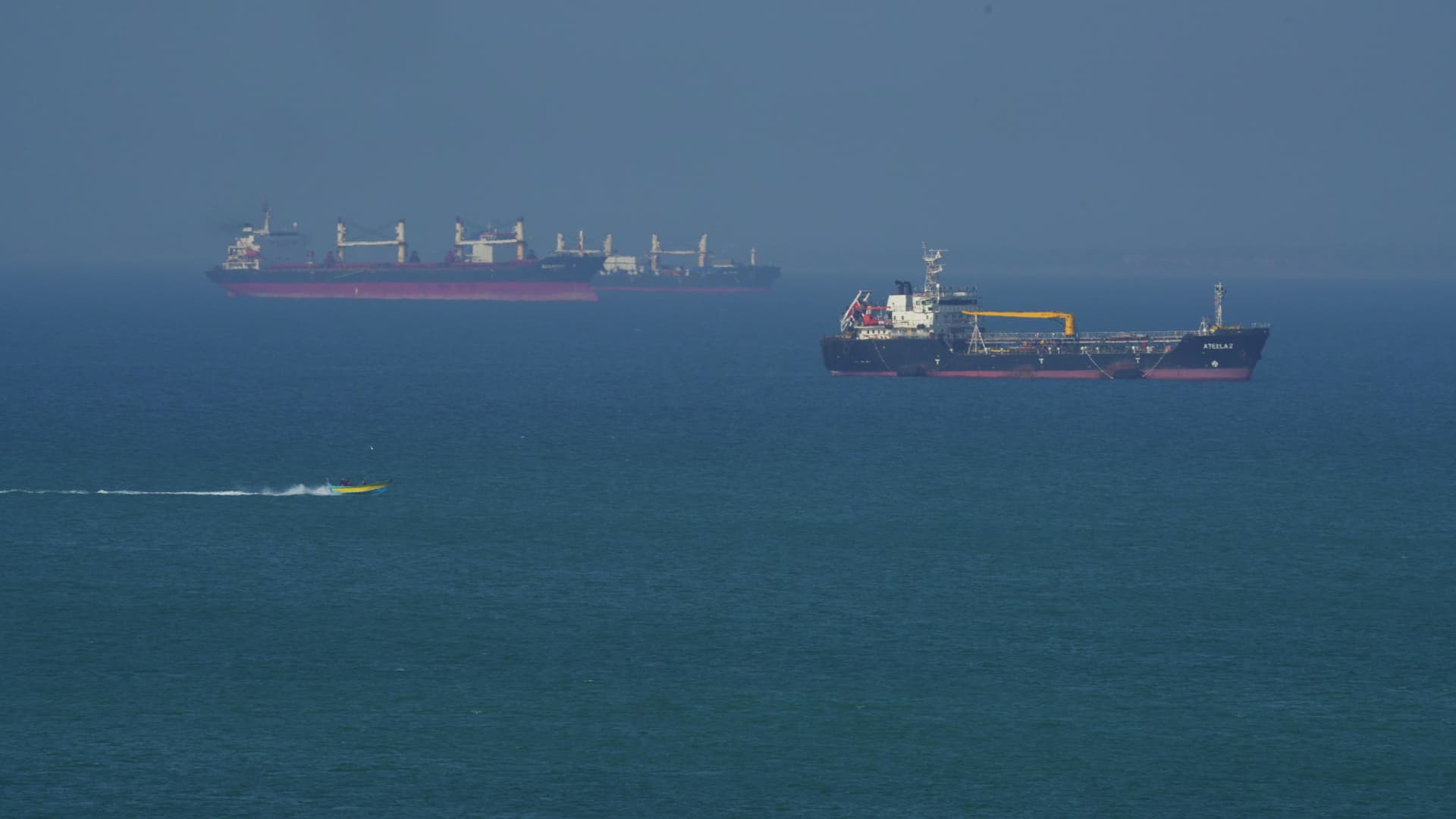
Oil prices tumbled Sunday after President Donald Trump said the U.S. has completed a deal with Iran to reopen the Strait of Hormuz.
U.S. crude oil futures were down 4.8% to $80.80 per barrel by 6:01 p.m. ET. Brent futures, the international benchmark, traded 3.9% lower to $83.89 per barrel.
"The Deal with the Islamic Republic of Iran is now complete," Trump said in a Truth Social post. Hormuz will open without a toll system and the U.S. will immediately end its naval blockade of Iran, the president said.
"Ships of the World, start your engines," Trump said. "Let the oil flow!"
About 20% of world oil supplies passed through Hormuz before tanker traffic plunged in early March due to Iranian attacks. The disruption to Hormuz has triggered the biggest oil supply disruption in history.
Pakistan Prime Minister Shehbaz Sharif said Sunday that the U.S. and Iran have declared an immediate and permanent termination of military operations on all fronts including Lebanon.
Washington and Tehran will officially sign the peace deal on June 19 in Switzerland, Sharif said in a social media post. The Pakistani prime minister has served as a mediator between the U.S. and Iran.
"We would like to thank the United States of America and the Islamic Republic of Iran for their commitment to finding a diplomatic solution to the conflict," Sharif said. Mediators will facilitate meetings this week to lay the foundation for technical talks and the official signing ceremony, he said.
The CEO of the oil tanker company Frontline told CNBC last week that he expects ship traffic through Hormuz to pick up quickly if the U.S. and Iran reach a credible deal.
"I'm actually very optimistic the minute the tide turns and the U.S. and Iran have found some sort of agreement, at least not to attack shipping, that those transits are going to resume pretty quickly," said Frontline CEO Lars Barstad.
The price collapse reflects the speed at which supply can return. Tanker rates, which spiked during the blockade, are likely to normalize as vessels re-enter the route. For crude traders, the question shifts from disruption premium to how fast Iranian barrels hit the market. The June 19 signing date gives a concrete timeline for that supply to flow.
For a broader look at how geopolitical shocks reshape energy markets, see our commodities analysis.