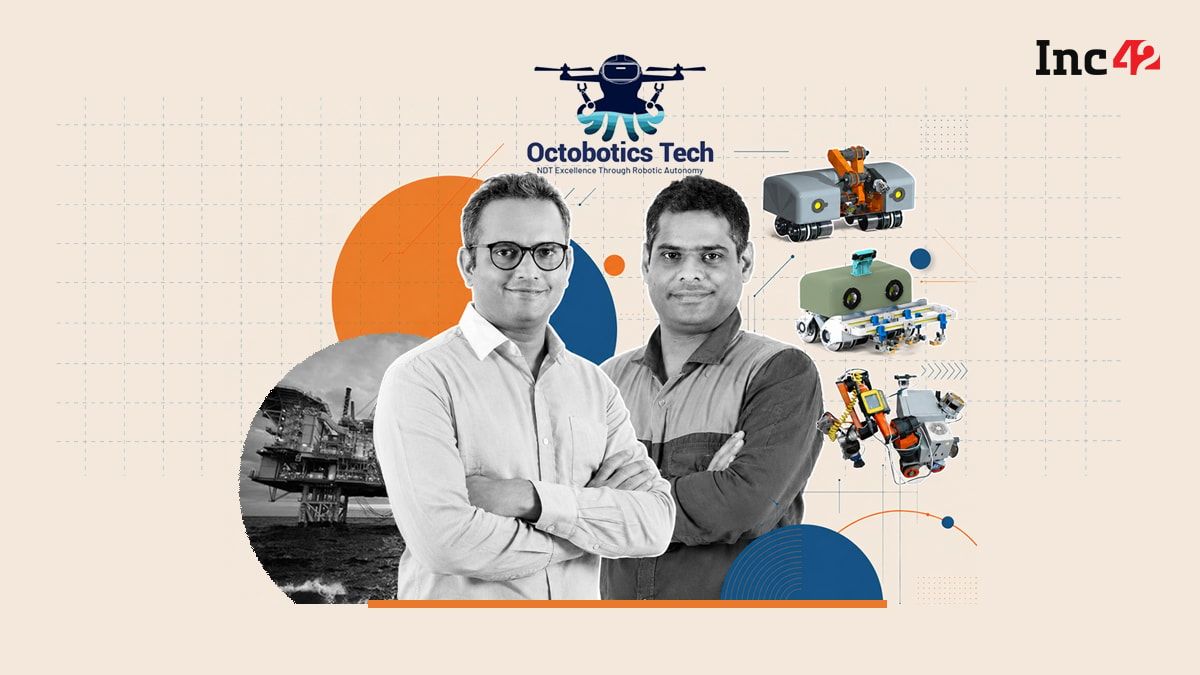
Two field operators died in July 2025 at Mangalore Refinery and Petrochemicals Ltd, exposed to hazardous vapours while investigating a storage tank malfunction. The incident spotlights the dangers of manual industrial inspections, a job that still forces workers into confined spaces, onto steel structures, and near toxic gases. Octobotics, a Delhi-NCR deeptech startup, has built magnetic crawler robots that climb steel surfaces and use phased-array ultrasonic sensors to detect cracks and corrosion without putting a human in the danger zone.
The company recently raised ₹10 crore in seed funding from Navam Capital and BYT Capital. It plans to scale production of a new modular robot under 15 kilograms, set to debut around August 15, and target clients in India and the Middle East.
Founded in 2020 by Ishan Bhatnagar and Gulshan Kumar, both marine engineers who worked on offshore rigs, the startup emerged from repeated exposure to fatal accidents. “We watched people risk their lives and sometimes lose them, just to determine whether a ship, tank or pipeline was safe. We believed a robot should be doing that job instead,” Bhatnagar said.
The duo first tried a drone-based inspection platform but found it impractical. In 2021 they developed a magnetic crawler – a robot that sticks to steel and moves across surfaces while pressing ultrasonic sensors against the metal. The technology uses phased-array ultrasonics, which sends multiple sound waves at controlled angles and reads the reflections to map internal defects such as corrosion and cracks.
Octobotics holds three granted patents and has two more under review. Its existing products, Weld Sensei and Track Sensei, weigh about 37 kilograms and are dedicated to specific inspection tasks. The company is replacing them with a single modular platform that can carry both inspection tools through interchangeable modules. The lighter robot should reduce handling time and make the system easier to deploy in tight spaces, Bhatnagar said.
The startup serves eight commercial clients including Indian Oil Corporation and Bharat Petroleum. About half of its revenue comes from overseas markets – Singapore, Greece and the Middle East. It recently shifted from selling robots outright to a service model: Octobotics deploys two field teams with robots and charges per inspection. A standard storage tank inspection costs roughly ₹10 lakh and takes two days, compared with nearly ten days using manual methods. More complex jobs, such as refinery cracker units, bring ₹20-25 lakh per inspection.
Octobotics closed its last financial year with revenue of ₹1.94 crore and is targeting ₹6 crore in the current fiscal year. The company eventually plans to rent robots to third-party inspection vendors and add a SaaS reporting layer for an additional revenue stream.
The challenge now is moving from pilot projects to a scalable industrial partner. The new lighter robots and service model are designed to meet that goal, but the company must prove reliability across more assets and regions. Field tests with existing clients will begin after the August launch.