Nykaa spent ₹1,757.9 crore buying traded goods in Q1 FY27, a 21.7% jump from a year earlier. The company buys stock from brands outright, holds it in its own warehouses, and sells it on its own account. That makes it the seller of record, giving it control over supply, pricing, logistics and quality in a category where counterfeits are a real consumer worry.
The trade-off is the risk of everything that doesn’t sell. Beauty is a hard category to hold. Shades and formulations go out of trend, skincare and cosmetics carry expiry dates, and returned units often cannot be sold again. Slow-moving stock is cleared through markdowns, which means giving up margin after the sale is already priced in. Whatever cannot be cleared is written off.
Gross Margin and Its Limits
Nykaa does not disclose margins by product or brand. It reports the gap in aggregate as gross margin. In Q1 FY27, that expanded to 45.9% from 44.6% in Q1 FY26, helped by a rising share of House of Nykaa owned brands and an uptick in marketing income from brands paying for placement.
Gross margin only covers what is left after buying the product. Every warehouse, every store lease, every beauty advisor, every rupee of advertising and every discount Nykaa funds itself sits below it. The two cost lines the company highlights each quarter – fulfilment and marketing – are only part of what stands between the 45.9% and the ₹79.8 crore net profit.
Most of the gross margin an inventory-led retailer earns is spent, not kept. The model works only if the businesses that money builds eventually earn more than they cost to run.
Working Capital: The Other Price of Ownership
A marketplace collects from the customer and pays the seller later. Nykaa pays brands upfront for stock that then sits in a warehouse until somebody buys it. Cash stays locked up for as long as each unit takes to sell. The wider the catalogue and the bigger the store network, the more cash the model swallows.
In Q1 FY27, Nykaa spent ₹274 crore on fulfilment, or 9.9% of revenue, covering the movement of goods through its warehouse and logistics network. Marketing cost ₹412 crore, up 26% YoY, though as a share of revenue it eased to 14.8% from 15.2% a year earlier. On the earnings call, management argued that marketing should be read as an investment rather than a cost, pointing to a growing base of repeat customers.
What Beauty Pays For
Beauty and personal care remains the biggest revenue contributor and the main profit engine. In Q1 FY27, the vertical posted GMV of ₹4,105 crore, up 28% YoY, and an operating profit of ₹159.1 crore. It is the segment that pays for everything else.
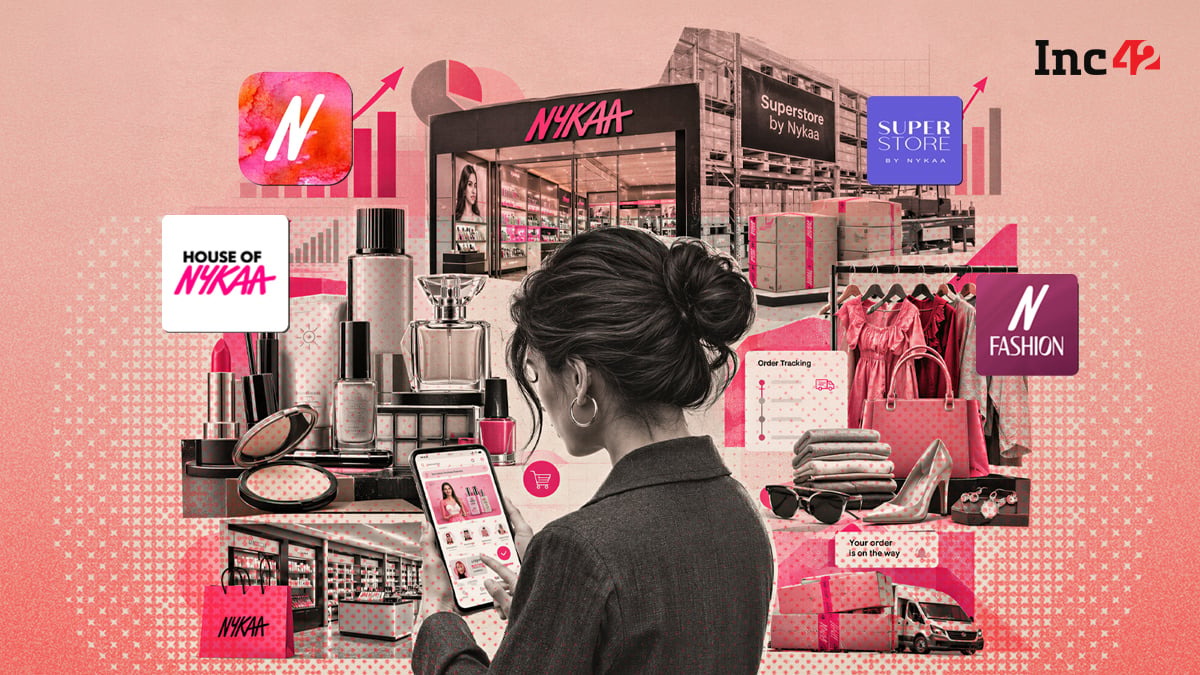
The first layer beyond online is a physical network. Nykaa operated 237 stores across 79 cities as of Q1 FY27 spanning Nykaa Stores, Nykaa Luxe and Nykaa On Trend. Stores do a job online retail cannot: beauty is a category shoppers want to test before buying. Each of those 237 stores comes with a lease, a payroll of beauty advisors, and a second set of stock that has to be paid for and eventually sold. This is the clearest example of the trade-off running through the whole model.
In 2018, Nykaa moved into fashion with Nykaa Fashion, which runs mainly as a marketplace earning commissions, brand partnership fees and marketing income. Nykaa Fashion reported an annualised GMV of ₹3,760 crore in Q1 FY27, up 39% YoY, and narrowed its operating loss to ₹8.5 crore from ₹27 crore a year earlier. It still loses money, which is problematic given that beauty cannot sustain investments in fashion for too long.
Then there is the House of Nykaa, the group’s own portfolio of brands including Kay Beauty, Dot & Key, Earth Rhythm and others. Here Nykaa is both the brand owner and the retailer, earning the manufacturing margin as well as the retail one. The rising share of owned brands pushed gross margin higher.
It also puts the company on both sides of its own shelf. Nykaa decides what shows up in search, how often a particular brand is flashed to consumers, and what its beauty advisors recommend in a Luxe store. It now owns brands competing for those slots alongside third-party labels. Owning a brand outright earns more per sale than stocking someone else’s, so any retailer in this position has a reason to favour its own. That is a description of the incentive, not of anything Nykaa has done.
The fourth engine points at trade rather than consumers. Nykaa Superstore supplies beauty products to retailers, neighbourhood stores, salons and beauty professionals, and had crossed 5.23 lakh registered retailers by Q1 FY27, up 30% YoY. Wholesale is a thin-margin business everywhere it exists.
The Cost of Speed
Today, Nykaa operates in a more crowded market than it did in 2012. Tira, Purplle and Amazon compete in beauty, while Myntra, AJIO and a long tail of D2C labels compete across fashion and lifestyle. Quick commerce has changed what “available” means, putting beauty and personal care next to groceries at ten-minute delivery.
Nykaa’s answer is Nykaa Now, which expanded from three cities to 13 over the June quarter with more than 1,000 brands, and is targeted at 25-plus cities by the end of FY27. On an inventory-led model, speed is bought with stock. Serving a customer in minutes means keeping the range close to them instead of in one central warehouse. That multiplies the number of places the same catalogue has to sit, and the cash frozen in it. The markdown risk rises with it.
Nykaa has also bought rather than built. It has taken majority stakes in skincare brands Dot & Key and Earth Rhythm, activewear brand Kica, and content platform Little Black Book. It has announced plans to acquire a majority stake in D2C skincare brand Aminu, which focuses on products for melanin-rich skin.
Content ties the rest together through Nykaa Play, tutorials, reviews, live commerce and collaborations with 1.7 lakh-plus creators under its affiliate programme. It is also where marketing income comes from: the advertising, placement and launch spending that brands pay Nykaa for, and one of the two reasons the company gave for its gross margin rising this quarter. That money carries almost no cost of goods, which makes it the most profitable revenue in the business.
Nykaa has said it wants to cross $5 billion in GMV by FY30, grow revenue by 2.5-3 times, expand EBITDA by 4-5 times and deliver a return on capital employed of over 40%. Those targets only work if several things go right at once. Beauty has to keep premiumising, fashion has to turn profitable, House of Nykaa has to keep growing fast, and customer acquisition has to stay efficient while competition gets harder.
Every engine Nykaa has built sits on top of the same decision it took at the start: to own the stock rather than rent out the shelf. That is what pays for the stores, the fashion marketplace, the owned brands and now the ten-minute delivery. The question the next few years will settle is not whether Nykaa can grow. It is whether each of those engines earns back the capital it takes, or quietly spends the margin that beauty generates.