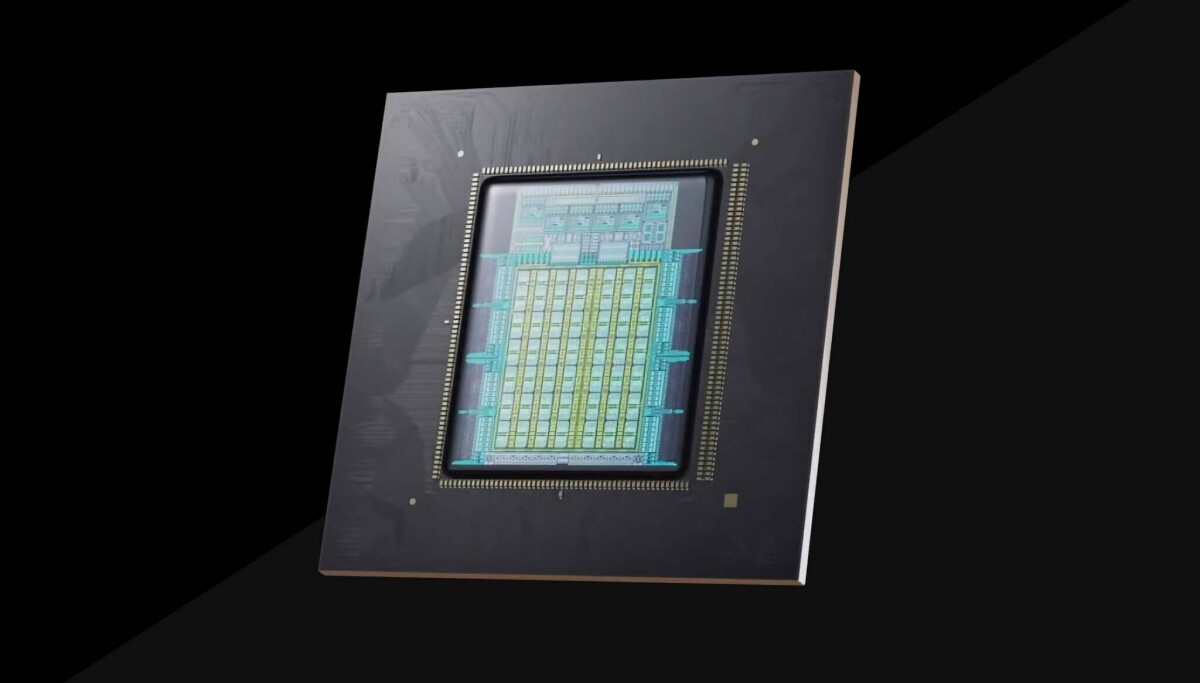
Nvidia has put its first custom CPU into the hands of hyperscalers. Alibaba, ByteDance, Meta, Oracle, CoreWeave, Lambda, Nebius, and NScale have signed up to deploy Vera in their clouds. The move marks Nvidia's first direct challenge to Intel and AMD in the datacenter CPU market.
The chip packs 88 custom Armv9.2 cores, called Olympus, on a monolithic compute die fabbed on TSMC's 3nm process. Nvidia argues the monolithic design beats AMD's chiplet architecture on core-to-core bandwidth and latency. Vera supports up to 1.5 TB of LPDDR5X memory and is among the first chips to support PCIe 6.4 and CXL 3.1. In a dual-socket configuration, the Vera CPU Superchip delivers 1.8 TB/s of bidirectional NVLink bandwidth.
Nvidia released a whitepaper late last month detailing the Olympus core for the first time. It features a 10-wide decoder, eight integer ALUs, six vector/FP pipelines, and a custom neural branch predictor that can explore two branches simultaneously. The company also implemented memory renaming and a value prediction scheme to reduce pipeline stalls, particularly for pointer-heavy and agentic workloads.
Vera supports simultaneous multithreading, though Nvidia calls it spatial multithreading. Instead of two threads sharing a core's resources, the core can be bifurcated into two smaller cores with a shared cache. This design avoids the thread contention seen in x86 SMT implementations, the company said, and can improve determinism for containerized workloads like AI agent sandboxes.
Nvidia claims Vera delivers 1.8x higher per-core performance than AMD's 128-core Epyc 9755 in benchmarks representative of agentic workloads, and up to 2.6x faster in graph traversal jobs. Those comparisons are against a chip that launched nearly two years ago. AMD's next-generation Venice platform, expected in the coming months, will feature up to 256 cores and support for 12,800 MT/s MRDIMMs, delivering between 1 TB/s and 1.6 TB/s of memory bandwidth. Venice will also use LPDDR5X, similar to Vera.
Intel's Diamond Rapids platform, with 192 cores, is also in development. Both Intel and AMD are moving to 16 memory channels, while Vera uses eight LPDDR5x controllers. Nvidia's memory subsystem draws just 30 to 40 watts under sustained load, the company said, compared to 100 to 200 watts for traditional RDIMMs.
Vera is designed to serve two roles: as the AI head node managing GPUs in Nvidia's Vera Rubin systems, and as a standalone host for AI agents. The agentic workload market is the bigger question. Nvidia's reference designs call for racks with 128 Vera superchips (256 CPUs) totaling 22,528 cores and 384 TB of memory. The company is betting that the chip's branch prediction and pipeline optimizations will make it especially effective for Python scripts and runtime frameworks generated by AI code assistants.
Nvidia's NVDA stock page carries an Alpha Score of 72, a Moderate label, with the stock up 2.93% today at $200.75. AMD stock page scores 44, a Mixed label. The competitive dynamic between the two will sharpen as Venice and Vera reach production.
Independent benchmarks on production hardware will tell the real story. AMD's Venice is expected within months, and Intel's Diamond Rapids is on the horizon. Vera's performance in its target workloads looks promising, the market will decide whether the custom Arm core can unseat the x86 incumbents in the datacenter.