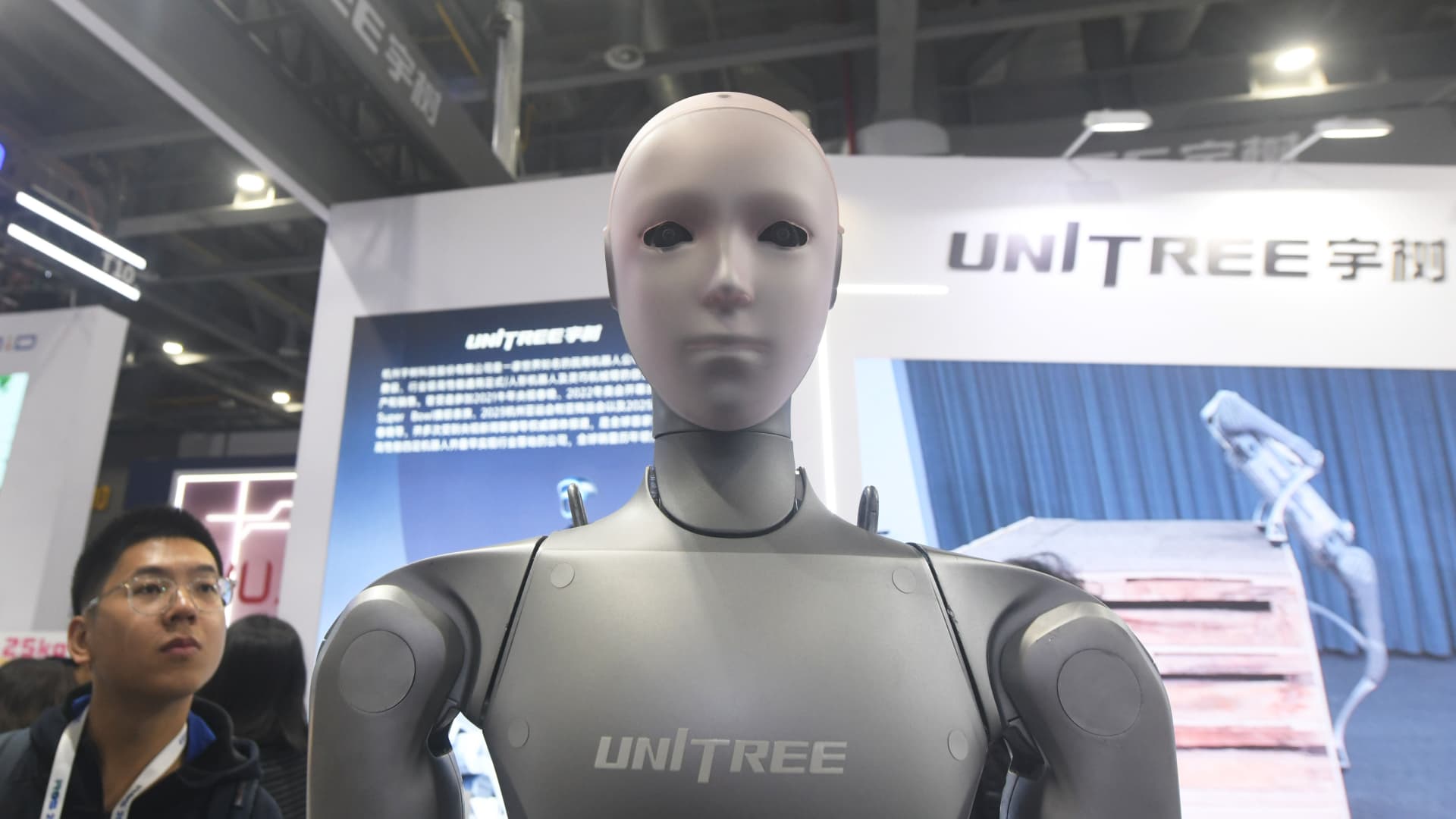
Nvidia selected Chinese humanoid robot maker Unitree for its first integrated reference humanoid system, the Isaac Root, announced Monday. The same day, Unitree's $620 million IPO application goes before Shanghai's STAR board for review.
The pairing of Nvidia's Jetson Thor hardware (housing the Blackwell GPU) with Unitree's H2 robot – 6 feet tall, 150 pounds, 25 degrees of freedom in each Sharpa-made hand and 31 in the body – creates a turnkey research platform. Nvidia's Isaac GR00T AI models and simulation tools run on the device, allowing researchers to train and test code without needing a cloud connection.
For traders tracking the AI hardware theme, the event confirms a shift: Nvidia is selling an integrated system, not just chips. That widens its ecosystem moat if adoption scales, though the robotics segment remains a rounding error against data-center GPU revenue.
Nvidia's Isaac Root: A Turnkey Platform for Humanoid Research
Why Unitree's H2 Robot Was Selected
Unitree's H2 robot provided the physical base – a 6-foot, 150-pound bipedal design with 31 degrees of freedom. Nvidia added its Jetson Thor module, which includes the Blackwell GPU, and the GR00T software stack. The system also uses mechanical hands made by Singapore-based Sharpa.
Jensen Huang unveiled the Isaac Root in a Taipei keynote Monday, saying the platform runs the company's entire software and simulation stack. “We built this for higher education and university researchers, because for them to build this is insanely hard to do,” he said.
The Software Stack: GR00T and Simulation Systems
The edge Nvidia is selling is the software ecosystem. Researchers can use Isaac Sim to train the robot in simulation, then deploy to the physical hardware. That reduces breakage risk and speeds iteration.
Huang has predicted that “physical AI” could become a market worth tens of trillions of dollars. He told investors last month he expects rapid growth in the robotics segment over the next five years. The Isaac Root gives that thesis a concrete reference point.
Risk to watch: The robotics software revenue is negligible for Nvidia today. If this platform is priced as a loss leader to seed the ecosystem, it will not move the company's income statement for quarters. The real test is whether other robot makers adopt the Jetson Thor module as a standard.
Unitree's $620M STAR Board IPO: Timing and Revenue Profile
Unitree is seeking to raise 4.2 billion yuan ($620 million) through a listing on Shanghai's STAR board. The exchange scheduled the IPO application review for Monday – the same day Nvidia announced the partnership. The timing strengthens Unitree's narrative as it heads into pricing.
More Than 40% Revenue From Outside China
Unitree disclosed in its STAR prospectus that more than 40% of its revenue already comes from markets outside China. That international weighting reduces single-country dependency, though it also exposes the company to export-control regimes that could affect Nvidia hardware availability.
The IPO valuation will set a benchmark for humanoid robotics companies globally. If Unitree prices above the 4.2 billion yuan target, it validates the premium that Nvidia's platform partnership creates.
Qiming Venture Partners is listed among Unitree's backers, according to PitchBook. The startup needs to show that its H2 Plus – an upgraded version arriving in October – can scale beyond university labs.
Early Adopters and the Unlisted Labs
At least four research institutions plan to use the H2 Plus humanoid, the press release said:
- Ai2 (Seattle)
- ETH Zurich (Switzerland)
- Stanford Robotics Center
- UC San Diego's Advanced Robotics and Controls Laboratory
No China-based research arms were listed. That omission stands out given Unitree is a Chinese company. Two possible explanations exist. U.S. export controls on advanced chips may complicate delivery to Chinese labs, even when the robot is made by a Chinese manufacturer. IP concerns may also limit Nvidia's initial rollout to partners it can monitor closely.
Rev Lebaredian, vice president of physical AI simulation at Nvidia, said the H2 Plus “will be available in October, and anyone can buy it.” He described the move as “taking frontier humanoid research out of the hands of only the world's largest tech companies and AI unicorns, and putting it in reach of every lab.”
Practical rule: The early adopter list is heavy on well-funded Western research centers. The ecosystem will broaden only if Nvidia navigates cross-border hardware delivery and compliance.
NVDA Stock: What the Robotics Platform Changes for the Narrative
Nvidia shares traded at $211.14, down 1.45% on the session. The stock carries an Alpha Score of 73 (Moderate) on AlphaScala's proprietary framework, reflecting solid earnings momentum but elevated valuation that limits upside surprise.
For Nvidia shareholders, the near-term financial impact of the Isaac Root is small. The robotics segment is still a rounding error compared to data-center revenue. The stock narrative now includes a hardware-plus-software robotics platform that competitors such as AMD and Intel cannot replicate easily. Both rivals announced robotics initiatives, neither has an integrated humanoid reference design running their own silicon.
Alpha Score 73 and the Physical AI Horizon
The Alpha Score 73 suggests the stock is fairly positioned for current earnings growth. The robotics platform does not change that near-term calculus. The catalysts to watch are Unitree's IPO pricing and the H2 Plus shipping in October. A strong IPO validates the sector premium. A delay or weak pricing would raise questions about humanoid robotics demand.
The four research labs will publish results within the next year. Those papers will either validate Nvidia's GR00T model stack or expose weaknesses. Traders tracking NVDA should bookmark those publication dates as real catalysts.
For broader context on Nvidia's AI edge in robotics, see the NVIDIA profile. Sector positioning and market analysis are available in the stock market analysis section.