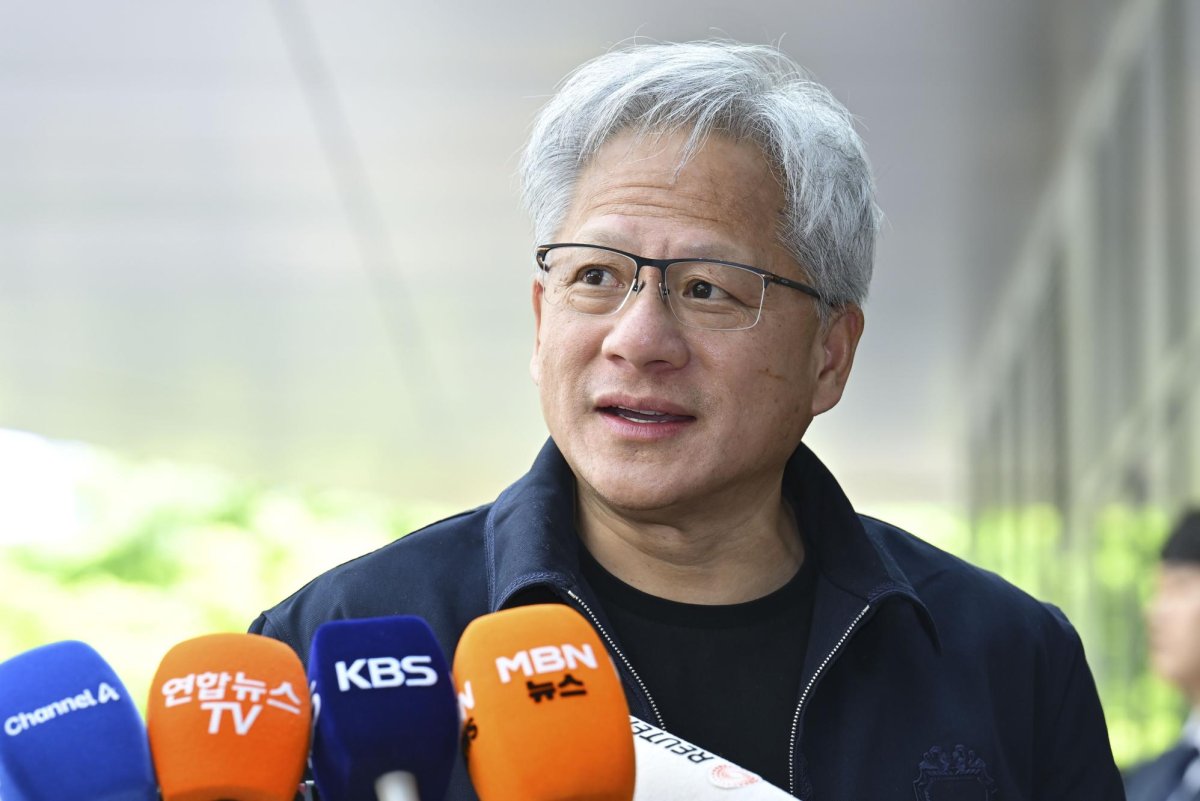
Nvidia Corp. CEO Jensen Huang said Friday that robotics will be the next major growth sector in South Korea, naming the country's manufacturing base as the natural launchpad. The remark, made upon arrival in Seoul for a four-day visit, sets a concrete sector premise for investors tracking the AI supply chain's geographic expansion.
Huang's trip includes dinner meetings with the chairmen of SK Group, LG Group, and Naver, plus talks with Krafton executives and South Korea's science minister. The lineup spans semiconductor fabrication, data centers, AI models, gaming, and robotics startups–layers of a value chain that Huang explicitly tied together when he said Nvidia will partner with domestic manufacturing firms in robotics and physical AI.
Huang's Robotics Call Puts Korea's Manufacturing AI in Focus
The Catalyst: A Four-Day Visit with Dinner Meetings
The timing matters. Huang last visited South Korea in October 2024 for the APEC CEO Summit. This second trip in less than a year signals a step-change from relationship-building to deal-making. The informal dinner expected to include SK Group Chairman Chey Tae-won, LG Group Chairman Koo Kwang-mo, and Naver Chairman Lee Hae-jin–with Hyundai Motor Group's executive chair confirmed unable to attend–covers every major Korean conglomerate with AI exposure.
Huang also said Nvidia will partner with domestic manufacturing firms in robotics and AI, adding that semiconductor manufacturing itself will become "increasingly robotics and increasingly AI driven." The manufacturing of chips, he said, presents a "great opportunity to partner with the semiconductor companies here."
Why Korea's Manufacturing DNA Makes Robotics Different
Robotics as a sector is not new–Tesla and Boston Dynamics have been visible players for years. What changes here is the infrastructure premise. South Korea is home to Samsung Electronics and SK hynix, the world's two largest memory chipmakers, plus Hyundai Motor Group, a top-five automaker with its own robotics subsidiary. Huang's argument: a manufacturing-heavy economy can absorb physical AI faster than a services-driven one because the production lines already exist.
"Because Korea is a manufacturing center of the world, we can apply the robotics technology, the physical AI technology that we invent here for the industry," he told reporters.
The mechanism is straightforward. Physical AI–robots that perceive, plan, and act in real-world environments–requires high-end GPUs for training and inference. Nvidia's Jetson platform and Isaac simulation tools are the dominant stack. Korea's factories represent a ready deployment zone where chip demand for robotics could supplement traditional data center GPU sales.
Sector Readthrough: Which Layers of the AI Value Chain Benefit
Semiconductors: The HBM Loop and Foundry Pull
The clearest read-through is to the memory and foundry segment. Huang's previous visit in 2024 featured a public plea for SK hynix to accelerate HBM4 production. This time the robotics angle adds a second demand vector: robotics edge devices require power-efficient memory, not just high-bandwidth memory for training clusters. Samsung Electronics competes in both HBM and edge AI chips via its Exynos line.
SK hynix and Samsung are not directly named in Huang's robotics comment, the cause-effect chain is visible in the source statement: "manufacturing of semiconductors will become increasingly robotics and increasingly AI driven." That means Nvidia's GPU sales into Korean chip fabs for process control and equipment automation could grow. It also means the chipmakers themselves become customers for Nvidia's industrial AI software–a software-defined factory thesis that has been a talking point in Nvidia's own investor materials.
Robotics and Physical AI: Krafton's Ludo Robotics and Naver's Lab
Krafton, the gaming company behind PUBG, established a robotics subsidiary called Ludo Robotics earlier this year. Huang is expected to meet Krafton Executive Director Chang Byung-gyu to discuss cooperation involving Nvidia's RTX Spark platform for premium Windows laptops and physical AI technologies. The meeting has not been confirmed on the schedule, the mention of RTX Spark ties Krafton's hardware ambitions to Nvidia's consumer GPU ecosystem.
Naver, the Korean internet giant, operates its own AI research lab and has invested in Naver Labs, which develops autonomous driving and robotics software. Naver's chairman attending the dinner puts the company inside the discussion for how physical AI might integrate with cloud and mapping services.
LG Group has electronics and home appliance divisions that have been testing robotics for warehouse and logistics use. LG's presence at the dinner suggests potential collaborations around factory automation and service robots powered by Nvidia's Isaac platform.
Gaming: The Esports and GPU Demand Angle
Huang visited an internet cafe in Seoul and met esports players, including superstar Faker. He called South Korea "the birthplace of esports" and noted that Korean gamers are among the world's most competitive, using Nvidia's GPUs. Gaming is a mature segment, the GeForce franchise still represents a material revenue stream for Nvidia. Any deepening of the relationship with Korean game developers–beyond Krafton to other studios like Nexon or NCSoft–could sustain GPU replacement cycles.
Key insight: The gaming angle is the least novel part of the visit, it reinforces Nvidia's consumer dominance in a market where the RTX 50-series launch is pending.
Valuation and Positioning: Nvidia's Alpha Score and the Korean Exposure
NVDA's Alpha Score 74 – What It Says About the Setup
Nvidia's current Alpha Score is 74 out of 100, labeled Moderate. The stock trades at $218.66, up 1.82% on the day of Huang's arrival. The Alpha Score, AlphaScala's proprietary composite of momentum, valuation, and sentiment, suggests the stock is not at extreme overbought or oversold levels. A Moderate label typically means the risk-reward is balanced, a catalyst like a confirmed Korean robotics partnership could push it into Strong territory (80+).
For comparison, Hudbay Minerals (HBM) carries an Alpha Score of 80 (Strong) in Basic Materials, and RTX Corporation scores 52 (Mixed). Nvidia's placement in Technology means sector momentum is a factor–semis have been under pressure recently due to export controls and capex rotation. A tangible robotics revenue pathway could differentiate Nvidia from peers that rely purely on data center GPU sales.
The practical mechanic: Huang's comments do not change Nvidia's Q1 revenue guidance, they provide a new medium-term narrative about the total addressable market for physical AI. Investors should track whether Nvidia announces an official Korea robotics partnership, either during the visit or as a follow-up. That would move the thesis from rhetoric to execution.
The Risk: Execution and Regulatory Hurdles
South Korea's export control relationship with the U.S. regarding advanced chips is a known overhang. Huang's visit occurs amid ongoing negotiations over chip equipment restrictions to China. Robotics does not directly trigger the same controls as HBM, any AI training hardware deployed in Korean factories could face scrutiny if those factories have supply chains into China.
Also, robotics adoption in Korean manufacturing is not a 2025 event. Factory automation cycles are multi-year, and Nvidia's revenue from Jetson and Isaac is currently a fraction of its data center sales. The bumper-sticker read that "Nvidia wins from robotics" is true in the long term insufficient for a near-term trade without a specific product launch or order catalyst.
What Confirms or Weakens the Robotics Thesis
Confirmation Checklist
- A joint Nvidia-Korean company robotics announcement within 90 days of the visit.
- Huang meeting with science minister Bae Kyung-hoon yields a GPU supply guarantee for Korean AI research.
- Krafton releases a product roadmap linking Ludo Robotics to Nvidia's Isaac platform.
- Nvidia's Q2 earnings call mentions Korea as a growth region for industrial AI.
Risks to Weaken the Thesis
- No formal partnership emerges from the dinner meetings–the visit remains a goodwill trip.
- Korea tightens foreign exchange or capital controls that slow chip imports.
- Physical AI adoption in Korean factories proves slower than expected due to labor union resistance (a known factor in Korean manufacturing).
Next Decision Point: The Dinner and Government Talks
Huang is scheduled to meet SK Group Chairman Chey, LG Group Chairman Koo, and Naver Chairman Lee for an informal dinner. Hyundai Motor Group's executive chair is now unable to attend. That changes the seating: without Hyundai's automotive robotics angle, the robotics discussions may focus more on semiconductor manufacturing (SK, LG's electronics arm) and software (Naver).
Separately, the meeting with Science Minister Bae Kyung-hoon–whose timing, venue, and agenda are still being finalized–could produce a GPU procurement framework for Korean universities and research institutes. During Huang's October 2024 visit, similar discussions around HBM supply were a major takeaway. This time the GPU supply angle is tied to robotics research centers.
For a broader view of how AI capex is reshaping different sectors, see Alphabet's Buyback Freeze Signals AI Capex Squeeze. And for Nvidia-specific data and updates, visit the NVDA stock page.
Bottom line for traders: Huang's robotics statement is a sector-level catalyst for Korean AI and manufacturing stocks, the near-term implications for Nvidia are modest. The stock's Alpha Score of 74 leaves room for a 5-10% move if a partnership is announced, without one, the read-through is a watchlist entry, not a position. For investors looking at Korean tech exposure–via Samsung Electronics (SSNLF) or SK hynix (HXSCL) or Naver (NHNCF)–the robotics angle adds a long-term demand driver that is not yet priced into current consensus estimates.